Showing posts with label Singlehand. Show all posts

Sunday, December 12, 2010

MINGMING & the Art of Minimal Ocean Sailing


the cover of Roger's latest offering


Mingming's voyages

2007


2000 miles under patched up battens, 2007


Whales through the Porthole


Piloting Pilot Whales west of Ireland 2007


Pilot Whales West of Ireland 2007

2008


Jester Azores Fleet, Plymouth 2008


Leaving Plymouth for the Azores, Jester astern


Azores Arrival (Photo Tony Head)


Leaving the Azores for Plymouth, 2008

2009


Sailing North to the sun, 2009


Inside Mingming


Approaching southern Jan Mayen


Arctic ice


and again,ice


Yet more...ice


Coast of Jan Mayen 2009


Snaefell Glacier, West Iceland


Off north-west Iceland


Leaving Adalvik, NW Iceland

all photos and captions Roger Taylor


"There are, according to the tetrahedral view of the earth, four oceans; but of these three only are generally necessary to navigation, for the Arctic Ocean is only used by Polar bears and Polar explorers, and in any case not navigable."

So mused the intrepid Irish circumnavigator Conor O'Brien in the opening sentence of his account of his sail around the globe 'Three Oceans', published in 1928. 82 years on, I think Roger Taylor would take exception to that, though certainly not to it's author, whose adventurous spirit mirrors his own.

'MINGMING & the Art of Minimal Ocean Sailing' is Roger's second book. His first, 'Voyages of a Simple Sailor', tells of the events which have led him to his current philosophy and practice of ocean cruising. This new book deals with the implementation and execution of his ideas, and the results of his experiments in real tests, his cruises. He is building on the innovations and experience of his mentors, Blondie Hasler and Mike Ritchie, pioneers of small boat singlehanded ocean cruising. He also brings to his projects a wealth of hard won personal experience gained through a lifetime of sailing. But I don't want to give a false impression. These are not clinical trials. Roger's cruises are his passion. Though he only goes to sea once a year for six to eight weeks, leaving behind his duties as head of an investment management company, his entire year revolves around the planning and preparation for this escape to the solitude and grandeur of oceanic wilderness. It's remarkable that Roger conducts his forays into the Atlantic, the North Sea and the Arctic Ocean in a little 20'7" Corribee MkII, Mingming. Not only is she small, she's also junk rigged and has twin bilge keels, which according to some sailing pundits should make her next to unsailable. Roger's adventures prove otherwise, and I'd hazard a guess that at times he regards her as a living being. She's been heavily modified to allow singlehanded sailing from the warmth and safety of her cabin. Here's Roger on first the planning for his 2007 cruise, then his preparations and modifications to Mingming:

"The winter evenings gripped tighter, darker, colder, but I cared little. I had work to do. I may well have been intending to simply set off and see what happened, but this did not in any way presuppose some sort of lax approach to the project. True freedom of the seas, especially for the sailor of a tiny, engineless yacht, can only be derived from the most rigorous preparation. More than fifty years of sailing had honed my wariness to razor sharpness. Having concieved the general shape of my intended journey, I now had to drill down into the smallest navigational details. Every aspect of the potential routes had to be explored. I had to think through every possible adverse situation to ensure that, in the worst case, I would not be putting myself and Mingming at risk."

And later on, three major modifications to Mingming: Tuning his self steering to allow for infinitely fine adjustments...without having to go on deck, adding protection from spray and weather around the main hatch, and giving her a proper bowsprit.

"My winter preparations for the voyage north were therefore of a dual nature. Contemplation was supported by carpentry. The kitchen worktops, ideal for heavy duty clamping requirements, particularly when it was too cold to work in my garage workshop, were littered with weird works in progress and their constituent parts, along with the saws, files, chisels, glues, screws and so on used to construct them. In the lounge and by the bedside the piles of charts and pilot books and almanacs grew steadily higher. To sail properly, and by that I mean to go to sea unequivocally and without compromise for a month or two each year is a year round business. The preparatory ten months are as integral to the project as the weeks afloat. They are almost as satisfying, too. The more time and effort that go into creating a successful modification, and indeed a successful cruise, the greater the pleasure of experiencing that success during the weeks at sea."

One has to wonder where the time was found to write this book.

Roger goes on to recount three voyages taking place in '07, '08 and '09, two tales of northing and one southern cruise to the Azores. His straightforward accounts of sailing are interspersed with musings on the nature of his projects, and they pull you along with him and Mingming quite skilfully. This is not, in my estimation, your run of the mill cruising yarn ( and I've read lots ). In the interest of brevity here, and so as not to spoil any surprises, I'll leave the rest for you to discover.
The scale of what Roger Taylor is achieving with these cruises brings to mind Joshua Slocum and Webb Chiles, to name a couple. Like those intrepid sailors, he is pushing at the edge of the possible.
Inevitably, I questioned Roger on his influences. Here's his reply:

"Hasler

Richey

Slocum

Guzzwell

My real guiding light, for all his faults (see the article on my website for that) is Bill Tilman. He was of course sailing big fully crewed craft, so with him it’s not about technique but attitude.

And of course Moitessier, whom I met in NZ in the 70s."

I asked Roger to expand on his meeting with Moitessier. His response :

"Nothing to tell, really. He had Joshua on the hard for a while at Opua in the Bay of Islands, where I kept Roc after her Tasman crossings. This was mid-70s, so he hadn’t quite established his legendary status. He was just a fairly well known French sailor. We just had a nodding acquaintance. Can’t even remember exactly what he looked like, apart from a shock of hair. I look back now and think what a missed opportunity it was. If I knew then what I know now I’d have made a much greater effort to get to know him – and I’d have been down there with a camera looking for photo opportunities!

Too late now..."

I hope you'll enjoy Roger and Mingming's adventures as much as I do, and please visit his website.

You can order the book directly from Roger here, or from my Amazon bookstore, too the right.

A great last minute gift idea.

I've never met Roger Taylor in person, but we have had many exchanges (see my earlier posts) and some dealings over the years, and I count him a friend. I'm sure that he's a quiet, retiring type in a crowd, but he opens up deeply when writing. And, I recently persuaded him to join facebook, look for him there.


Tuesday, May 18, 2010

Jester Challenge Preview


Some of the assembled fleet prior to the start of the 2008 Jester Azores Challenge


Copyright © Anne Hammick 2006 Copyright © Sandra Leek 2006


Trevor Leek, one of the organizers, will be sailing the reborn Jester


Kenyan Tim McCloy's China Blue is a modified junk rigged Folkboat fitted out in fashion which bears great similarities to Jester

photo courtesy tim McCloy


Roger Taylor's minimalist entry Mingming, a modified junk rigged Corribee MK1.
Roger is planning to start with the fleet but then take a divergent course, in a move reminiscent of Moitessier in the Golden Globe, and head for Baffin Island. I'll have more on Roger soon


The interior of Mingming packed up for the Azores in the '08 Azores Challlenge


The smallest entry in this years Challenge at 20', the self built Golant Gaffer Just Right, is Gus Davidson's entry. She is sailing in support of Macmillian Cancer Support.

photo courtesy We sail the North Atlantic Ocean


Bill Churchouse and Belgean will be looking to repeat his performance in the '08 Azores, where he was first in.


photo courtesy Bill Churchouse via Jake Kavanaugh


Here's Bill in the cabin of his Westerly 22


photo courtesy Bill Churchouse via Jake Kavanaugh


Rory McDougall built his Wharram Tiki 21 Cooking Fat and then sailed her around the world, being the smallest catamaran to do so.

photo courtesy Rory McDougall


Guy Waites will be sailing his Contessa 26 Red Dragon

courtesy Guy Waites


Thomas Jucker's 28' Lyle Hess Bristol Channel Cutter built by Samuel L Morse in 1990. Marta was bought in the US for the express purpose of entering the Jester Challenge. Feeling unsure of his single handed capabilities, Thomas tested himself over the summer of 2009 by sailing first to Bermuda, then the Azores, and England.


Here we see the starting gun being fired (2008) with it's plume of talcum powder to make it visible to all entrants. the shot is fired from Ewen Southby Tailyour's Black Velvet by the late Mike Richey. Ewen is one of the organizer's of the event, and also a participant.

all photos courtesy Jester challenge/Jake Kavanaugh unless otherwise noted


"Camaraderie, fun and a lack of formality are the guiding principles: in effect these Jester Challenges are organised by those competing in them"


"It is vain to do with more what can be done with less" William of Occam 1285-1349


This yaar mark the 50th anninversay og Blongie Hasler's ' Amazing Idea'

This year's Jester Challenge is set to commence to the starting blackpowder blast at 1300hrs on Sunday, May 23 from Plymouth England. First run in 2006, The Jester Challenge has been instituted to restore to open ocean racing the spirit ot of Blondie Hasler's 'Amazing Idea'. The race is from Plymouth, England to Newport, RI. This will be the second time the Challenge has been run from Plymouth to Newport, the first was in 3006, with an amended version to the Azores taking place in 2006. It is a single handed race for boats under 30' intended to revive Blondies' vision of Corinthian, unassisted sailing in small yachts based on self reliance and seaworthiness. It is in fact, a sort of laboratory for developing tools and techniques for singlehanded sailing of smaller boats. Though technically not a raid, because it's not done in open boats, and not about rowing, I would posit that in some sense it is the inheritor of the spirit which allowed the inventors of the raid, the vikings, to sail from Scandinavia to the New World! The mother of all raids.

On the original conception of the Jester Challenge:

JESTER CHALLENGE
Notes by Ewen Southby-Tailyour
Up-dated 23rd November 2005
One of the aims of The Jester Challenge is for the skippers to take full responsibility for their actions and their vessels without nannying sets of rules (nor a £1000 entry fee). Another aim is that it should be FUN with the results not taken too seriously: who wins is less important than arriving safely. Sponsorship of the event and of individual yachts is not overtly encouraged - although Blondie certainly had no objection and was always grateful, knowing that without it his race would not have achieved the status it enjoys. The rules are at a minimum on the understanding that Challengers - as Corinthian yachtsmen - will accept that it is up to them to ‘behave like gentlemen’ with regard to the use of engines, accuracy of timings, numbers on board(!), adherence to common-sense, safety equipment and so on. We want to keep The Jester Challenge simple and un-fussy while proving that events like this can take place without all the hullabaloo and hype - and yet still be worthwhile taking part.
In 1960 Blondie Hasler's 'amazing idea was first sailed by five yachts, four of whom were under 26 feet: navigation was 'traditional', self-steering was 'experimental' and all crossed the Atlantic in good order. The only time that this has occurred. However, by 1968, he was worried that the race's success contained the seeds of its own death, with excessive competitiveness one of the reasons cited. Fearing a demise he planned a Series Two that, if necessary, would begin in 1980 with…no sponsor nor organising club…ordinary yachtsmen going about their (legal) business…making an independent passage on (their) own responsibility…no rules…no entrance fees…treating (the skippers) as adults who can…take their own risks….

More here and updated here.

This years entry list is a testament to the chord this event has stuck in the hearts of adventurous yachtsmen. The entry list for the first Challenge included 13 brave souls. This year's entry list shows a whopping 82 entrants!

You'll be able to follow the boats as they move across the Atlantic with Ocean Race Track here.

Special thanks to Jake Kavanaugh and Roger Taylor for their assistance in writing this article.

You should be able to follow the 'race' on Ocean Race Track.

See also Bill Serjeants post: http://bills-log.blogspot.com/

Sunday, April 25, 2010

Alessandro Di Benedetto: Around nonstop in a Mini 6.50


Alessandro Di Benedetto


Improving and strengthening the boat in preparation for her voyage


Building the protection cabin


rotta teorica


the Mini fitted out


Departing Les Sables d'Ollone


Mini with Alessandro aboard


Modification aft, the 'protection cabin', is apparent here


Underway


Mist


all photos courtesy Alessandro Di Benedetto


With the spate of circumnavigations one reads about these day's, from teenagers to 60' Maxi's, this particular adventurer stands out, at least for me. Alessandro Di Benedetto is no stranger to open ocean sailing, having crossed both the Atlantic and Pacific in, or rather, on a 20' catamaran with no cabin. Now he's pursuing something no less audacious. He's making an attempt to go round via the three capes in a modified 21' Mini 6.50 with no assistance and without stopping or landing. If he succeeds he will have done so in the smallest boat to achieve this to date. He cites the rule and spirit of the first Golden Globe as inspiration:
"The new trip rules are very simple. They are the same used for the Golden Globe, first regatta single-handed sailor held by Sunday Times in 1968/69, later become Vendée Globe:

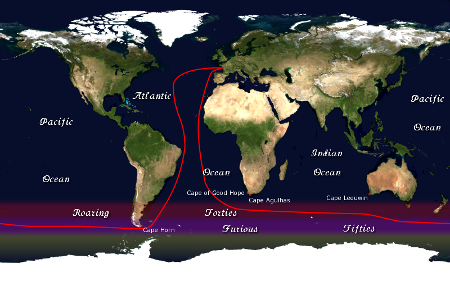
* A sailor, a sailing boat, the globe circumnavigation sailing past the 3 Capes at left (Agulhas, Leeuwin, Horn), without any landing and not assisted."

Alessandro made some significant modifications to his Mini in preparation for this endeavor. He built a cabin at aft which will allow him protection from the elements while allowing him to steer from within, much in the vein of Blondie Hassler's innovations to Jester. He's also strengthened the rudder/steering system.

Alessandro has rather lofty goals for his project which range beyond simply being the 'first' to achieve something. In his words:

Some of the aims of the project:

* To accomplish a unique feat which would be recognized as World Record.
* To be ambassador and international testimonial for sponsors taking part into the event.
* To contribute to the scientific research in several fields (renewable energy, environment protection, medical researches, new technologies, clothing, materials).
* To promote extraordinary experience to be shared with people from different cultures in order to make them feel citizens of the world.
* To be a source of inspiration and motivation for children and young people and to educate them to consider themselves citizens of the world in order to sustain the protection of both natural and artistic earth heritage, with special regard to the next generations.

In order to guarantee the successful achievement of the Round World Sailing and to allow the creation of new multi-medial high-quality products (high resolution videos, satellite communication ,etc), the sail-boat is equipped with the latest technologies (regarding sailing safety, sailing systems, sustenance, complete protection of the body in hostile environments).
The expedition and the boat itself are a real laboratory with the aim to receive new ideas, various kind of projects, testing new tools, materials, renewable energy systems, clothing and realizing medical researches. Documentation which is being collected during this expedition and Alessandro's overall experience will be used not only to fully respond to the sponsor requirements in terms of image, but even to promote the culture of the sea among young people and in order to give strong support to the scientific research, specifically about the environment.
(from Allesandro's website-ed)

Alessandro made good Cape Horn on April 16.

In response to my request for permission to write about him, with some words of encouragement and admiration added, he replied: (relayed through his mother, Anne Marie) "Thanks a lot. Your message gives me -and the boat too - new energies." Sent from Atlantic Sud 46°37'37"S/49°45'43 W, his latest location. You can track Alessandro's progress and read his log updates on his homepage.

My thanks to Alessandro and his mom for their cooperation and I am wishing him great success for his project. You can read about his past adventures in his books and read more about his current venture and listen to a lengthy interview here.

Tuesday, January 5, 2010

Michael Richey, 1917-2009


courtesy Billy Black


courtesy Billy Black


A life well lived and very rich indeed. I do not mourn the passing of Michael Richey, but rather wish to celebrate the life of a man who lived his life to the fullest with a great many significant achievements. Mike passed away on Tuesday, December 22, 2009, leaving a rich legacy for all sailors who aspire to adventure. A veteran seaman who saw action in WWII, Mike later followed his passion for navigation to became one of the founding members of the Royal Institute of Navigation. Mike was also the inheritor of Jester, Blondie Hasler's seminal junkrig conversion Folkboat which inaugurated the OSTAR transatlantic races, and it's his dogged participation in these races, all of them, after acquiring Jester from Blondie in 1964, which interests me. Mike was persuaded to buy Jester upon her return from the second Ostar and he and Jester participated in every one of these races until she was lost in the '88 race. A new cold molded Jester was created with the help of a trust organized by Nigel Rowe, and Michael continued to make these crossings. Over the years the race grew more and more competitive, with larger, faster, hugely funded racers quickly betraying the Corinthian( (dated),(nautical) An amateur yachtsman who sails his own yacht without a professional skipper ) origins of the event. Michael seems to have joined the race for reasons other than winning , seemingly it was the journey that mattered. He and Jester last participated in 2000, when a special dispensation was granted to allow the 26' boat to enter as the minimum length had been raised to 30'. In total Mike crossed the Atlantic single handed a whopping 28 times!, nine of which were Ostar's. One source reports: 'He confessed that coming in perfectly last became his objective, since it wasn’t so much the sailing that interested him, rather the navigating. He would often sail with centuries-old Portuguese, Phoenician, Chinese and Spanish navigational instruments borrowed from local maritime museums. ' Mike celebrated his July 5th birthday many times at sea, alone, surrounded by his books and good wine, including his 80th.

Truly a man all can admire, and a life all can celebrate.

There is a great obituary here.
A lovely reminiscence here.
A timely tribute here.
And the Jester Challenge biography here.
Take a look at Mike's articles for the Jester Challenge page here.
There is also a very good article on Jester, and Michael, in WoodenBoat #113, by Sheila McCurdy.

Monday, November 23, 2009

A VOYAGE OF PLEASURE: the Log of Bernard Gilboy’s Transpacific Cruise in the Boat, “Pacific” 1882-1883


Webb Chiles, author of several books on his sailing adventures may be best known to my readers for his near circumnavigation in an open Drascombe Lugger, chronicled in
The Open Boat and which I wrote about here. Webb is an intelligent and gifted writer, poet and photographer, and you can access much of his work at his website. Webb has the laudable distinction of making several of his books available in PDF for free download. Others may be accessed via my amazon bookstore in the sidebar. Today he graciously sent me a heads up about this latest post in his Journal:


Evanston: fools

Monday, November 23, 2009

I seldom read sailing books any more; but recently a small boat sailor and reader of this journal generously sent me a copy of A VOYAGE OF PLEASURE: the Log of Bernard Gilboy’s Transpacific Cruise in the Boat, “Pacific” 1882-1883.

I had read this slight volume of only 64 pages several decades ago. Naturally I had forgotten many details and found interest and pleasure in rereading it, particularly from the perspective of greater years and experience.

In 1876 Alfred Johnson made the first solo Atlantic crossing in a 20’ dory, sailing from Gloucester, Massachusetts, to Abercastle, Wales, in just under two months, with a brief stop in Nova Scotia.

Johnson named his boat, CENTENNIAL, and said his voyage was to commemorate the nation’s first hundred years.

When I completed my first circumnavigation in 1976, a journalist wanted me to claim that I had done so to honor the Bicentennial. As readers of STORM PASSAGE know, this was not true and I refused.

Inspired by Johnson, Bernard Gilboy, a professional seaman, had an 18‘ schooner built in San Francisco specifically for his voyage at a cost of $400. He considered this the smallest boat capable of holding provisions for the five months he thought his non-stop passage would take.

Her length of 18‘ and beam of 6‘ were almost identical to those of my open boat, CHIDIOCK TICHBORNE; but the PACIFIC had a keel and a draft of 2‘ 6”, as apposed to unballasted CHIDIOCK TICHBORNE’s 12” draft with her centerboard up and 4‘ with it down.

Gilboy somehow squeezed into his craft: “14 ten-gallon casks, read more...


Thanks, Webb.

Bernard Gilboy's story is also featured in Bill Longyard's 'A Speck on the Sea'.


Is anyone competent enough to comment on this rig?