Showing posts with label Designers. Show all posts

Wednesday, July 17, 2013

22nd annual WoodenBoat Festival at Mystic Seaport .3

Around the Seaport


The 28' sandbagger 'Annie' was built by D. O. Richmond about a half mile downriver from the Seaport in 1880 and came to Mystic in 1931 as the first boat in a collection that now numbers over 500 craft. Much more of her story here.


'Aida' is a 33' keel/centerboard yawl built in 1926 by the Herreschoff Mfg. Co., designed by N. G. Herreschoff.
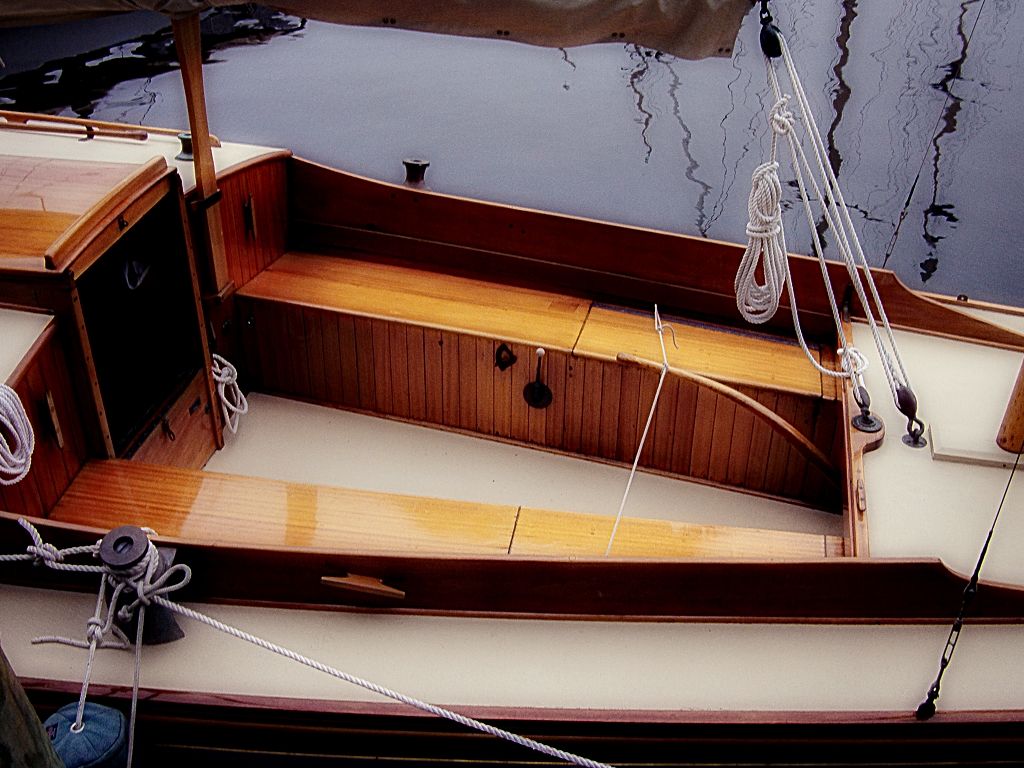


Recently restored by Doug Hylan in Brooklin, ME. More about 'Aida' here.


'Aida' is the most recent addition to the Seaport's fleet. There's a beautiful book about 'Aida' written by Maynard Bray available in the Seaport's bookstore.


The 'CW Morgan' in the water, on her cradle, "taking up" ie swelling her planks to a tight fit before her launch this Sunday, July 21, 2013.


A view to give a taste of the immensity of this ship.


Continuing the theme of immensity, here are some of the spars waiting in the wings for rigging the ship. She'll be rigged after the launch.


By way of supreme contrast, here's the microcruiser Scamp, a joint project of The Small Craft Advisor and noted NZ boat designer John Welsford.


? Found art


Higher ups aboard the 'Joseph Conrad'


Jon Wilson, the creator of WoodenBoat Magazine. We had a short chat and Jon informed me that while he's still at WoodenBoat almost daily, he is also deeply involved as director of a non-profit called JUST Alternatives which mediates victim/offender dialogue. There is an in depth article about this man with a foot in two worlds from Yankee Magazine, well worth your time.


Ben Fuller, "Living National Treasure" ( he'll no doubt hate that). Ben's an avid small boat advocate and member of the TSCA. Ben is the Curator at Penobscot Marine Museum (look into their extensive photo archives) and a former Curator at Mystic. He's also the owner of 'Ran Tan', more of which later. Here he's chatting with John Harris of CLC.


Coasting Schoooner 'Austraila' was built in 1862 on Long Island. She served as a blockade runner based in the Bahamas during the Cival War, and consequentially spent over 60 years in the Chesapeake hauling goods.


Later she was acquired by the DuPont family as their yacht, and was donated to Mystic in 1951. In 1961 she was hauled for refit but the damage at that time was too great, she was retired to a shed on campus as an educational exhibit. Read more..,


'Breck Marshall' is a reproduction Cape Cod catboat c.1900, built at  Mystic in 1987 and  in use today as an excursion boat for museum visitors. More...


The John Gardner Small Craft Workshop is held most years at Mystic as part of the WoodenBoat Festival. It is situated on Australia beach, adjacent to the 'Australia's shed and directly in front of the John Gardner Small Craft workshop, still in use, building small craft in the Gardner tradition. John was a visionary historian and teacher. He is credited with saving many American small craft from obscurity and as a key figure in the wooden boat revival. He served as Associate Curator of Small Craft at Mystic Seaport from 1969 to 1995. The workshop is held as a collaboration between Mystic Seaport, WoodenBoat Magazine and The Traditional Small Craft Association.


Good night, Mystic Seaport
 

A quick sail aboard 'Ran Tan'


'Ran Tan' is a modified wherry, drawn by Antonio Dias. imagined and owned by Ben Fuller.


Ben brought 'Ran Tan' down for the John Gardner Small Craft Workshop, which operates a livery under the auspices of the TSCA. Here you can try any of the offered boats, no charge.


Ran Tan is Irish slang for a sort of walkabout, according to Tony.


Tony is a friend and invited myself and brother John for a sail.


John's duty was to watch for other craft, especially where the sail blocked Tony's view. I, being considerably heftier, was assigned to be moving ballast. The boat is very light (200lbs.), and lively, so I was moving around quite a bit trying to keep her on the flat.


Antoino at the helm.


Sailing past the 'Morgan'


Tony and John back at the dock after a fun sail. I do not have lot's of experience in small craft and it was enlightening. Antonio Dias is a truly multifaceted man, artist, talented designer and writer, take a look at his website. Thanks, Tony. You can read an earlier post on this blog about Tony and his boat designs here.


Text and photos copyright Thomas Armstrong, first posted on 70.8%

Sunday, April 15, 2012

"straight is the line of duty; curved is the line of beauty": G.L. Watson - the Art and Science of Yacht Design

The handsome cover of this volume from the Peggy Bawn Press


George Lennox Watson by Sir James Guthrie RSA


Peggy Bawn sailing herself off Brooklin, Maine, 2007


Peggy Bawn on Belfast Lough c.1894


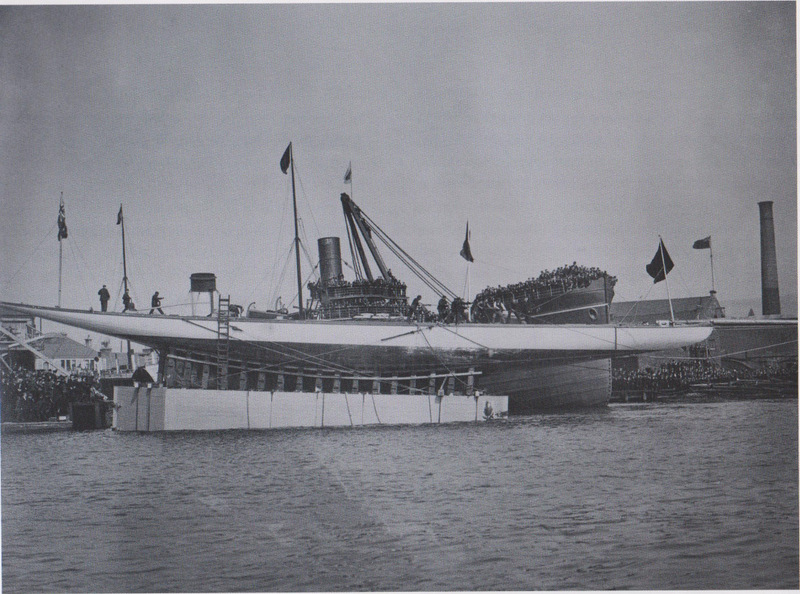
Shamrock II's launch, Clydeside


Hunter's Quay c.1882 Royal Clyde Regatta


In Famous Clyde Yachts, Henry Sheilds painted Watson's 1884 5 tonner Shona. Shona gained her fame in America as Charlie Barr's first command.


J. Stwart Clark's Ornsay on Rothsay Bay.


Watson designed this Lowestoft Beach Yawl Happy New Year IV, 1893


Spinnaker Letting Go by Barlow Moore depicts Watson's Valkyrie II losing the 1893 Americas Cup to Nat Herreshoff's Vigilant


Watson, c.1894


Sir Thomas Liptons Watson designed Shamrock II in the 1901 America's Cup


A rare onboard view of Shamrock II during the 1901 Cup. That's Watson with binoculars.


Queen of Scots (1903) designed for William Coats


I must confess that when I received this lavishly illustrated work, I had no knowledge of Watson or his renown. Gary MacMahon (see my AK Ilen posts) was a member of the production team for this sumptuous book through the work of his design firm Copper Reed Studio in Limerick, Ireland and was kind enough to send me a copy. The publisher, Peggy Bawn Press, is named after the small cruising/racing yacht, recently restored and pictured above. Below is a synopsis of this beautifully designed and exhaustively researched volume found on the publisher's website. I'm including this as it is far more succinct than I would be.

"Martin Black’s biography of the great Scottish designer, George Lennox Watson, is much more than a record of his life and work during the Golden Age of Yacht Design. Perhaps uniquely, it also describes the emergence of the role of the modern independent designer, of any profession or discipline. Watson’s career spanned a seminal period in industrial and social development, marking the transition from instinctive and evolutionary craft work to the application of disciplined technological innovation, using new material technology and tank testing.
So this book sheds light on social and industrial history with hundreds of contemporary illustrations, most of which are previously unpublished. Watson’s genius shines through in early racing cutters carrying clouds of sail, pro-bono pioneering work on lifeboats, America’s Cup challengers, and ultimately in sumptuous steam yachts, Watson’s adage: Straight is the line of duty; curved is the line of beauty... is consistently evident.
Carrying his prodigious research lightly, the author’s work floats easily above its load waterline, including delightful mini biographies of the colourful leading characters. Even the footnotes are entertaining.
Meanwhile this extensive and ambitious first volume has an easy “dip-in” structure to be savoured in slices. For example, the chapters on the America’s Cup challenge the conventional histories with newly discovered first hand insider sources.
In recent years, through many superb restorations, classic yachting has found a significant nostalgic niche in the yachting media, if only because of the innate beauty of the yachts and the spectacle they provide. This has revived the reputations of designers Herreshoff and Fife, but Watson’s genius needed to be rescued from a relative obscurity which was triggered by his early death. Was he “the greatest yacht designer of the 19th century”, as Olin Stephens acknowledged? Read Martin Black’s book and see if you agree. At the very least, you will find that George Lennox Watson deserves his place among the pantheon of the greats.
Then you may also answer the question I posed initially; along the way, you will enjoy many illuminating experiences, and also a rattling good yarn!"

Henry J Cooney

While this is not an inexpensive book, it is one that deserves a place on the bookshelf of anyone interested in yacht design and/or the America's Cup. Have a look!

Originally published by Thomas Armstrong in 70.8%

Sunday, February 27, 2011

Newblogs


Delaware River TSCA Messabout
Photo: Andy Slavinskas


Peter Duck is a character in one of Arthur Ransome's famous children’s novels, in later life he commissioned Jack Laurence Giles to design a comfortable cruising ketch which was named after the character. The design was commissioned just after the war in 1945, built by Kings of Pin Mill in Suffolk she was completed in 1947


All my plan packages includes a set of "boatbuilding sheets" giving instructions on "how to" using epoxy, scarfing plywood panels, making laminated frames, planking a hull with strips or clinker plywood, making masts and spars, etc... These sheets are coming from a book written in French "Construction bois les techniques modernes". Until now, I did not found time to translate all these sheets into English but of course I intend to do it and even improve them. In the meantime, a builder of Meaban, Geodino Carpio Ding, living in the Philippines, has made an English version using an automatic translation tool and incorporating the pictures. This may help other builders and this document may be downloaded.


The galley stove


The past few weeks have seen a flurry of interesting new weblogs come online and I wanted to share them with my readers. They've all been added to my blogroll, but I felt an introduction was appropriate.

First, there are two designers who will be very familiar to many of you and who share similar approaches to their work. John Welsford and Francois Vivier are both known for their ability to adapt and invoke traditional boats into seaworthy new designs aimed at the homebuilder and using contemporary materials and techniques. These are two prolific designers and one must wonder where they can find the time to also author blogs. Glad to see it though.

These other new blogs, Traditional Small Craft and 1001 Boats were started by friends. Mike Wick, a friend and fellow member of the Delaware River chapter of the TSCA, has teamed up with Steve Bookman and Dave Lucas of Lucas Boatworks to produce a weblog devoted to the history and building of the small craft of New Jersey and the Delaware River Basin. Off to a great start. 1001 Boats is the brainchild of fellow blogger Max Taylor, aka the Burlsledon Blogger with a big assist from Michael Bogogger, aka Doryman. An elegantly simple idea: a blog devoted to posting your favorite boats. I predict the list will eventually top 1001! I have been invited as a contributing editor and plan to do just that. Contribute, but the beauty of it is, so can you. The site is also sponsoring two charities, so you can contribute in more ways than one!

All of these new weblogs are interesting and informative and beautifully done, and to all their respective authors I'd like to say thank you and well done. Oh,and by the way, I am also working on a new blog, not quite ready yet...I'll let you know.

Thursday, January 13, 2011

Francois Vivier, Eliboubane and Yvon Le Corre


The model boat is a sardinfiskare from Brittany. Just "Eliboubane" who inspired us...

courtesy Arwen


Exposition d'Yvon Le Corre

courtesy

IPPA Iles et Phares du Pays des Abers


Eliboubane with Vincent Malandain as skipper.

courtesy Moulin-Mer


Eliboubane detail.

courtesy Moulin-Mer


The pardon of Saint Eliboubane early 20th century: the departure of boats with banners (Etienne Bouille, AD 22)

courtesy
(c) Région Bretagne, 2008 ; (c) Conseil général des Côtes-d'Armor, 2008


The magnificent work of Yvon Le Corre is reissued by The Chasse-marée/Glénat, seven years after its previous printing and twelve years after the original publication. Legends of the hand of the author were added to a number of boards. (© Chasse-marée/Glénat)

courtesy Olivier Chapuis


Inside Outils

courtesy coop-breizh


Le Corre drawings and a base map Beautemps-Beaupre, a masterpiece of nineteenth-century French engraving.
(Double page of the 2010
Double page of the 2010 edition of Tools of passion © Chasse-marée/Glénat)

courtesy Olivier Chapuis


'Twice Round theLoggerhead' was written by Lance Lee and Bruce Halabisky. It's a poetic tribute to the Azorean whaling tradition, illustrated by Yvon.


Francois Vivier is a French boat designer who, after a long practice as a naval architect designing large commercial craft, turned his eye and hand to smaller, more traditional craft. He primarily draws boats based on tradition but modified for more contemporary usage and building techniques, and does so brilliantly. He also occasionally draws plans for very traditional Breton boats. Eliboubane was a rather special request from celebrated artist Yvon Le Corre. Here's Francois:

"Yvon La corre is both an unequaled artist and sailor. Both are linked as his boats have always been a means to wander with paper and pencils and come back with awesome illustrated notebooks.
When the first volume of Ar Vag, was published, with an extensive description of Breton sardin boats, he wanted to rebuild one of them. Eliboubane was built in 1981 by Daniel boatbuilder in Paimpol on a line plan drawn by myself on the basis of historical plans. Original sardin boats had a crew of 7, but Yvon was frequently alone or with only a few people on-board. So he tried many rig arrangements, to avoid gybing the sails when tacking".

Eliboubane (10m l, 3m w, 6.4 T d) I have been in love with this boat since I first saw her. Her owner, Yvon Le Corre is a highly respected and rather prolific painter/illustrator and author. He's also widely regarded in his native France as a gifted sailor, some have even likened him to the fabled Moitessier in his love for the sea. As Francois says above, he's figured a method for sailing his dipping lugger singlehandedly. Admirable. Yvon uses his boats to travel and makes sketches along the way, which he then turns into beautiful paintings/illustrations.

I have a copy of 'Twice Round the Loggerhead', a special project written by Lance Lee and Bruce Halabiskey documenting the life and waning culture of the Azorean whalers. It's beautifully illustrated by M. Le Corre, who does more than justice to the elegantly elongated whaleboats developed in the Azores.

After years of trying to contact M. Le Corre to no avail, I now have a slow mail address to write him, hopefully more to come.