Showing posts with label Catboats. Show all posts

Friday, October 8, 2010

28th Mid Atlantic Small Craft Festival

I find this old Chesapeake Deadrise one of the most elegant creations I have ever seen, even in her current state and am drawn to the CBMM 'small' boat shed on every visit.


I am also drawn to the apprentice boatshop, there's always something of interest there.


This years interest was a Finger Lakes trout fishing boat, from Lake Keuka, brought in by Dan Sutherland, head boatbuilder at the museum, for a bit of repair/restoration.
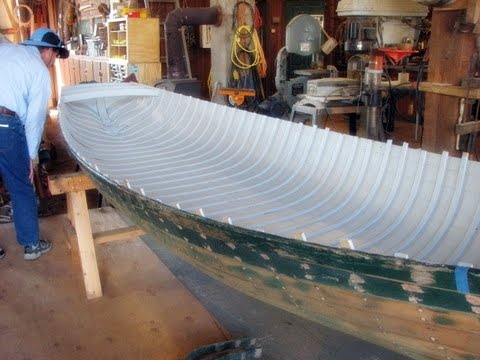


The trout boat is having her frames replaced in white oak, with new bronze fastenings replacing the sick old iron ones, the original northern white cedar planks are being retained. Thanks to John Hutchinson, the apprentice on duty, for a nice chat about her.


One of the nicest boats of the day was this Herreschoff Coquina, Calico Jack,
brought down from the Springfield MA area by Scott LaVertue. My friend, new to boats, declared this her favorite boat of the day. I'd say she has a good eye.


Pulling into the dock looking just great, Coqina's seem to be meticulously cared for by their owners, who all seem to share her maker's opinion off her, that being Nathaniel Herreschoff himelf. Nat declared Coquina to be his favorite boat.


She's quite lovely


Here's Scott's dad Bob LaVertue cleaning his glasses after a slight mishap (capsize) with Pretty Jane during the all craft free for all 'race'. Bob is the genius behind the Springfield Fan & Centerboard Co. Long time sailing canoe fan, Bob commissioned Everett Smith to build Twilight years ago, in the 1970's.


Here's Bob's friend Dan Sutherland, another sailing canoe aficionado out of the Clayton, NY school. Dan is resident at the CBMM as head boatbuilder.


Dan's sailing canoe is looking a little more canoeish than most decked sailing canoes.
Formerly owner of of Sutherland Boat & Coach in Hammondsport, NY, I have an inkling that Dan is one of the foremost builders of decked sailing canoes today. For instance, see this.


Buna Mon I Ya is a Crotch Island Pinkey and a perennial participant here.


Built in 1974 by her designer Peter Van Dine, he's owned by George and Marla Surgent


Pete Lesher with a bit of heritage. Pete's the family custodian for this boat originally built by his great uncle, if I got it right.Built to a design by George Washington Sears, aka 'Old Nessmuk' , guru of the Adirondacks and the return to the woods movement around the turn of the 19th C. Sears, if I'm not mistaken, based his work on the lines of Rushton's Sairy Gamp.
This canoe was built by none other than Mr. C. Lowndes Johnson, the creator of the Comet Class boat.


Pete is the Curator at the CBMM, nd here he's about to launch his canoe with the help of co-worker Dan Sutherland


A delicate, almost ephemeral design, yet sound enough


for Pete to venture out with his very young daughter


There's a museum installation which recreates the style of camping pursued by the canoe enthusiasts of that time, and background on an extended cruise undertaken by Lowndes Johnson & co. Pete has said he will forward me some of the logs from that journey, watch for the story here.


C. Lowndes Johnson's class boat beauty, the Comet, intended to be a smaller version of the Star class.


Tim Shaw, author of Chine Blog, looking happy to have his skin on frame outrigger canoe AL DEMANY CHIMAN in the water.


Mike Wick showed up this year with his lovely Pepita, always a favorite.


Barry Long's Melonseed Caesura, one of a pair he's building for himself and his better half. I'm guessing the first one finished is his, at least until the second improves on the lessons learned on the first. Both boats are almost finished, and the workmanship more than impressive. Barry has been writing a blog about his build of the two boats which is hands down the best build blog I've ever seen, informative and entertaining, and that's not an oxymoron.


Another Melonseed, Kandid, built by Barry's friend Tim Thatcher for his parents. Tim flew in from CO. for the fest.


On the road leading into the museum , adjacent to the camping area, I found this lovely creature which I'm guessing is a small Chesapeake Log Canoe, and if not a local sharpie type...can anyone help?


Certainly she's fitted out in a most serious manner, notice the holes drilled in the floors.


Another mystery boat, again appears to be a traditional Chesapeake type. Look at that sloped mast! Taken from the dock at the Crab Claw while enjoying steamed shrimp, local microbrew, and the company of my companion for the day. What a good day it was.


All photos Thomas Armstrong


The 28th Mid Atlantic Small Craft festival was only my third. It's a thoroughly enjoyable event. Relaxed and friendly, Saturday is the public day but this is really a four day messabout staring Thursday and running through Sunday for most participants. I had hoped to get down there on Friday and camp, but sadly it was not to be, hopefully next year. Many of the participants come every year and the event has the flavor of a large family reunion, with camaraderie winning out over competition, though the race is seriously contested. It's a beautiful sight, with 80+ small/ish boats of varied description out in the river at once. Not there at the race's start, I was able to get photos of several of the boats as they returned from the melee.
I've connected with several friends at this event, its a great way to meet folks with a shared interest, in a lovely setting on the Miles River. The host is the Chesapeake Bay Maritime Museum and the museums collections are open to visitors. Both the museum and the charming historic town of St. Michaels are worth the trip, any time of the year.

Mike Wick, member of the Delaware River TSCA and a friend, (see his Pepita above) sent me the race results:


Race Results for sailing race at MASCF 2010 Thanks to David & Kathy Cockey
Finish Order Owner Type Class

NN Al Fittipaldi Thistle !st HP Blue
Marianne Pete Lesher Log Canoe 2nd HP Red
Moth Adam Blackwell Moth 3rd HP White
Black Swan Bill Covert Sail Canoe 1st SC Blue
NN Larry Haff Sail Canoe 2nd SC Red
Mud Hen Ron Gibbs Celebrity 4th HP
Spat Bill McGraw Sharpie (Kirby) 5 HP
Malu Michael Jones Stretch Windmill 1st 2-sail Blue
Pepita Mike Wick 16 ft Melonseed (Brady) 1st 1-sail Blue
NN Andy Slavinskas Blue Jay (S &S) 1st BJ Blue
NN Harold Bernard Glen-L 15 2nd 2-sail Red
Obadiah Pete Peters Marsh Cat (Barto) 2 nd 1-sail Red
Skye David McCullouch
Skinny Swampscott 3rd 2-sail White
Junie Jump Up Turner Matthews Penobscot 17 1st schooner/ 3-sail Blue
NN Dan Sutherland Sailing Canoe 3rd SC White
Buna-Mon-I-Ya Aaron Surgent Crotch Island Pinkey 2nd 3-sail Red
NN George Loos Blue Jay (S & S) 2nd BJ Red
Slip Jig Kevin Brennan Navigator (Welsford) 3rd 3-sail
Baguette Carl Weissinger Baby Sandbagger 4th 2-sail
NN Kevin MacDonald Marsh Cat 3rd 1-sail
NN John Deppa Sailing Canoe 4th SC
Dandy Cat Paul Skalka Handy Cat 4th 1-sail
Catnip Ned Asplundh Marsh Cat (White) 5th 1-sail
Calico Jack Scott Lavertue Coquina (Herreshoff) 5th 2-sail
Whisper Dennis Keener Lug-rig skiff 6th 1-sail
Allegretto Larry Huffman Sea Pearl 6th 2-sail
NN John Guidera Melonseed (Jones) 1st MS Blue
Kandid Tony Thatcher Melonseed (Barto) 2nd MS Red
Crab Skiff Mike Moore Cambridge Skiff 7th 2-sail
2nd Wind Ron Hearon Blue Jay (S & S) 3rd BJ White
Wild Rover Frank Stauss Core Sound 17 8th 2-sail
Stiff Woodie John Allen Sailing Canoe 5th SC
Comfort Doug Oeller Marsh Cat 7th 1-sail
Mystic Charlie Steigerwald Sailing Dinghy 1st small Blue
Dolphin Jon Bornman Marisol skiff 2nd small Red
Sallie Adams Bob Pitt (FMM) Spritsail Sharpie 9th 2-sail
Bonita Marie Cobb DC 10 Sailboat 3rd small White
Utility skiff Jack Mizrahi Dobler 16 8th 1-sail
Whisp Phil Maynard Sharpie (Redmond) 9th 1-sail
Sierra Howell Crim Dinghy 10th 1-sail
NN Bob Lavertue Sailing Canoe 6th SC
NN Pamela Claggett Chesapeake 18 Tri Special
Apple Pie David Kavner Sailing Canoe (Rushton) 7th SC
Hanna Banana John England Skiff (England) 4th small
Sailing Canoe 8th SC
Woodwind John Sandusky Dory 9th 2-sail
Catnip Ron Gryn Catboat ( Gill Smith) 11th 1-sail
Bill Rutherford Peapod 12th 1-sail
Wee Punkin Lacy England Punkin (Thayer) 1st Sq Bow Blue
Kermit Ed Cobb SF Pelican (short) 2nd Sq Bow Red
NN Jim Thayer Punkin 3rd SQ Bow White
Wm Henry Harrison Paul Helbert Sailing Canoe (Storer) 9th SC


Tuesday, May 25, 2010

Phoenix Rising: Silent Maid Sendoff


Silent Maid, a 33’ sleek gaff-rigged catboat, hand-crafted by Workshop on the Water at Independence Seaport Museum in Philadelphia, PA, will be touring boat shows, regattas, and yacht clubs from New York to Maine. This lovely vessel is a recreation of the original Silent Maid, designed in 1924 by Francis Sweisguth for Edwin Schoettle of Island Heights, NJ,and built by Morton Johnson of Bay Head, NJ. Intended primarily as a cruising boat, the original Silent Maid was the B class catboat champion on the Barnegat Bay in 1925. The original boat will become a display piece at Independence Seaport Museum, preserved with all her history intact.

courtesy ISM


John Brady offering thanks to the volunteers who have helped make Silent Maid a reality.
Joan Bernstein, in the green 'lascivious biddies' T, organized the event, with the help of Wendy Byar and Gina Pickton.


Carolyn Hesse varnishing the mainmast


Gina Pickton working on...?


Maid's stern counter littered with tools, the previous Sunday as last minute preparation is underway


Here my brother John seems to be contemplating Torch, in for maintenance. Torch is one of the fleet of the much ballyhooed A Cat Barnegat Bay racing revival. This is a local to NJ racing class which evolved from the classic working catboats of Barnegat Bay and dates back to the 1920's. It is an all out pure racing group, constantly evolving, grounded in tradition, and a viable though expensive alternative to today's hyperventilated carbon fiber delicacies. John Brady and David Beaton and Son's Boatyard have been the main producers of the contemporary boats, each with about five builds. There is a valuable book on the boats, their origins and contemporary exploits here.
J
ohn and I were hanging out hoping to sight
Niña
and Pinta, replicas commissioned and sailed by the Columbus Foundation, due into the ISM basin for a weeks stay, but they had not arrived late in the day and we decided to go.


all photo's Thomas Armstrong


The Independence Seaport Museum is a Phoenix rising. Despite the not so distant trauma inflicted by a negligent and criminal director, the museum is healing and emerging as a vibrant and vital presence. The recent Tattoo exhibition mounted by curator Craig Bruns was a flash of brilliance, and the museum's core collection, library and archive is a deep and valuable cultural and educational resource. But the heartbeat of the museum is the Workshop on the Water, the museum's boatworks, where invaluable pieces of the past are renovated and maintained and where newly minted traditionally built instant classics are the norm. John Brady, lead builder at the workshop is recognized as one in the highest echelon of contemporary boatbuilders using traditional build techniques and is a very fair hand at designing boats with traditional roots. He is supported by a(very) small number of paid employees and a large group of volunteers, who range from quite skilled and experienced to completely green (not for long) folks wanting to get a taste of boatbuilding. If you stop by with a little time on your hands, you will be put to work. It offers a learning experience as deep as you'd like to take it.
John Brady is not only a gifted boatbuilder, he's also a very experienced sailor, and this summer he will be visiting ports from NY to Maine, campaigning the Maid in both races, appearances at boat festivals and assorted soirees. If you'd like to volunteer as crew, there may be some openings on some legs of the journey...contact John Brady at215.413.8638 or jbrady@phillyseaport.org

Here's the schedule:

May 25 Silent Maid departs Philadelphia for Bay Head, NJ
May 30 Bow Tie Party at Bay Head Yacht Club
June 11-13 New York Yacht Club Annual Regatta, Newport, RI
June 25-27 Wooden Boat Show, Mystic, CT
July 10-11 Catboat Association, Wickford Rendezvous, Wickford, RI
July 17-18 New York Yacht Club Raceweek, Newport, RI
July 24-25 Woods Hole Historical Museum, Woods Hole, MA
July 30-Aug. 1 Padanaram Cat Rendezvous, race Kathleen, Padanaram, MA
Aug. 5 Castine, ME, race to Camden, ME
Aug. 6 Camden, ME, race to Brooklin, ME
Aug. 7-8 Eggomogin Reach Regatta, Brooklin, ME
Aug. 8-14 New York Yacht Club Cruise, stops in NE/SW Harbor, Swans Island,
Mercent, Gilkey Harbor, Camden, ME
Aug 18-22 Arey’s Pond Regatta, Arey’s Pond, MA
Aug 27-29 Herreshoff Regatta, Bristol, RI
Sept. 4-6 International Yacht Restoration School/
Museum of Yachting Regatta, Newport, RI
Sept. 11-12 Race Rock Regatta , Stonington, CT
Sept. 18-19 Greenport Classic Regatta, Greenport, NY
Sept. 25-26 Governor’s Cup, Essex, CT
Oct. 2 NY Classic, Manhattan, NY
Oct. 8—13 New York Yacht Club Cruise on the Hudson

For the inside view of whats going on at the Workshop, check John's website, and Wendy Byar's
blog Green Boats for frequent updates on the activities at WoW. Wendy is the dilithium fuel cell for the boatworks, a volunteer who radiates the energy for projects getting done and an invaluable member of the team.

I'd like to also mention that this incredible replica was generously commissioned by Peter Kellogg, with help from some friends, and he's put the boat into safekeeping with John and the ISM.

Correction:
This communication was sent to me by Charles Bernstein to correct my erroneous assumption that the TSCA had organized the event:

"The sendoff was organized by Joan Bernstein (a WOW volunteer who is handling publicity and advance work for the Maid's summer tour at John's request,) with much assistance from Gina and Wendy as well as, of course, John Brady. "

Several members of the Delaware River branch of the Traditional Small Craft Association attended. What fun we had.


Monday, February 15, 2010

Slider's Basecamps for Beachcruisers


Phil Maynard in his stitch & glue melonseed and Mike Wick in his Bolger Gypsy heading South.


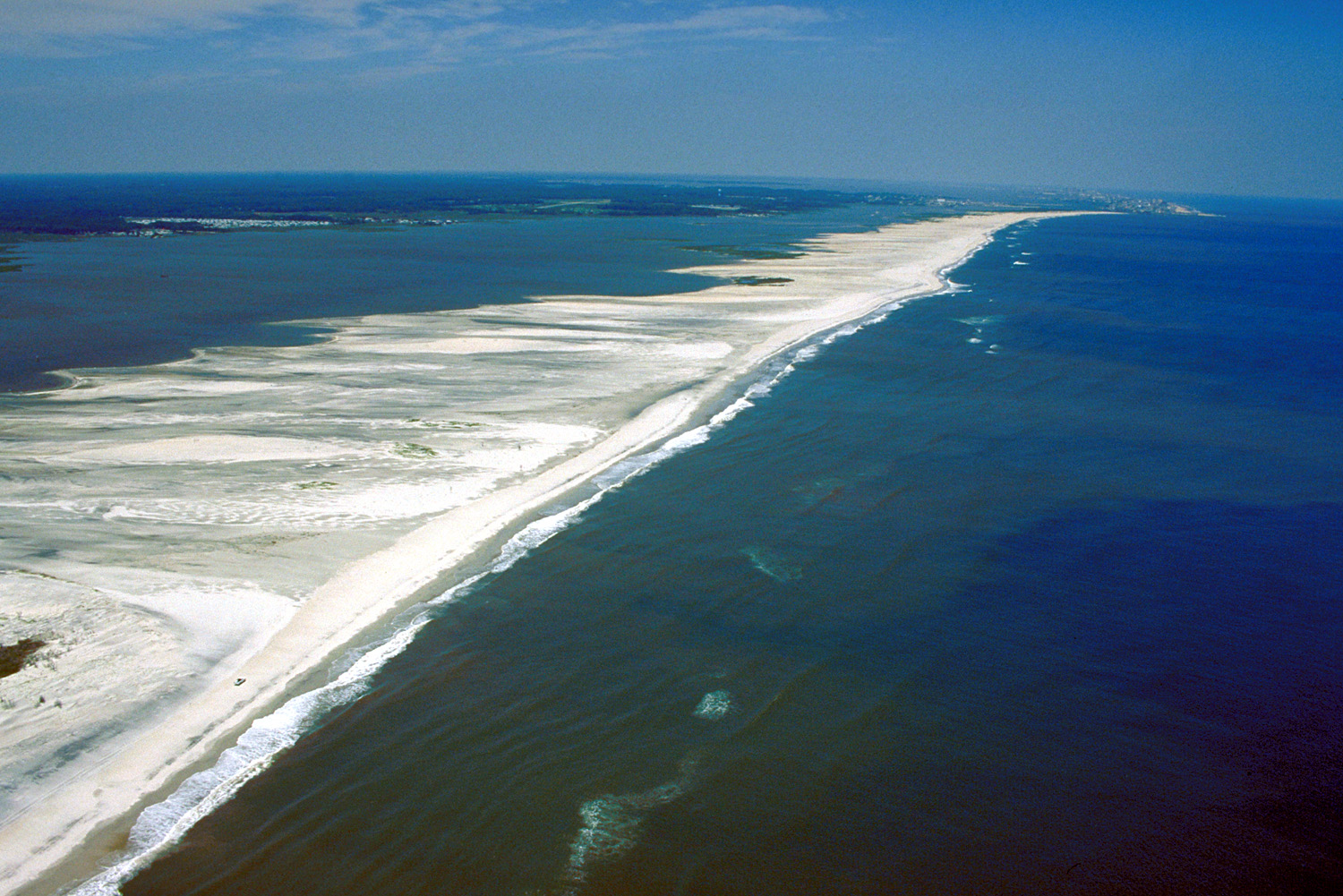
The beach at Assateague, 1/4 mile walk from Green Run.


You can see that my Gypsy has low freeboard and was prone to swamping when she was
an open boat. She was planned for rowing more than sailing.. I built the red sunbrella
deck in this picture to make her more seaworthy. It didn't help. The next winter I built
a plywood and epoxy deck that worked well.


Green Run. The campsite is up among the trees. The building is a boarded up hunting
shack, abandoned before 1965 when the Island became a national park.


John's sprit-rigged melonseed with Home Depot high-tech daggerboard clamp. They are
perfect for shallow water sailing.


all photos courtesy John Guideras


See details of the Assateague trip pictured here in the article by Mike Wick below.


Base Camps

Big Lagoon State Park, Florida

Dog Island, Florida

Apalachicola, Florida

Davis Bayou, Ocean Springs, MS

Driftwood Campground, Cedar Island, NC

Fort Walton Beach and Destin, Florida

An invitation: help me compile a free base camp database, available to all small boaters on the worldwide web.

For a while now I’ve been thinking about how to make Slider’s site more useful.

I’d like to offer information of interest to small boat sailors in general, not just to those who might be interested in a boat like Slider.

One idea came to me in part because I’ve been the book reviewer for Living Aboard magazine for a number of years. Many cruising guides have passed over my desk, as a consequence, and I’ve noticed that there are very few such guides that would be particularly useful for small sailboats. There are cruising guides for deep draft cruising boats, full of dire warnings about “reported shoaling to 3 feet” and other remarks irrelevant to small boat sailors. And then there are the guides meant for kayakers, who require nothing but on-foot access to the shore, and who must be very cautious about crossing open water.

In between, there seems to be relatively less coverage of cruising from the viewpoint of small open boat sailors, despite the fact that this kind of sailing seems to be growing in popularity. And these folks have a unique perspective as to what makes for a good cruise. Even the pattern of movement is usually different with a small boat cruise. While a live-aboard cruiser tends to pass through an area from end to end, the small boat cruiser is more likely to establish a base camp and sail forth each day in a new direction, until the area is explored for a few miles all around. It struck me that small boat cruising guides might best be organized by base camps rather than cruising routes, because spending one’s nights inside a big tent on land in relative comfort, and sailing every day is one of the most popular and luxurious ways to go cruising in a small boat. Why not, I thought, try to encourage the collection of some good base camp descriptions around the country or around the world– short articles that describe one person’s idea of a perfect base camp– its amenities and costs, a description of the place and of the surrounding sights viewable from a small boat.

When I was out cruising the coast for a few days, back in September, Slider and I visited an anchorage near Big Lagoon State Park, not far from the Florida-Alabama state line. I’d visited this well-situated park before, and the other day went back for a look. I measured the ramp, took a few pictures, and generally enjoyed the park. It seemed to me that the park had everything you’d want in a base camp, so I wrote the first piece and published it on Slider’s blog:

Big Lagoon State Park

I’m hoping my fellow small boat sailors will help me put together a selection of potential basecamps from everywhere there’s good sailing for little boats. I have a list of suggestions for the kind of information I think most of us would like to see, but I’m sure I’m forgetting lots of stuff, and I hope you’ll help me out with your suggestions and criticisms.

I think each base camp article should start with a bulleted list of basic info:

  • Name of base camp: If nameless, pick a name! Link to pertinent website if possible.
  • Brief description: One sentence summation of the base camp’s main appeal for small boat sailors.
  • Location: Country, state or province, nearby towns, mailing address, and a link to a map showing the route and a link to an online NOAA chart, if available.
  • Weather and climate: Here a link to a local weather page is nice. I like Weather Underground.
  • Fees: Entry fees, ramp fees, camping fees, etc.
  • Ramp: Depth, capacity, condition, parking, etc.
  • Amenities: a list of resources in or near the camp: shady campsites, phones, ice, grocery stores, convenience stores, service stations, ice, restaurants, motels, libraries, marine chandleries, amusement parks, other attractions within driving distance, and so on.

As many useful links as possible should appear in this first small section. I’ve undoubtedly missed some good ideas, and I’d be grateful for any suggestions for adding useful data to this list.

The rest of the piece is up to you. Whatever way you choose to get across the pleasures of visiting one of your favorite base camps is fine by me. You can develop the attractions of the site in any pattern you prefer– put it in the form of a narrative about a trip, actual or ideal, or use any other approach you think will work. I may make suggestions and edit your material a little, but I’ll ask you to approve any substantial changes before I publish the piece. I think we should keep these descriptions to under 2000 words, if possible.

Photos are very helpful, I believe, but they need not be of professional quality to greatly improve any story. Include anywhere from 3 to 8 shots, preferably sized down for the web, but I can easily do this. A shot of the ramp, a shot of an adjacent beach or dock, a couple other nice views will lend a lot of punch to the story, and give your readers a better understanding of the cruising area the base camp serves. I like pictures of living things and boats, so the best shot of all would be a beachcruiser parked on a beautiful beach, with a sailor or two busy having fun.

Base camps need not be official campgrounds of some sort. For example, I plan to write a base camp piece on a great little cruising area in my own back yard. The gateway to the base camp is a city park here in Fort Walton Beach that has nice ramps, just a couple of miles east of a string of little spoil islands in Santa Rosa Sound, created when the Gulf Intracoastal Waterway was first dredged. These islands are popular on the weekends with locals, who set up tents and spend the day swimming, sunbathing, and fishing. During the week, they are largely deserted, and can provide an almost wilderness experience just a few minutes sailing from a small but lively city, with every imaginable amenity, and across a wide shallow lagoon from the Air Force-owned portion of Santa Rosa Island, which is almost pristine.

Another possible idea, for those who like a little luxury with their cruising, is to find an inn or bed-and-breakfast in a cruising area, and make that the base camp.

Or you may know of an island with organized camping facilities that can only be reached by campers with a boat or a ferry ticket. For example, right now you can camp at Ft. Pickens on the western tip of Santa Rosa Island, if you have a boat or are willing to walk or bicycle in over a road that was destroyed by the recent hurricanes. Eventually the road will be rebuilt, but for now Ft. PIckens provides a unique kind of base camp. There are many other wonderful island base camps to be found, from Lake George in New York, to the Maine Island Trail to the Apostle Islands of Lake Superior.

I really hope folks will help me to start this moving. I believe it would be of interest to microcruisers of all sorts, particularly for those of us who sail small open boats. I can only do a limited number of these articles by myself. But I’m certain that if the small boat cruising community gets behind the idea, it will become a wonderful resource for all of us.

Contact me with your ideas!


Here's Ray's formula applied to Mike Wick's adventure sail to Assateague:


  • Name: Assateague Island National Seashore.
  • Location: Ten miles South of Ocean City, Maryland. Nearest small town, Berlin, Maryland.
  • Weather: See Ocean City, Maryland.
  • Chart
  • Fees: $10 entrance fee. Car Camping rates $20 per day. Remote campsites $5 per week. Significant reduction if over 62.
  • Ramp: Shallow sandy beach at Old Ferry Landing is fine for small boats. Larger boats at either South Point launch ramp, 1 mile west or Verrazano Bridge Ramp, off Route 611 at Sinepuxent Bay.
  • Routes: Four remote campsites on Assateague Island, 2,5,10,12 miles South of National campground. Two day, 30 mile passage South to Chincoteague Island. Eight mile passage north to Isle of Wight Bay inside Ocean City.
  • In brief: The Eastern Shore is on the primary flyover for birds migrating up the East Coast. There are extensive shallow water passages on the bayside of Assateague Island with clamming and mussel harvesting opportunities.Can be hot and buggy in the summer. Best seasons are late in the fall and early in the spring. Mosquitoes are worst after multi-day rains.

  • Many thanks to Mike Wick, who contributed this information, and the story that follows. Looking at the chart, this appears to be a paradise for small shallow draft boats.

    There were three of us in three boats, three cars, three trailers. We had decided that we would sail the length of Assateague Island, campcruising along the way.The latest weather report showed that the wind would be mostly out of the North for the next few days, so we decided that we would sail South from Assateague Federal Seashore toward Chincoteague Island. I arrived at Old Ferry Landing and launched my Bolger Gypsy, dropped off my trailer near the Ranger Station and drove South to Chincoteague. I found a quiet parking place and cell phoned Phil, who drove straight to Chincoteague and picked me up. He and I drove north in his pickup truck, launched his melonseed and launched John’s melonseed. We left their cars and trailers at the Ranger Station.Thus, we had two cars at the North end of the Passage and one at the south end.

    It was about 11 A.M. when we set sail in convoy from Old Ferry Landing in a light northeasterly breeze. We passed the Tingles and the Pine Tree campsites in smooth water with a lee from Assateague Island keeping down the waves. Seldom is the water much more than knee deep if you are outside the Intracoastal Waterway, so there is no anxiety about swamping or capsizing, you can just walk ashore. We rounded the point of the island in the channel between Green Run and the Pirate Islands.At this point, the wind had picked up enough to warrant a reef, but there was less than a mile of windward work to our destination, so we just luffed along toward our destination. By six we had reached our remote campsite at Green Run, ten miles south of the large campground at the Federal Seashore.

    Green Run is a nice shady campground with picnic tables, fireplaces for each group, and a portapotty. but there is no potable water, so we had each brought three gallons with us for drinking and cooking. A quick meal and bed in our tents; we were too tired for a campfire.It is a short walk to the ocean with a beautiful beach, and we had a quick swim before bed.

    The next day was sunny and light air, just enough wind to ghost along. That section of the passage is an intricate maze of quite shallow channels inside swampy islands. We beat up a river to the most distant campsite on the Island, Pope Bay wehre wwe stopped for lunch and walked over to the ocean beach. Here we realized that, if we kept sailing, we could finish our passage that night, so we rushed out to Chincoteague Bay and sailed across the Maryland/Virginia border. It was a lovely plain sail beat in a brisk Southeast breeze of maybe 12 miles an hour wind. We passed to the East of Wildcat Marsh, on the northern tip of Chincoteague, tacking in close company to the haulout at Quip Hole Road, just inside Morris Island.

    Then came the strenuous part. I walked into Chincoteague to retrieve my car, then I drove the others to Assateague for their cars. It was dark by the time we got our cars and trailers back to the ramp, but we were practiced at packing boats on trailers, so it went smoothly even in the dark. What could have been a problem, we decide to drive straight home. We probably should have stopped at a nearby motel, but we made it safe home about eleven, even though we were tired and bug bit. We had made a nice thirty mile, two day passage in company and had seen parts of the refuge that were new territory for us.

    Posted in: Base Camps for Beachcruisers, Cruising, Sailing.

    Saturday, October 17, 2009

    Bolger Cat on ebay.


    courtesy ebay


    This is a lovely Phil Bolger catboat for sale on ebay. Elegant beyond description, and offered at what seems a reasonable price. There are more photos on ebay, including the interior which is warm and inviting. I must say this boat has some of the sweetest, cleanest lines I've ever seen, in my humble opinion. Listed as Bolger design#373. Take a look. Here's the ebay blurb:

    1989 Atlas Cat Sloop. Bolger design #373
    Vehicle Description

    1989 Atlas Cat Sloop. Bolger design #373, built 1989. Solid fiberglass. Length 35'4", Beam 8'6" Draft board up 2'3" Displacement 12,500#. Ballast internal lead 4,500# Vessel kept in excellent condition. Last bottom job March 2009 with Pettit Vivid. New running rigging. Aluminum spars and mast. One mainsail, 3 jibs, all excellent condition. Stereo CD, VHF, DF, Solar charger, Yanmar 2gm Diesel. Very fast boat, with the prettiest hull on the water. Be prepared to answer questions underway and at the dock. Wineglass transom. Bulkheaded engine room. Integral water tank. Full Blueprints. Coast Guard safety equipment, docklines, ground tackle, and fenders all included. This boat has low headroom, but is very big inside. 4 berths are 6'6" long, one of those a double berth, enclosed separate head, equipped galley, heater, custom teak boarding ladder, and the list goes on. This boat is insured for $26,000, and replacement cost is well over 90,000.

    The dates on the pictures are not correct. These are recent pictures taken a few days ago.

    I am going to be out of town until Monday. Any questions about this vessel should be directed to the owner. His email address is reliabletow@earthlink.net. You will get same day replies.