Showing posts with label Circumnavigation. Show all posts

Sunday, October 30, 2011

AK Ilen Restoration part one: Conor O'Brien


Conor O'Brien and his sister Margaret aboard Kelpie

courtesy Irish Military Online


Molly and Erskine Childers sailing Asgard in the Baltic,1910

courtesy Wikipedia


Molly Childers and Mary Spring Rice aboard Asgard bound for Howth

courtesy Echoes of Erin


Arklow Harbor about the time of the build of the boat on whose lines Conor based the Saoirse.

courtesy The Traditional Boats of Ireland Project


Saoirse in the late 1920's, rigged as a staysail schooner

courtesy The Traditional Boats of Ireland Project


Saoirse

courtesy Betty CK 145


Conor and wife Kitty

courtesy AK Ilen Company


Conor at the yuloh of the engineless Saoirse

courtesy The Traditional Boats of Ireland Project


The AK Ilen building at the Baltimore Fishery School, Tom Moynihan and crew.

courtesy The Traditional Boats of Ireland Project


The Ilen is launched

courtesy The Traditional Boats of Ireland Project


Conor and crew, I believe, about to leave for Port Stanley, Falkland Islands, delivering the Ilen

courtesy AK Ilen Company


The AK Ilen

courtesy AK Ilen Company


The Ilen in her new digs at the Hegarty Boatyard, Oldcourt, near Baltimore, Cork...but that's the next story.

courtesy AK Ilen Company

&

Kevin O'Farrell, photographer


I find this an absolutely magnetic story. At it's heart is a true Irish character, Conor O'Brien. Aristocrat, author, naval architect and intellectual, O'Brien was also an Irish patriot and supporter of the Irish rebellion. In 1914 O'Brien in his Kelpie, along with Molly and Erskine Childers in Asgard among others, ran guns for the rebels into Howth harbor in 1914.
Fast forward a few years to 1922 and we find Conor working with the master shipwright Tom Moynihan at the Baltimore Fishery School's boatyard to bring a vision of his to life. That vision was a cruising yacht which was a combination of the traditional and not so traditional. The hull was based on the lines of an old Arklow fishing boat O'Brien had been to sea in, but with more modern accommodations below and a rig designed for ease of handling at sea. Conor's design became Saoirse, (seershuh) gaelic for Freedom in celebration of the new Irish free state. 42' with a 12' beam he seems to have been pleased with his creation. Responding to an invitation from New Zealand, Conor set out in 1923 on a voyage that would bring him to the attention of the yachting world.

"I was invited to join a mountaineering party in the New Zealand Alps at Christmas, 1923, and having a nearly new yacht I regarded this as an excellent opportunity of finding out the merits or demerits of her design, which was of my own making."

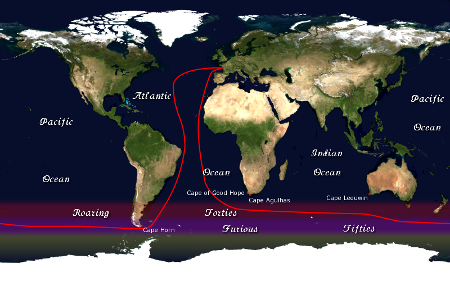
The trip to New Zealand became the first leg of a rather bold circumnavigation, rounding the Southern Ocean before returning to Dun Loaghaire, and flying the new Irish Tricolour. Planning his voyage, O'Brien studied the logs of sailing ships from the past, helping him find his way. He made twelve ports of call on his voyage, which took almost exactly two years. This heroic voyage was chronicled by O'Brien in his 'Across Three Oceans'. The book, one of fourteen under his authorship, got the attention of the bluewater cognoscenti at the time. Don Helm, in his informative 'The Circumnavigators' says:

None other than L. Francis Herreshoff said of him: "I consider
O'Brien's books the most masterly analysis of seagoing conditions perhaps ever
written, and even if he and I do not see eye to eye in all matters pertaining to
rig and rigging well, no progress would be made if we all thought alike- but
under no circumstances would I contradict Conor O'Brien for he has had actual
experience." Quoted from the old master's instructions on how to build
Marco Polo, which ran in Rudder magazine, 1946.

On his return leg up the Atlantic, Conor O'Brien and Saoirse called in at the Falkland Islands for a somewhat extended stay. The stopover resulted in the Falklands Islands Company commissioning a larger version of Saoirse, which became, on Conor's return to Baltimore, the AK Ilen.
Construction began in late 1925 under the supervision of Tom Moynihan at the Fisheries school boatyard, Irelands first vocational school. Upon her completion in 1926 Conor pronounced her a 'handsomer model' than the Saoirse. He proceeded to sea trial her around Kerry and the Shannon and ransacked Saoirse for gear. He then set out for the Falklands with two 'Cape Clear' men, arriving in Port Stanley early in 1927, where the boat and crew received a warm welcome. The Ilen was subsequently put to work as a jack of all trades workboat servicing the needs of the islanders for nearly 70 years (!), "working for her living in some of the most demanding waters in the world, ferrying people, school teachers, sheep, stores and mail between the scattered island communities of the Falklands". The Ilen finally retired from worklife in the early 1990's.
In 1997, one keen Irish sailor lamenting the loss of Saoirse in 1979, focused his attention on the Ilen. That was Gary MacMahon. Gary learned the Ilen might be available and with help quickly put together the financing to secure and return her to her birthplace. He founded the AK Ilen Company with Anthony Keane and began planning the Ilen's return. But that, as they say, is another story. (there's more coming)

I'd like to thank a few folks who have been invaluable in starting this series.

First is Kevin O'Farrell, photographer, who put me on to this story and whose invaluable photos of the restoration will be seen later,

Gary MacMahon, who opened the whole can of worms and is still active as the principle of the project,

And Dr. Martin Kay, who spearheads the educational side of the Company and has been exceptionally liberal and forthcoming with information. He's working on grants for writing a book about the Ilen as well as presenting papers on this project and the educational and general status of traditional boatbuilding in Ireland to groups such as Dorna. Martin has promised to send updates as the project progresses.

And the Traditional Boats of Ireland Project, for it's extensive research and some very special photos.

Links:

AK Ilen Company

Big Boat Build Workshops

Traditional Boats of Ireland Project

Don Holm's e-book 'The Circumnavigators'

Wikipedia ConorO'Brien

Wikipedia Howth Gun Running

Wikipedia Erskine Childers

The DORNA Project


Originally published by Thomas Armstrong in 70.8%


Wednesday, July 28, 2010

Two Arrivals


Alessandro was towed into harbor, his engine disabled for the record attempt.


Ebullience!


Alessandro looks happy to be home!


Plastiki in Sydney Harbor with the iconic Opera Hall in the background


David de Rothschild


Plastiki crew, seemingly also ebullient.


the escort


my apologies to the photographers whose images are represented here for my failure to credit


Two arrivals, two goals accomplished. I'd like to congratulate each of these dreamer/doers.

First, Alessandro di Benedetto completed his circumnavigation, smallest boat around nonstop and unassisted, recognized by the powers that be of such things. An impressive, possibly amazing achievement, aboard his Mini 6.50. Dismasted during his initial attempt at Cape Horn, and expected by all watchers to retire, Alessandro persevered, jury rigged, and got on round.
Time taken by Alessandro Di Benedetto to make his trip around the world in the Mini 6.50 sailboat: 268 days 19 hours 36 minutes and 12 seconds. Applaud. He returned to Les Sable d' Olonne to fanfare, with his mom Anne Marie Di Benedetto there on the docks for his arrival. Anne Marie handled much of the logistics for the attempt, and was the email liaison which allowed me, and others, to communicate with Alessandro in the midst of his journey. See my initial post here.
Alessandro made it back to Les Sables on 7/22/2010. My personal congrats to Alessandro and Anne Marie

Brad Hampton of Yacht Pals wrote about the journey, here's an excerpt from after the dismasting:

On April 2, after receiving word from his team, YachtPals reported that Alessandro would have to make for land in Chile. And then a few hours later, we had to retract that statement. Alessandro had notified shore support that he was going to try to jury rig his boat, AND SAIL AROUND CAPE HORN! We double- and triple-checked. Was he serious? Was he crazy? Cape Horn is the nastiest patch of water on the planet, and most sailors wouldn't round it on a perfectly sound boat. Yes, he was serious, and maybe crazy too! But ever-so-slowly, Di Benedetto approached and then rounded Cape Horn, after which he pointed his bow for home.


The final trip across the Atlantic was slow, and held many challenges, but Alessandro crept along, persistently making headway while many YachtPals members watched his progress via his route tracker, fingers crossed for his success. We are now happy to report that Alessandro Di Benedetto has arrived back at his starting point after nearly nine months at sea. Pending WSSRC ratification, he will hold the official world record for a non-stop circumnavigation aboard the smallest boat in history. Bravo Alessandro! When sailors tuck their children into bed at night, they will tell your story, using words like bravery, persistence, and hero.

by Brad Hampton for YachtPals.com

David de Rothschild had a very different dream, and project. He set out to raise awareness of our degredation of the oceans, to see and document the almost mythical swirl of detritus forming an 'island' in the Pacific, and to do this with a boat built almost entirely of recycled material. To sail across the Pacific from the US to Australia. He managed the crossing, despite some harsh weather, and judging from the media attention to his landfall in Sydney, he'll certainly achieve his goal of consciousness raising. Whether it will have any real impact on how we treat our oceans is impossible to judge today, one can only hope. His catamaran, Plastiki, incorporated tens of thousands of plastic bottles built into the hull as structural and flotation elements. The boat has many other environmentally friendly adaptations, to wit, in the words of her creator:

"The Plastiki was nothing if not ambitious. We wanted bicycles that would generate electricity, a hydroponic garden, water stills, vacuum de-salinators, a composting toilet, solar panels, wind turbines, regenerative electric propulsion, satellite communications and pretty much anything else that constituted an innovative sustainable “system”. She was to be a floating showroom of non-emitting futurist ideas that were simple, elegant and wholly attainable."

Plastiki arrived in Sydney harbor on the 26th of July to great fanfare and media attention. Hopefully David will be able to leverage his success into increased awareness and eventual action. It's really nice to see someone who knows how to use wealth, bravo David, we expect to hear more from you.

Now where's that plastic bag?

Sunday, April 25, 2010

Alessandro Di Benedetto: Around nonstop in a Mini 6.50


Alessandro Di Benedetto


Improving and strengthening the boat in preparation for her voyage


Building the protection cabin


rotta teorica


the Mini fitted out


Departing Les Sables d'Ollone


Mini with Alessandro aboard


Modification aft, the 'protection cabin', is apparent here


Underway


Mist


all photos courtesy Alessandro Di Benedetto


With the spate of circumnavigations one reads about these day's, from teenagers to 60' Maxi's, this particular adventurer stands out, at least for me. Alessandro Di Benedetto is no stranger to open ocean sailing, having crossed both the Atlantic and Pacific in, or rather, on a 20' catamaran with no cabin. Now he's pursuing something no less audacious. He's making an attempt to go round via the three capes in a modified 21' Mini 6.50 with no assistance and without stopping or landing. If he succeeds he will have done so in the smallest boat to achieve this to date. He cites the rule and spirit of the first Golden Globe as inspiration:
"The new trip rules are very simple. They are the same used for the Golden Globe, first regatta single-handed sailor held by Sunday Times in 1968/69, later become Vendée Globe:

* A sailor, a sailing boat, the globe circumnavigation sailing past the 3 Capes at left (Agulhas, Leeuwin, Horn), without any landing and not assisted."

Alessandro made some significant modifications to his Mini in preparation for this endeavor. He built a cabin at aft which will allow him protection from the elements while allowing him to steer from within, much in the vein of Blondie Hassler's innovations to Jester. He's also strengthened the rudder/steering system.

Alessandro has rather lofty goals for his project which range beyond simply being the 'first' to achieve something. In his words:

Some of the aims of the project:

* To accomplish a unique feat which would be recognized as World Record.
* To be ambassador and international testimonial for sponsors taking part into the event.
* To contribute to the scientific research in several fields (renewable energy, environment protection, medical researches, new technologies, clothing, materials).
* To promote extraordinary experience to be shared with people from different cultures in order to make them feel citizens of the world.
* To be a source of inspiration and motivation for children and young people and to educate them to consider themselves citizens of the world in order to sustain the protection of both natural and artistic earth heritage, with special regard to the next generations.

In order to guarantee the successful achievement of the Round World Sailing and to allow the creation of new multi-medial high-quality products (high resolution videos, satellite communication ,etc), the sail-boat is equipped with the latest technologies (regarding sailing safety, sailing systems, sustenance, complete protection of the body in hostile environments).
The expedition and the boat itself are a real laboratory with the aim to receive new ideas, various kind of projects, testing new tools, materials, renewable energy systems, clothing and realizing medical researches. Documentation which is being collected during this expedition and Alessandro's overall experience will be used not only to fully respond to the sponsor requirements in terms of image, but even to promote the culture of the sea among young people and in order to give strong support to the scientific research, specifically about the environment.
(from Allesandro's website-ed)

Alessandro made good Cape Horn on April 16.

In response to my request for permission to write about him, with some words of encouragement and admiration added, he replied: (relayed through his mother, Anne Marie) "Thanks a lot. Your message gives me -and the boat too - new energies." Sent from Atlantic Sud 46°37'37"S/49°45'43 W, his latest location. You can track Alessandro's progress and read his log updates on his homepage.

My thanks to Alessandro and his mom for their cooperation and I am wishing him great success for his project. You can read about his past adventures in his books and read more about his current venture and listen to a lengthy interview here.

Monday, February 22, 2010

The Voyage Of The Damien


Damien is a Robert Tucker design with reverse sheer

courtesy Creed O'Hanlon


Damien departs La Rochelle in May of 1969
courtesy Gérard Janichon


In the ice
courtesy Gérard Janichon


Passage du cap Horn d'Est en Ouest, le 4 mars 1971
courtesy Gérard Janichon


Damien returns to La Rochelle, September 1973, after 50,000 miles
courtesy Gérard Janichon


After the first Damien there were several iterations, larger boats most with steel hulls.
cf. Northanger
courtesy Gérard Janichon


One of several books on the journey
courtesy Gérard Janichon


By Creed O'Hanlon

In May, 1969, a small sloop named Damien slipped its mooring within the French harbour of La Rochelle, on the Atlantic coast of south-west France, and made its way seaward through the 12th century fortified stone walls that protect its entrance. Once across the narrow channel between the harbour and the low shores of Ile De Ré, it altered course northwest, out into the wide maw of the Bay of Biscay. She wouldn't be seen again off this coast for another four years.

The beginning of this voyage was the culmination of a long-held dream for two young Frenchmen. Five years earlier, when they were both still teenagers, Jérome Poncet and Gérard Janichon seized on the idea to build the 33-foot, cold-moulded, reverse-chine Robert Tucker design and follow in the wake of their hero, Bernard Moitessier.

They ended up sailing to places even the far-voyaging Moitessier had never ventured.

After rounding Ushant, the westernmost extremity of France, they made their way 'up' the English Channel to the North Sea and after a layover in Bergen, in Norway, continued north to Spitzbergen, in the Svalbard Archipelago, well inside the Arctic Circle. They then turned south-west to Reykjavik in Iceland. From there, they laid a course past Greenland's Cape Farewell to the east coast of the USA. After rounding Cape Hatteras and beating south to the Caribbean, they port-hopped to the north-eastern coast of Brazil, where they decided to sail 2,000 nautical miles up the Amazon before resuming their voyage south. Months later, after rounding Cape Horn from east to west, they double-backed and sailed homewards through the Southern Ocean, via the three great Capes (including a second rounding of the Horn). They eventually logged more than 55,000 nautical miles over a track that spanned the parallels of 80ºN and 68ºS and encircled the globe.

Janichon and Poncet were among the most prominent of a distinctly Sixties' generation of young French sailors who were all inspired not by phlegmatic English deep-water sailors, such as Francis Chichester, Alec Rose, Blondie Hasler, Bill Tilman, Robin Knox-Johnston and others, but by the somewhat hermitic, hippy-ish Bernard Moitessier and his 'agricultural', Jean Knocker-designed, 39-foot steel ketch, Joshua. Born and raised in colonial Vietnam, Moitessier was a tough, highly skilled sailor – arguably, the most accomplished of his age – but he was also a man very much of that odd, spacey time: a dope-smoking, philosophical, manic-depressive visionary for whom ocean voyaging was as much an opportunity for Zen-like self-exploration as it was an adventure.

Damien's long, extraordinary voyage attracted little attention outside of Europe and Janichon's classic book, Du Spitsberg Au Cap Horn (From Spitzberg To Cape Horn) was published only in France (one of many wonderful maritime titles assembled by the local house, Arthaud). The influence of Moitessier's reflective interior monologues are occasionally apparent not only in Janichon's writing but also the narration for the 16mm film Poncet and he shot during their voyage (just as Moitessier did on his non-stop voyage around the world during the Sunday Times' Golden Globe Race in 1969). An excerpt from Janichon's film, during which Poncet and he recklessly pilot Damien right up to the sheer blue cliffs of a towering, castellated iceberg in the high latitiudes of the Southern Ocean, can be found here: http://www.dailymotion.com/video/x9t2bt_retour-sur-le-voyage-de-damien_travel

In these days of corporate sponsorships, professional crews, and exotic multi-million dollar vessels built to claim the most arcane of ocean passage records, its worth reminding ourselves that the men and women who undertake such unsung, unsponsored, under-funded but perilous voyages in small, spartan yachts for no other reason than the voyage itself – think Roger Taylor in Ming Ming or the Berque twins, Emmanuel and Maximilien, in their tiny, home-built Micromegas – still have more capacity to capture our increasingly meagre imaginations than the flashiest, fastest, highest profile, round-the-world racer.

Monday, November 23, 2009

A VOYAGE OF PLEASURE: the Log of Bernard Gilboy’s Transpacific Cruise in the Boat, “Pacific” 1882-1883


Webb Chiles, author of several books on his sailing adventures may be best known to my readers for his near circumnavigation in an open Drascombe Lugger, chronicled in
The Open Boat and which I wrote about here. Webb is an intelligent and gifted writer, poet and photographer, and you can access much of his work at his website. Webb has the laudable distinction of making several of his books available in PDF for free download. Others may be accessed via my amazon bookstore in the sidebar. Today he graciously sent me a heads up about this latest post in his Journal:


Evanston: fools

Monday, November 23, 2009

I seldom read sailing books any more; but recently a small boat sailor and reader of this journal generously sent me a copy of A VOYAGE OF PLEASURE: the Log of Bernard Gilboy’s Transpacific Cruise in the Boat, “Pacific” 1882-1883.

I had read this slight volume of only 64 pages several decades ago. Naturally I had forgotten many details and found interest and pleasure in rereading it, particularly from the perspective of greater years and experience.

In 1876 Alfred Johnson made the first solo Atlantic crossing in a 20’ dory, sailing from Gloucester, Massachusetts, to Abercastle, Wales, in just under two months, with a brief stop in Nova Scotia.

Johnson named his boat, CENTENNIAL, and said his voyage was to commemorate the nation’s first hundred years.

When I completed my first circumnavigation in 1976, a journalist wanted me to claim that I had done so to honor the Bicentennial. As readers of STORM PASSAGE know, this was not true and I refused.

Inspired by Johnson, Bernard Gilboy, a professional seaman, had an 18‘ schooner built in San Francisco specifically for his voyage at a cost of $400. He considered this the smallest boat capable of holding provisions for the five months he thought his non-stop passage would take.

Her length of 18‘ and beam of 6‘ were almost identical to those of my open boat, CHIDIOCK TICHBORNE; but the PACIFIC had a keel and a draft of 2‘ 6”, as apposed to unballasted CHIDIOCK TICHBORNE’s 12” draft with her centerboard up and 4‘ with it down.

Gilboy somehow squeezed into his craft: “14 ten-gallon casks, read more...


Thanks, Webb.

Bernard Gilboy's story is also featured in Bill Longyard's 'A Speck on the Sea'.


Is anyone competent enough to comment on this rig?

Saturday, May 23, 2009

Around without instruments:Marvin Creamer celebrates the 25th anniversary of his circumnavigation

Map of the route taken by Globe Star
courtesy globestar.org


Globe Star
courtesy globestar.org


Heavy weather
courtesy globestar.org


and here


Marvin being feted
courtesy Liz Lourie


Marvin Creamer
courtesy Liz Lourie


Marvin explaining 'Transit Meridean' to me
courtesy Liz Lourie


There was a party for Marvin Creamer last Sunday. Celebrating the 25th anniversary of Marvin's amazing circumnavigation without using instruments. No sextant, no compass, certainly no gps. No clock! Only an hourglass for timing watches. Marvin first conceived this adventure during long night watches while cruising, mainly in the Atlantic. He put his ideas into practice on three Atlantic crossings prior to his circumnavigation. A geography professor at what was then Glassboro State College (now Rowan University), the professor worked out the problems such a voyage represented using mathematics  the stars, wave direction, bird life and in the daytime, using an "overhead point and sky geometry". He had read David Lewis'  'We the Navigators', he told me, from cover to cover. Marvin says the real motivation here was not to win glory but rather the intellectual challenge of working out such problems and the satisfaction of having done so. And satisfied he is. At 93, Marvin seems as intellectually sharp as he must have been at the time of his excellent adventure. He's a seemingly inexhaustible source of stories and anecdotes and is adept at explaining his methods to those of us less navigationally gifted.
While these ideas had most certainly been fermenting somewhere in the recesses of the professor's mind, it was chance which really brought them forward. My chronology may be off here, but it went something like this...during a cruise to England and back to NJ, the failure of a compass light gave Marvin the opportunity to use the stars to sail by, and he contemplated what it would be like, what it would feel like, to cruise without the 'toys'. In 1978 he deliberately made a return voyage from Ireland using no instruments and arrived at his destination only 4 miles off his mark. Feeling that his ideas and techniques were thus confirmed, he set off for Pico, off the coast of Africa in 1980. On that voyage he turned back (a little) early due to protestations from crew about 35' seas. The return was made again without instruments and Marvin was able to find both the Cape Verde Islands and Bermuda on the way back to NJ.
He was ready, and shortly after retiring, Creamer, now in his mid 60's, and crew set off from Red Bank Battlefield on December 15, 1982 having received much help in their preparations from local people. Initially sceptical they were undoubtedly won over by Creamers confidence and enthusiasm for his project, which remains unabated today. They returned May 2o, 1984, proving Marvin's theories and having never opened the sealed package of instruments carried on board. The biggest challenge, said Marvin, was how to get 'round Cape Horn in overcast.
You can delve into the solution of that problem, and many others by purchasing a DVD put together by Ralph Harvey, webmaster for the Globestar website.  The DVD includes powerpoint presentations by Ralph, the entire Furled Sails interview w/Marvin, and an unpublished manuscript of Creamer's book The Voyage of the Globe Star. Contact Ralph" here. Marvin says that prospective publishers have declined the project, because there is too little tragedy in the book, and the adventure is primarily an intellectual one. So if anyone is interested, contact me. I'd like to thank Ralph for inviting me to the celebration, giving me the opportunity to meet himself and Marvin and hear his story firsthand and for hosting the website. And of course,I'd like to thank Marvin himself and congratulate him on his marvelous achievement.

I would have posted this story much earlier but for difficulty in posting video on blogger. Ultimately I am unable to do so, always encountering error messages. Any readers who know how to work around these problems, please write me.
 Thomas


Sunday, April 19, 2009

rkj Day April 22


Messing About's Adam Turinas is celebrating Knox Johnston's achievement on Thursday, the 40th Anniversary of his completion of the first Golden Globe.


Here's the late Don Holm on Robin:


The Circumnavigators - by Don Holm

CHAPTER 30 –  “A Tortoise Among the Hares”


I could not accept that anyone but a Briton  should be the first to do it, and I wanted to be  that Briton. Nevertheless, there was an element of selfishness in it. I was sailing around the world simply because I bloody well wanted to and I was thoroughly enjoying myself.(l)

ON THE DAVID FROST TELEVISION TALK SHOW ONE NIGHT early in 1970, there appeared as one of the guests a young bearded man of remarkable poise, engaging of personality, with a well-modulated British accent of the kind that seems to fascinate Americans.  Unlike many of the tortured, self-righteous, bearded young dissidents of the period who populated this production, this one seemed almost disgustingly "normal" in political views and reaction to social stimuli.
In fact, Mr. Frost had some difficulty keeping his guest's mind off one of the other guests a beautiful and voluptuous movie starlet. What had he missed most, Frost asked, on his 313-day nonstop solo voyage around the world in Suhaili?  
The young man leered at the other guest and replied: "What do you think?"  
The bearded young man was, of course, the winner of the Sunday Times Golden Globe round-the-world race of 1968-1969, in which he had sailed alone in his 32-foot ketch some 30,123 nautical miles at an average speed of 4.02 knots, without putting into a port, without anchoring, and without any outside assistance.(2)
Many people since Captain Joshua Slocum's time had sailed around the world in small vessels, many of them alone but none had done it nonstop. This young man, a professional merchant marine officer named Robin Knox-Johnston, had achieved a real first in bluewater annals, a fact which he himself tended to pass off casually, and which was largely unappreciated at the time because the general public had become pretty well surfeited with dudes sailing around the world, which after all had become ruddy commonplace.(3)
After all, three young Americans, also the previous year, had circumnavigated the moon for the first time in the history of man, and returned with a spaceship load of epochal scientific data a voyage of infinitely more importance than a frivolous yacht race. This may have been partly the reason why Knox-Johnston did not receive his country's official blessing in the from of knightship from Her Majesty, as had both Chichester and Rose for lesser feats of sea-manship.
Almost the direct opposite of Sir Francis Chichester, Robin caught the fancy, however, of a large cross-section of the public at the time.  He almost perfectly fit the British image of a young, plucky merchant seaman which, indeed, he was. His boy-next-door charm, outgoing personality, and obvious competence had wide appeal. Moreover, as has been noted by perceptive British journalists, such as Ron Hall and Nicholas Tomalin, "his judgment was impeccable... and he had an uncanny gift of saying and doing the right thing at the right time" (not the least of which was winning the Golden Globe).(4)
As Knox-Johnston himself puckishly noted in his own book, he had been sent to a psychiatrist before and after the voyage so that the mental effect of such an ordeal could be assessed. On both occasions, the head-shrinker found him "distressingly normal."
His only eccentricity, for one so young wrote the young journalists, Hall and Tomalin was his unfashionable tendency to very right-wing and blimpish views.
Born on St. Patrick's Day, March 17, 1939, in Putney, this "distressingly normal" boy was christened William Robert Patrick Knox-Johnston, which almost at once became Robin Knox-Johnston. He was of mixed Ulster and English stock. Both the Knoxes and the Johnstons were Presbyterian farmers who fled the lowlands of Scotland to Ireland in the early seventeenth century. His ancestry also included at least one East India civil servant who spent many years as a prisoner in Ceylon, but lived to escape and retire as a pensioner from "John Company's" service. His mother was a descendant of a Scottish family of lawyers which had migrated to Kent and thereafter engaged in maritime activities.
When Robin was an infant, World War II was raging. Once, when his father was home on leave, their flat in New Brighton was destroyed by a buzz bomb, the family narrowly escaping disaster.  They moved then to Heswall on the Dee estuary where boats and the sea soon were to capture the lad's fancy. When he was four, he built a raft of orange crates. Next came a ten-foot canoe. At seventeen, he decided to join the Royal Navy, but failed the mathematical phase of the examinations. He then shipped out as an apprentice in the Merchant Navy, with the British Indian Steam Navigation Company as an officer cadet.
He spent three years on the cadet ship, learning seamanship, navigation, and other skills, sailing between England and the East African ports. He passed his second mate's examination in 1960, joined the Dwarka between India and the Persian Gulf ports, took his first mate's examination, and got married. The couple set up housekeeping in Bombay. The monotony of this life eventually motivated Robin and a fellow officer to build a yacht and sail her back to England. They sent for plans which appeared in a British yachting magazine, but got by mistake those of a modified Colin Archer. Since they wished to catch the monsoons of the following season, they decided to build this model instead.
The vessel, which was named Suhaili, the Arab word for the local southeast wind, was built by hand of native teak. The work went slowly, and she was not launched until September 1964, too late to keep their planned schedule. Meanwhile, Robin's marriage broke up and his wife flew home to England.
In December 1966, with the yacht about half-finished (and only half paid for), Robin and his brother, Chris, and a fellow officer, departed Cape Town on Christmas Eve. After a nonstop run of seventy-four days, they tied up at Gravesend. Suhaili, although small, proved to be a remarkably seaworthy and easy-to-handle vessel.
The vessel was berthed at the Benfleet Yacht Club, of which Robin was a member, and he reported back to work. While waiting for a ship, he began to write a book about his voyage. Meanwhile, he became interested in the current excitement over bluewater yacht racing. England was buzzing with sea fever over the upcoming Observer Singlehanded Transatlantic Race and Chichester's well-publicized escapades at sea. One day, his father remarked casually that Tabarly was building a trimaran, which was reputed to be faster than anything the British could come up with. The idea of a Frenchman beating a Briton on the sea appalled Robin.
Also, Robin suspected that Tabarly was going to attempt a nonstop circumnavigation, a project he had mulled over in his mind for a long time. As he said later, it was something that remained to be done, and he didn't care who achieved it as long as it was a Briton. Now the idea grew on him, until it became an ambition and eventually a crusade, as he confided to close friends and fellow yacht-club members. One of them, David Waterhouse, took him to see the now-famous designer, Colin Mudie. The imaginative and innovative Mudie had several suggestions of revolutionary concept all of which cost a lot of money. Robin and his friends began to look for sponsors (there always seem to be well-heeled English angels around who don't mind investing a few quid in a ruddy yacht race).
But Robin needed  GBP5,000, and even if he sold Suhaili, he would need  GBP2,000 more. Failing to find enough sponsors, he wrote to his company and asked for its help. He was granted an interview at the head office, but the final decision was no. He still owed  GBP2,000 on Suhaili, and also he owed the Royal Navy some reserve time. He then joined the H.M.S. Duncan in Portsmouth to discharge his obligation, and meanwhile had the good fortune to interest George Greenfield, the literary agent who had handled Sir Francis Chichester, in the book he was writing. Greenfield immediately grasped the potential, and urged Robin to go ahead with his preparations for the circumnavigation and leave the financial worries to George.
Robin went on active duty January 2, 1968, and a few weeks later, Greenfield signed a contract for a book about a nonstop circumnavigation that had not even got to the departure stage yet. This contract was followed by another for the American edition, plus numerous magazine and television commitments in the United Kingdom and the U.S. But also by this time, several of the contestants in the Golden Globe were well along with their projects, including Bill King, Moitessier, Chay Blyth, and Captain John Ridgway.
Completing his reserve training, Robin and his backers, including newly formed fan clubs, flung themselves into final preparations. Robin chose Falmouth as the starting point and finish line. Suhaili was reconditioned and fitted out. Finally, on June 14, 1968, Robin cast off amid the usual farewell publicity and official escort vessels. Then, suddenly, he was alone on the Atlantic, the months of tension, preparations, and uncertainties behind him. Ahead were more than 30,000 lonely miles. The moment of truth had come. His reaction was one of extreme let-down and depression.
It was to be a long, plodding voyage, and generally uneventful. Unlike the spectacular and glamorous starters, Galway Blazer II and the Piver trimarans, Suhaili was a lumbering tortoise in a race against fleet hares.
On June 21, Robin was off Cape Finisterre. On the twenty-eighth, he passed the Azores. On July 12, he left the Azores to port. Wallowing through the doldrums, he reached the latitude of Cape Town on August 23. He encountered a gale that knocked Suhaili flat. On September 10, he doubled the Cape. Sailing along on the northern edge of the Roaring Forties, he came up on the rocks called St. Paul and Amsterdam on October 4, after 112 days out. On the 133rd day he was approaching Cape Leeuwin. Passing close in on the Australian bight, he sighted Kooringa on October 25. A few days later, the self-steering mechanism failed. He made contact on shore near Melbourne on November 8, receiving news of home and passing on reports. 
Passing to the north of Tasmania, he came up off South Island in the middle of November and on November 20 he ran aground. Getting off, he headed eastward along the old grain and wool clipper route toward Cape Horn, crossing the International Dateline on November 25. 
On January 17, 1969, Suhaili passed Cape Horn at 1915 hours, with light westerly winds. Robin wrote in his log: "Yippee!"
He passed the Falklands on January 23, and by February 2 was out of the variables. He passed to the east of Trinidade Island after 252 days out of Falmouth. On March 6, he crossed the equator, and on April 5 spoke to the tanker Mobil Acme, reporting his position by radio to the Sunday Mirror.
From then on, it was smooth sailing, and waiting for him at home  were fame and fortune and the assurance that he would not have to worry about drudging through life in a boring career job again. The other nine entrants in the Golden Globe had failed or dropped out. All he had to do was cross that finish line. The press and television build-up had already begun, and by the time he approached England, public interest had reached fever pitch.
On April 22, after 313 days out of Falmouth, he crossed the finish line and was escorted into port to a noisy welcome at 3:25 P.M. First on board Suhaili, now rust-streaked and peeling, her bottom foul, and her sails tattered, came the customs men.
"Where from?" asked the senior port officer.
"From Falmouth," replied the now-bearded Robin Knox-Johnston with a puckishly straight face.(5)
After the excitement had settled down, and Robin learned that Donald Crowhurst was supposed to be missing at sea, he generously offered his  GBP5,000 cash prize to the Crowhurst Appeal Fund for the family of the "lost" contestant. Later, at the Golden Globe dinner aboard the Cutty Sark, when the real story of Donald Crowhurst had been revealed, Robin stuck to his original intention of donating the cash prize to the Crowhurst family.
"None of us," he said, "should judge Donald Crowhurst too harshly, and the family will need the money now...."
Still later, he announced he would stand for election to Parliament as a Conservative candidate, and immediately embarked on a publicity tour of the U.S.A. and British Isles to promote his books. From this, he drifted into more yachting activities, made several short voyages in Suhaili, and found himself pondering what to do now with his young life.
Still in his mind was the thought that had followed him all the way home on the last leg from Cape Horn, after he had listened to radio stations from the southern United States broadcasting recordings from the Apollo 8 crew as they circled the moon.

There they were, three men risking their lives to advance scientific knowledge, to expand our frontiers that have so far held us to this planet. I was doing absolutely  nothing.(6)


AUTHOR's NOTES  (Chapter Thirty)

1. A World of My Own by Robin Knox-Johnston (New York: William Morrow & Co., 1970).
2. Suhaili's vital statistics were: 32 feet 5 inches loa, 28 feet lwl,11 feet 1 inch beam, 5 feet 6 inches draft. The plain sail area was 666 square feet, Thames measurement, 14 tons; gross tonnage, 9.72, net 6.29. The keel was cast iron of 2 1/4 tons.
3. The spectacular voyages of Francis Chichester and Alee Rose, both of whom were of retirement age, had so captured the public's imagination, that it obscured Robin's greater achievement.
4. See The Strange Last Voyage of Donald Crowhurst, cited elsewhere. See Bibliography.
5. Ironically, Robin almost missed crossing the finish line, which had been changed by the Sunday Times committee after he had departed. 
6. A World of My Own.

More here and here and here