Showing posts with label Historic Independence Seaport Museum. Show all posts

Saturday, July 31, 2010

Sjogin decoded!


Sjogin on the hard for her annual maintenance ,


and this season, measuring.


Here's Russ laying down the first 'finger' at the keel bottom.


The 'fingers' are set to critical measurement points, the rabbet, where keel joins to hull, top of the garboard, or first plank up, and at every lap until reaching the sheer, or top of the hull.


Another view, a little further along


The measurements are recorded and the lines for each section are drawn on a piece of ply . It gets a little congested where the lines converge.


A batten, a thin strip of wood, is used to plot the measurements and allow drawing a line of the hull shape at a particular station.


This is how it's done. The jig is laid down on the table to a preset position. The position of the ends of the fingers indicate the various measure points (at the laps). These are marked on the board,


measured, and the measurement recorded into a sort of spreadsheet, called a table of offsets. A table of offsets (shown above) represents a set of numerical measurements in three dimensions which will allow a designer or draftsman to recreate a drawn picture of the boat.


Here Steve's marking the finger points


Here he's 'pinning' the batten to the drawn finger points.
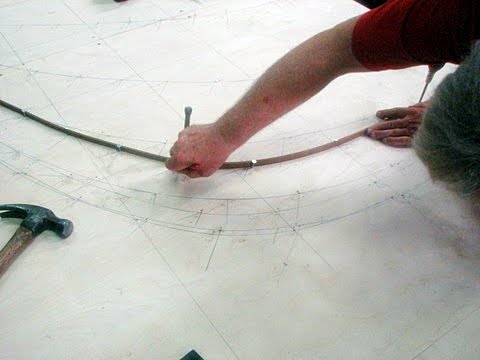


Batten pinned, here Steve draws the line.


And now taking the measurement from the drawn line to a baseline, giving the height of a point on the hull.


Here Steve is pinning the batten to draw a lie for the next to last station, no.9. Stations are cross sections through the hull at measured intervals, and the measurements describe the hull shape numerically.


I rarely like posed photos, but really felt this was an 'historic' moment, with the line being taken off Sjogin to be preserved for posterity. Russ and Steve reluctantly obliged


all images thomas armstrong


A little poetic license taken in the title for this post, actually, Sjogin described, or documented would be more accurate. Sjogin turns heads, both in person and on the internet, and it's easy to see why. Probably built by a retired Swedish ship captain, there's no denying that, whether by luck or by true artistry and insight, the design of this boat distills the essence of Scandinavian working craft and has an ineluctable charm. I am far from being the only admirer who shares this opinion. Back in February, a WoodenBoat Forum thread was started by 'RodB' about how to get the lines taken off so Sjogin could be reproduced. A gentle firestorm ensued, and to date there have been 271 posts on the thread. Several designers were approached, and at least three, Francois Vivier, Paul Gartside and John Welsford have expressed real interest in producing a set of plans for boats built in their attendant styles based on Sjogin's lines, with the intention of adhering very closely to the original lines of the boat, though with possible variations in the material and construction used. These would be plans available and accessible drawn with the home builder in mind. Two of the designers, Paul Gartside and Francois Vivier have already formed pools of subscribers, meaning interested parties who'd like to get a set of plans, and who band together to raise the funds to pay the initial design fee. Inquire if you are interested. Both Francois and Paul have done preliminary sketches based on photos of Sjogin, but in order to actually draw up plans from which a boat can be built, they need accurate measurements from several areas of the boat. This part's not about imagination, but precision, as the intent is to replicate that indescribable sweetness of this boat, this design.
Paul Gartside sent Russ Mannheimer, Sjogin's owner, detailed instructions on hoe to 'take off lines', ie, to take the measurements a designer would need to draw the boat in three dimensions. There are several ways of doing this and the method Paul described is simple and low tech, but the work is exacting.
The bulk of the work was done last Wednesday, by Russ and his accomplice, Steve Martinsen, up from Oxford, MD. The measuring took place at the venerable boatyard David Beaton and Sons, in Brick, New Jersey. Beaton's is a third generation boatyard still building and caring for wooden boats, and has a fabled history, more on the boatyard later. Beaton's is Sjogin's home, and exudes an atmosphere of the past, moving into the future, a real treasure.
I arrived at Beaton's in the afternoon to find Russ and Steve hard at work. They divided the work, Russ using a jig with fingers set to each of the salient measure points, then laying the jig on a board so Steve could measure the points of each of ten cross sections through the hull, and then measure, record and draw the curve. It was interesting to see this process, but I didn't get it all and am probably not explaining it very well. If you'd like to dig into how this process is done, there's an excellent ebook/resource put out by the Museum Small Craft Association. This is the go to text for documenting boats. I'll also recommend investigating this association, a group worthy of your attention.
All in all, a good day, even great, seeing Sjogin documented for all time. That doesn't imply that clones built to her lines will possess the same grace as Sjogin, but all will replicate her seaworthiness, if built correctly and if lucky have a little of her magic as well.

Monday, July 20, 2009

Skin and Bones

Entering


The Exhibition


This vitrine shows a typical set of onboard tattoo making tools


An image of Lady Liberty greets the visitor as you enter the show.


The original can be found on the ditty box on the left


Another example of sailors craft, here sailwork from the early 20th C.


Samoan tattoo tools


Image of an early Pictish warrior, with full body tattoos


A tattoo artist's box, with a rather nice painting


The exhibit uses many examples of sailors art to show how tattoos would have looked.


Here's a close up


This little bag serves the same purpose, and like many of the objects in the show, is exquisite.


Tattoo artists created 'flash books' of their designs to inform the sailors of the available designs. The museum created duplicate flash books for the visitor to thumb through.


This large ceremonial razor was to commemorate a 'Crossing of the Line" ie: the Equator, usually presented at a day long festivity which involved ritual indignation's directed at the novice 'Pollywogs' as part of being imitated into the veteran 'Shellbacks' .


An example of a document of passage presented at such a ceremony. This one invokes Rex Neptunis, king of the sea.


Here we see the tools of the electric tattoo artist, Cap'n Bill Coleman. Electric tattooing began in 1891 with artist and inventor Sam O'Riellly. Colemans kit includes early electric needles, dry pigments which were mixed with alcohol and a small statue which depicted an array of designs as a full body of tattoo.


A poster of designs


Tattoo magic. In a delightful interactive display, this cutout tattoo artist will draw with light one of the four designs seen above the table.
He'll also solicit your business.


Here a very young sailor gets a light tatoo announcing that she has sailed 5000 miles, the swallow design.


A little more revealed


Viola!


A continuing legacy


Independence Seaport Museum's curator Craig Bruns has outdone himself with the latest exhibit, Tattoo. It's intriguiging, informative, interactive and deep. Though nominaly about tattoo, it presents a wide range of sailors's craft, particularly in the age of sail, to give a context for the tatoo as a part of the sailor's life. The word tatau entered the English language at the time of Cooks voyage around the world in the Samoas, 1770's. It was an alliterive, recalling the rythmic tapping of the skin ink artist. It quickly morphed into tatoo which was already an English word depicting the drum beat to quarters. Inked skin drawing was not soley the province of the South Seas, however. Examples of the practice fade into the dawn of prehistory, and include, among others, the New Zealand Maori, Amerindian tribes and notably the wild tribes of Scotland, the Celts and Picts. But make no mistake, it is the sailor who brought this art form into the contemporary world. Mr. Bruns and the Seaport have created a vital, exciting and vivid history of the sailor's world and tatoo's place within it. I have only scratched the surface here, and the show has mch more to offer, including lots on the practice in the 20th C., which I have scacely mentioned. Check the museum's website for events and talks to be given before the exhibit closes in October. This is not to be missed. One of the really interesting things I learned from this exhibit is that there is a certain tatoo iconography, with certains images attesting to accomplishment, as in the sparrow denoting 5k nm. at sea, and in the case of the iconic image of feet the museum chose for it's display, the rooster and the pig, depict animals unable to swim and are a talisman against drowning. The U.S. Coast Guard Chief Warrant Officer Richard Sambenedetto Jr., whose feet bear these two tatoos, will be present at a museum event in October. See you there.

Tuesday, June 23, 2009

Philadelphia Wooden Boat Festival, Independence Seaport Museum

Here are some of the boats, from the bottom, Pepita, a
elonseed Cat designed by John Brady; a Cerlew built by Phil Maynard; a Delaware Ducker owned by the Museum and a Celebrity class racer, Mudhen.


Wendy Byar likes to stand up when sailing her 13' Lowell semi dory.
This is a Salibury Skiff built in1989 and originally owned by Wendy's Grandfather.
Wendy is a mainstay of the WOW and has a blog documenting the workshops progress here.
She tells me she has 10 or 11 other blogs, one devoted exclusively to sailing, but I'll let you know.


Here Wendy takes my brother John for his first sail, ever!


Mighty Sparrow is an Abaco Dinghy built by Thomas Winer Malone in 1957. Malone is recognized as one of the foremost boatbuilders in the Bahamas, having built over 200 of these boats. She's owned by the Florida Maritime Museum and was trailered from Cortez, Fl. to the festival by the director of said museum, Roger Allen, also a member of the TSCA National Council. Roger formerly was director of the Philadelphia Maritime Museum, which became the ISM, and initiated the Workshop on the Water.


On the river.


Painted in tradional Bahamian colors, she's built of madiera, horseflesh (woods, not wine and...) , Bahamian cedar and other traditional woods.


Phil Maynard and Mike Wick ready their boats for an afternoon sail.


Mike Wick coming back in. Mike's boat, Pepita is a 'Melonseed Cat', so called by her designer, John Brady of the Workshop on the Water. She was built by Carl Weissinger. Mike is the president of the Delaware River chapter of the TSCA.


Here's Mike's lovely Pepita at rest.


John Brady built this Delaware Tuckup, an early racing class which originated on the Delaware River.


Heading out of the basin into the Delaware river.


Nice boat.


Phil Maynard coming about in his Edwin Monk designed Cerlew. Phil built her himself.


Coming into the basin.
Phil has made some modifacations to the original design. Read about them here.


Built by Nick Roth 1977-78, Gwylan (Welsh for seagull) was commissioned by and owned until 1985 by John Cadwalader of Philadelphia, a major player in operation Skyhook. She's now owned by Roger Prichard who has done major restoration. She's an Herreshoff H28 and Roger has singlehanded her , mostly, including a nine day sojourn on the Chesapeake. Roger sails out of Riverton, NJ and brought her over to Philly for the festival.


Nice and comfy with a stove to boot.


Here's Barbara Monson rowing Ted Kilsdonk's Asphodel, a Jim Michalek design.


Ron Gibbs' Mudhen, a Celebrity class boat, built in 1963 to a 1931 design, still a viable racing class which originated in Northern Holland, in the Friesland area, They were originally cat rigged but over the years became sloop rigged. Ron rebuilt the centerboard box and the floors on this boat.


Nice day.


All photos Thomas Armstrong


The Indepedence Seaport Museum held it's second Wooden Boat Festival last weekend. The Traditional Small Craft Association held their annual meeting here, and brought lots of beautiful small boats. In it's second year, the Philly festival is still a nascent affair, with lots of potential for growth. It has a beautiful hosting facility, is centrally located in the mid Atlantic region with many great classic wooden boats, both large and small, within striking distance.
There was Elf up from it's Chesapeake home, and the recently launched Silent Maid, Gwylan, an Herreshoff 28, and numerous smaller traditional and not quite traditional craft. It rained. But the spirits of the participants and the visitors were undampened. Good wind for part of the day made for some exciting sailing on the Delaware River. My brother John had his first ever sail! This event has all the elements in place to become a major event. Let's make it so.