Showing posts with label Community. Show all posts

Tuesday, October 11, 2011

4th Annual Philadelphia Wooden Boat Festival

When I arrived at the Penn' Landing yacht basin, lots of boats werre in evidence, small, medium and large.


On the promenade fronting the boatshop I found a couple of runabouts, this one from Vintage Craft.


Gina Pickton was helping organize small boat races.


And there was John Schwarzenbach's Comet, almost fully restored, just needs working out the rigging details.


The boatshop crew and student volunteers have done a good job with her.


For comparison, her state last year.


Ned Asplundh's beautiful Joel White Marsh Cat, Frankford Yellow Jacket.


Ric Carrion's Elf


Ric doing his thing.


Paul Gray back with Quitessance. Her hull is a copy of Jarvis Newman's Dictator, a Friendship Sloop, but
Quintessance is schooner rigged. Making her one of a kind.


Paul races her in the Great Chesapeake Bay Schooner Race. In three outings he's placed two firsts and one third in the C class. He'll be there again this year.


Roger Pritchard was back with his sweet H-28 Gwylin.


He's packing her off this winter to the Cutts and Case yard in Oxford Md for some restorative hull work, their epoxy and kevlar cord treatment.


A rowing race, here's Ron Gibbs and Barbara Munson in the Whitehall Polaris.
vs.


Pete Byar in Pete Peter's ducker Thomas Eakins
vs.


Ann & Kate in the Whitehall Culture.


Marcus Brandt, a Gazella crew, looking very salty for the occasion.


His gear was interesting, so I asked him about it. It's all homemade and mostly scavenged. Only the marlinspike and rivets for the knife handle were purchased.


The tug Jupiter down from
Philadelphia Ship Preservation Guild (along with Gazela) doing double duty as stage for the serenade.


Here are Elizabeth Crampton and the aforementioned Marcus Brandt making ready the sharpie Isabel Una McKay for a sharpie race against Fish Stix.


Ned Asplundh leading Bill Covert to the start in a Delaware Tuckup race.


Shortly after the start with Bill leading.


Some 'match' racing here.


There off! Isabel Una Mckay v Fish Stix


Ned in Marion Brewington coming in far ahead of his adversary. Marion is a local TSCA boat. Top Priorty, the boat Bill Covert was in is,I believe,an ISM boat


Someone? rowed one of the Whitehalls squarely across the AJ Meerwald's bow as she was coming in. Not quite a near miss, but WHY risk it?


The Meerwald tying up.


My turn! Chis from Gazela paddlingus out from the dock in the Isabel Una for another sharpie race. His expression was a bit unsettling.


In truth, however, it was my inexperience in such a small craft which showed. Sitting on the thwart, the boom was at my elbow. Little to no wind. The gaff throat wasn't behaving correctly. I did something stupid and banged my coccyx which is only now feeling better.


Chris proved a capable helm and we did 'win' the race. Typically we finally got some wind just as we approached the dock and landed without grace, my fault. All is well, and despite some pain I enjoyed the experience.

all photos Thomas Armstrong


This years Phladelphia Wooden Boat Show exceeded expectations. More boats, from small craft to large ships, with some lovelies in between. More people, great weather, though the wind died in the afternoon. Wen Byar was the race committee, and along with Gina Pickton organized several small craft races which I am sure will become a mainstay of the fest. Sailing these older boat types is quite interesting and, in my case at least, somewhat instructive. These boats either were, or in the case of the tuckup, evolved from, traditional working boats from the 19th C. It is beautiful to see these craft come to life. The chance to get out and sail these boats is in a small way to re-experience the past and certainly gain appreciation for the skill of our forebears in working these boats. I found sailing the little sharpie in some ways more demanding and acute than the later, larger boats I am familiar with. What a generous opportunity.
Despite certain logistical difficulties having to do with being located in a major city, the ISM, under John Brady's guidance, and with the help of dedicated staff and the TSCA is moving forward and providing a rewarding experience for Philadelphia.

Saturday, June 11, 2011

Jack Tar #5


Cold Is The Sea provided cover art for this edition


all images courtesy Jack Tar Magazine


Kim Carver, editor of Jack Tar Magazine sent me an email alerting me to the fact that the 5th issue of her magazine has been published. It's available as a free pdf download here. There is also a print version but at $100.00 a copy I declined, though it will likely accrue value as a collectors item in the future for those who can spare the funds now. So, if you can, do and support this worthy endeavor. Here's an excerpt of Kim's editorial:

"Six years ago I created this magazine to educate green hands and entertain maritime enthusiasts of all ages. Stephanie Robb and I were encouraging more dialogue between sail training crews around the country, and Samantha Levens took it upon herself to write a thorough article on mariner rights. Without being inspired by these two passionate women I would have never started 'Jack Tar'.

Several folks did not like the name, and others did not like that I had no plans to focus solely on "tall" ships, where the bulk of my friends and experience lay. But what is the purpose of sail training? Certainly not to support thousands of young sailors to become captains of schooners and barques. Sail training exists to encourage teamwork, communication, and community and a good work ethic. For those who choose a career in the maritime industry, traditional sail training vessels provide the very best platform where one can learn enough navigation, meteorology, bosunry, basic diesel engine maintenance and general operations to set them on a course toward any maritime career. For hundreds of years, anyone could find a berth on a sailing vessel somewhere in the world. No money, no college degree, and often skills were necessary. This still holds true today; many vessels welcome green hands who are working their way up the hawse, and the use of these boats as easily accessible trade schools for future merchant mariners is invaluable. I encourage every American sail training organization to put up fliers at high schools, Job Corp campuses, community colleges and youth centers around the nation. Take on at least one green volunteer per season that might benefit more than most from the communal and educational experience a sail training vessel can provide.

Jack Tar continues to exist for these purposes:
Informing mariners about educational and employment opportunities
Promoting women and diversity in the maritime industry
Bridging the gap between different maritime subcultures (research, sail-training, leisure, shipping, building, etc.)
Documenting modern maritime culture, and serving as a forum where those in love with the sea can share their creativity with others"

There's more of Kim's inspired and passionate editorial to be found at Jack Tar. Download it and contribute as you are able. If you can spread the word or make a monetary contribution it'll help keep this valuable resource 'afloat'.

Wednesday, April 20, 2011

Nomadness, an interview with Steven K Roberts: Boats and Bikes part one.


Steven K Roberts


S/V Nomadness somewhere in Washington state.


S/V Nomadness


Pilothouse/control center


Not all of the on-board systems are electronic


This ER grade medical kit is the latest offering from Nomadic Research Labs. Steve is here addressing a perceived need.


Land based mobile laboratory. This is in the process of moving aboard.


Microship, in all her solar panel glory


Wordplay, predecessor to Microship


Steve's biotelemetrick helmet for his bike journeys, which included a head operated mouse.


BEHEMOTH


Here is BEHEMOTH's new display in the Computer History Museum - it's part of the permanent exhibit that just opened this month: “Revolution: the first 2000 Years of Computing." I'm working on the combined book of my three bike epochs, and this might be the wrap-up image... it's a fitting long-term home for this machine that took me 17,000 miles. (Thanks to the museum for the photo!)
Many hobbyists used the newly introduced microprocessor to create their own personal computers. Steve Roberts’ microcomputer used the Intel 8008 chip. Roberts was known later for BEHEMOTH, a bicycle that was a portable computing platform.
1974-10-31 © Mark Richards


all photos courtesy Steven K Roberts unless otherwise noted


To say Steve Roberts is interesting is inadequate, he is astonishing. Steve first came to notice and notoriety during his 11 year sojourn across America aboard his computerized recumbent bicycles, pioneering a nomadic lifestyle. Sort of a modern day John Steinbeck traveling the countryside but also working as a technical writer and consultant, making a living while moving around the country aboard an innovative and outlandish series of sophisticated contraptions. Steve increasingly adapted his vehicular home with more and more technological innovations which eventually led to the establishing of his Nomadic Research Labs. Like many nomads, ancient and modern, Steve Roberts eventually heard the call of the sea and has been working toward transitioning his entire enterprise to a floating home and laboratory. There is a personal connection here. Steve grew up in suburban Louisville near my own homeplace. A close friend of his, Dave Wright has long been a friend of my brother, Rand Armstrong. Rand had met Steve during a visit to Dave on the west Coast and hearing about that I recalled reading about Steve , I think in a Whole Earth publication. I recently interviewed Steve by phone and email to get a check on his trajectory and recent activities. There are tons of information on Steve's websites and blogs to allow you to fill in the blanks in my overview. Steve is what I'd have to name a geek encrusted visionary renaissance man.

Here's the interview:

What is the significance of Homebrew? I have partially answered that question with the entry from the computer museum, but if you'd care to elaborate on that, please do.

I think that I recall from the phonecall that you're referring to my 8008 system (1974) not more recent homebrew projects. It was very early in the game and I was a lone wolf-geek and I didn't make any attempt to market it. In retrospect...Oh well.

How's the book doing?


Which one? The most recent is Reaching Escape Velocity, which folks really seem to enjoy...though it is a somewhat specialized market (people who want to create insanely audacious markets and need to leverage sponsors, media and teams of volunteers...sort of a Martial Arts Geek Expressionism). My better known book, Computing Across America, is in the process of being edited and folded into a large combined volume that includes it's unpublished sequel as well as a host of gizmological goodies (especially about BEHEMOTH)

Why the transition to sea?


Ah so many reasons. Freedom, self sufficiency, the noise of the road, open space, global range...and new conceptual territory. My Microship project was a direct human scale spin-off of BEHEMOTH and it kept evolving over a decade until I had to admit that I needed something bigger than a pedal /solar/sail micro trimaran.


I hope someone needs one, however. It's sitting here in my lab. Know any technomadlings with a yen for adventure and (access to) Deep Pockets?

Any cruises on the horizon? Would you say sail out to the Marshall's and spend a year or two? What areas interest you?

Initially my own waters; so far I've single-handed my previous boat (Corsair 36 tri) up to Desolation Sound, and the aboard Amazon 44' explored Puget Sound, San Juans and Gulf Islands with my ex. Now it's time to head further north...the boat can take it...and is perfect for this environment. Steel hull, stout rig, wood stove and lots of self sufficiency tools.

Anyway, once I've had some larger adventure on this coast, it will be a natural thing to head out the Strait and turn left. South Pacific, Aus/NZ and Europe including Scandinavia are all inviting.

Are you completely transitioned or or you still somewhat land based?


About 50/50 now, with the boat gradually becoming home. The weekly forays to the home base facilities gives me the space for business, working and spending time with my partner, and tonnage reduction...and boat projects are warming up with the weather and the completion of my mobile lab (now parked inside a building, about 2 blocks from Nomadness)


What is the next product project?


We've just started producing a much-needed line of "Expedition Medical Chests," with ER grade supplies in gasketed Lexan cases. See here.

I'm also starting a publication series ("design packages") that document various interesting boat projects, and not just geeky ones. All are detailed enough to serve as a full how-to, though of course boat contexts differ widely and they're probably more likely to be used as resources more than blueprints. Still, having a working system in hand is hugely helpful. Some will have associated kits.

You are consulting a bit, what is the nature of your consulting?


A very common problem in industry is a lack of writing skills...some amazing engineering comes with such unreadable documentation (or none) that companies stay busy with more hand holding than is necessary. I'm on the other side of this now, in fact.

Something I've been doing freelancer for about 30 years is acting as a translator...it's unglamorous but really necessary. It's also kind of fun, giving me a short but intense learning curve.

I'd like a statement of the big picture from you, what's this all about? I mean a lot of that is self evident from your material, but what's the vision, where are you going?

Well, I usually just quip, "It's fun", since that's such a big question. A somewhat more precise answer is that I find the most rewarding lifestyle to be one that incorporates all my passions into a self-sufficient enterprise...not with any emphasis on business, but with that as a sort of automatic nickel generating component that burbles along in the wake of whatever I find most interesting.

What I find interesting at the moment is a layer of intelligence on the boat that provides a deep situation awareness (both ship internals and the outside world). This should not be misunderstood as a complicated system that will lead to even more breakdowns, I would never trust a microprocessor to turn on my nav lights. But a toolset that allows me to observe trends, do failure analysis, and otherwise overlay a sort of industrial-control environment onto the boat...now that's fun stuff. It also creates a system context into which it is easy to integrate other things of interest: a piano studio, 3D printing capability for parts creation, video production, efficient power management, robust communication tools and so on.

Why a sailboat? A tug like Stewart Brand's might be easier to negotiate, what's the allure, statement made/goal. Non petroleum?


Heh...years ago when I did the Phil Donahue show, he asked me, "Why not a Harley?"

I'm not a purist, though of course the ability to move with a minimum of expensive fuel is increasingly worthwhile. A lot of it is just my personal sense of aesthetics, though I do sigh with envy at the space inside some trawlers. Really it goes back to my general desire to blend passions: interesting stuff happens at the boundaries between specialties, and if those a seemingly divergent (sailing vs distributed control networks...or bicycling vs on-board computers back in the '80s) then it's intrinsically entertaining and door opening.

I look forward to being the only guy in the anchorage who can crank out a toner-transfer printed circuit board or a custom 3D printed plastic part. Geek pleasures, mixed with the languid pace of the traditional nautical life and the time-honored practice of barter.

Personals/Dave Wright/College or self taught/How did you get here?

Self taught, which is really just another way to say that passion is a much stronger motivator than fear of tests. I've spent my life doing whatever is most interesting, and that automatically causes education. The more I learn the more I find things I would like to know...and the more I am attracted to people who have related and highly varied expertise (that's why I've always found Dave Wright so interesting). I used to have a vague sense that I had missed something by skipping out of engineering school, especially with the obvious holes in my education...but I got over that when I spent a couple of years teaching a senior projects course at a large university. I was glad not to have been defined by such an environment, though of course some folks can just extract the good bits and not be damaged by the process.

Being self employed is not easy, though-I have terrible work habits and only get away with it because my interests keep me moving in the same general direction for a long time. Sometimes interesting things emerge.

Please add anything I may have overlooked or that you feel is relevant.


The biggest challenge is that my fantasies of what can be done keep on evolving faster than my abilities to actually build the stuff...and that can be deadly. Dave once said, "You're staggered by your own imagination". That sounds like a compliment but it's actually a rather accurate assessment...I need to freeze a specification and get 'er done. Recently I've been getting a little better at that, since I am annoyingly aware of being finite. The average completion time of a homebuilt boat is 137 years, and even though my boat is already "built", it's easy to see how projects can just never end. Here there be dragons...you see them all the time in the marinas.

Good project management skills help with this, keeping focus on what I call CDT's (Clearly Defined Tasks). When working on the boat, I try not to get lost in blue sky brainstorming, or the next version will seduce me long before the current one is done enough to enjoy.

You can access far more of Steve's technomadic brilliance at these sites:

Nomadic Research Labs

Nomadness weblog

Behemoth

Store

And others pursuing a technomadic lifestyle here.

Sunday, December 19, 2010

Jack Tar Magazine's 2011 Calendar

Last Minute Shopping Directive


Cover Photo, the Crew of the F/V Princess sporting some nice salmon and not a lot more!
l to r Mariah, Captain Heather & Sally

courtesy Jack Tar Magazine


Surely anyone who either consistently or intermittently reads this web log can help the Jack Tar Magazine stay afloat by purchasing the 2011 Calendar. Chances are good that there are at least one or two in your circle of family and friends who'll find this a very welcome gift. And you'll support a worthy organization. The stated aim of the organization: We strengthen community among sailors through interactive, informative and entertaining media, with a focus on the progressive side of modern maritime culture and it's roots in traditional seamanship.
And they do just that. So, don't equivocate, don't hesitate, don't procrastinate, order the calendar now.

and keep an eye out for the latest print version to become available early 2011.

Follow on facebook here http://www.facebook.com/JackTarMag...

Kim Carver, editor, goes on to explain her vision and mission: There are huge gaps in how information is being shared between the maritime subcultures today. Heavy industrial offshore and Lakes operations have trade magazines that focus on new technology or environmental legislation affecting their industry. Commercial fishermen, research vessel crew, tour operators and sail training crew have few, if any, forums where they share information. Wooden boat builders, cruisers, and racers have magazines and online forums that include technical articles and product information, but scarce offerings when it comes to well written sea stories, interesting art and photography, and thoughtful reflections about life on the water today.

This is where Jack Tar picks up the slack; our audience includes everyone who recognizes the great, and sometimes not-so-great aspects of the seafaring life. We educate new mariners on how to succeed in the maritime industry, while promoting the study of traditional seamanship skills. We provide venues to discuss important issues: whether it's about safety at sea, USCG compliance topics, relationships between operators and crew, or personal subjects that only a mariner might understand. We serve as an outlet for the creative and talented souls living and working on the water. We offer common ground where both fishermen and fisheries scientists may stand in support of dedicating their lives to the management of important natural resources. We are about bringing people together, and sharing our dedication to a safe, prosperous, and enjoyable future at sea.

There is an excellent quote on the back cover of this year's September issue of Maine, the magazine; "Seafarers, and the maritime community are the people that teach me about what it means to love thy neighbor, how to be hospitable, and how to welcome a stranger." - Rev. Dr. Nash Garabedian

That is the spirit in which Jack Tar Magazine was borne, and that is the attitude with which we bring culture and information to other mariners and the world. Please help us to narrow the gaps in communication. You are helping people on different sides of the issues understand each other better. You are helping educate young people regarding their options in the industry. You are allowing a new generation of Cousteaus, Heyerdahls, Conrads and Chichesters to emerge and renew centuries of public fascination with a subculture that is too quickly forgetting seamanship survival skills and the romance of going to sea.


Monday, September 6, 2010

Dorna Sail and Oar, the Scottish Coastal Rowing Project, and ruminations on both


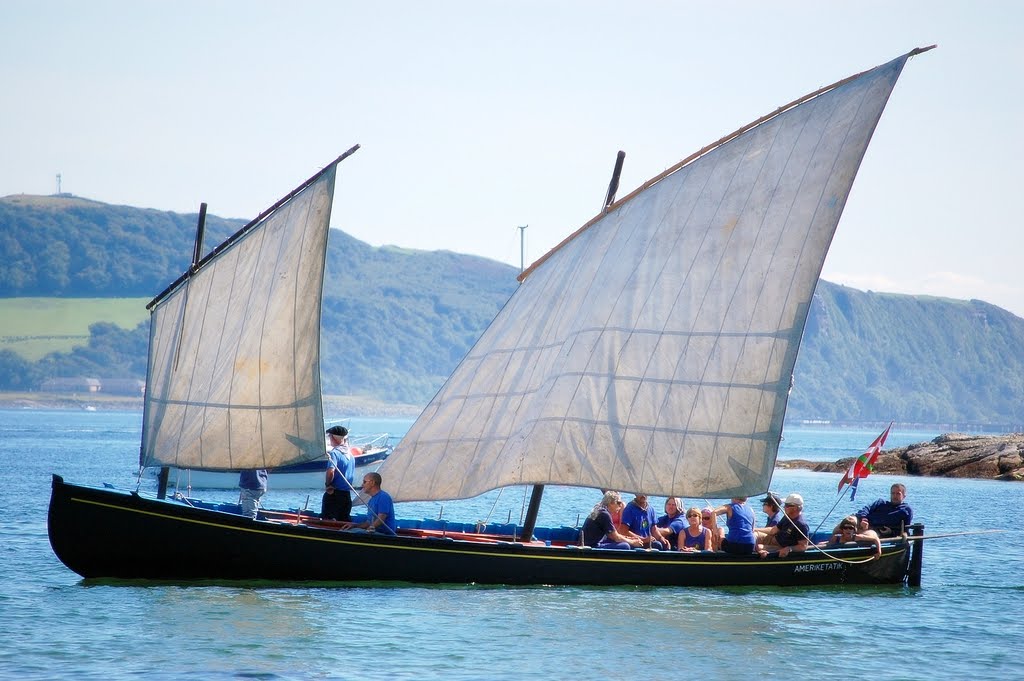
Boat Type: Trainera. Ameriketatik (“From the Americas”) was built in 1998 in the Rockland Apprenticeship in Maine, U.S.A., under the direction of Xabier Agote. Sardine fishing techniques, based on speed and manoeuvrability, demanded a length/beam ratio as high as 1/6, twelve metres being the most common length. The hull was light (800 kg approximately), with raised bow and stern, thus facilitating the turning of the craft. The crew was large, usually of twelve rowers, even sixteen in the case of the biggest traineras.


The trainera could also sail, although the sails were never used in the aforementioned fishing technique. The sailplan included main and fore dipping-lug sails. Ameriketatik Built 1998 Length: 11.5m Beam: 2m


Ameriketatik at Cumbrae


Beach at Cumbrae, Firth of Clyde, Scotland, site of the Dorna Sail and Oar


Two boats from the Scottish Coastal Rowing Project showed up, including Boatie Rows from Port Seton, aka Cockenzie . Here the Ulla crew, from Ullapool, tries out the Port Seton build. Apparently there's a lot of boat swapping and trying out at Coastal Rowing events, comparing builds etc, which seems very healthy and constructive.


Columcille crossed the Irish Sea to participate


Ocuan is a Scots Birlinn replica built and maintained by Galgael, the host organization for Dorna Sail and Oar


This boat, and the next, were both brought by the


RWSABC, the Royal West of Scotland Amateur Boat Club, based
Greenock, Clyde


Cockenzie aka Boatie Rows


Boatie Rows


Port Seton, aka Cockenzie aka Boatie Rows
from the rather small village of Port Seton/Cockenzie,
(pronounced ko'k?ni)


Hey! I love prams, especially those built in traditional lapstrake and finished with oil and pine tar.


Here we have Ulla, Boatie Rows and Columcillle


Ulla


Ulla and Ameriketatik


Ameriketatik


warmest thanks to Chris Perkins, aka Strathkanchris, for sharing his photos with 70.8%
these are a glorious record of the event, thanks Chris


Lot's to talk about here. First of all we have another instance where a traditional boat festival has invited the Scottish Coastal Rowing Project to participate, creating an impressive synergy. Dorna Sail and Oar is a traditional boat festival which took place recently at Cumbrae Island in the Firth of Clyde.International in character and intention, the festival had visiting boats and crews form Ireland and Galicia, Spain. The celebration, in it's first incarnation, is the production of several interesting groups. I feel a little background is in order to understand what's really going on here. Bear with me.

The Sail and Oar event is part of the DORNA project, a European initiative promoting traditional boat building and related skills.

GalGael Trust

Glasgow-based GalGael Trust are known for engaging the community in building and sailing traditional boats in celebration of Scotland’s heritage. GalGael's mission is to provide a template for renewal; cultural anchor points around which people can rekindle skills, community and a sense of purpose. They describe their innovative work in this way; “At our workbenches, we build skills and self esteem. In our workshop, boats and community are rebuilt.” One of their main achievements has been the development of a unique learning project; Navigate Life providing a place where people can navigate away from a broken sense of self and live life with dignity. Over the past four years 246 people have started this journey. From its Glasgow base, the Trust works with communities across Scotland.

Cumbrae Community Development Company

CCDC is the development trust for the island of Cumbrae, owners of the Garrison House, and charged with the regeneration of the island.

CCDC was established in 2002, after a sustained period of community-led action resulted in the salvation and sympathetic restoration of a magnificent local building - Garrison House - which is centrally located in the island's only town of Millport. After several years of work renovation of the property, including a partly-glass roof, was completed in 2008.

CCDC, following its success with Garrison House, has successfully expanded its remit and is now working with the community to identify ways forward for the sustainable development of the island through projects and initiatives that will boost the local economy and improve the quality of life of residents.

DORNA

The event is part of the DORNA project, a European initiative promoting traditional boat building and related skills. DORNA Scotland is led by the GalGael Trust. Dorna lead partners from Deputacion Da Coruna will launch the BATE brand at the event. The brand will assist in marketing activity in support of the traditional boat building sector. Martin Hughes, Training Manager, said: “DORNA Scotland is delighted to be involved in the Sail and Oar event; highlighting the importance of boat-building in Scotland both historically and in the future. DORNA aims to not only celebrate and share the historic craft skills employed in building traditional vessels, but also explore how traditional boat-builders can work together to find new markets in the future.”

The Dorna Project is partially funded by the EU through the European Regional Development Fund. Get that! The EU is funding marketing initiatives to restore and preserve traditional boatbuilding skills in the Atlantic coastal communities. European largess or wisdom applied to preserving traditional skills and revitalizing coastal communities? Let me know what you think.

I'd also like to share some enthusiasm shared with me by Alec Jordan, of Jordan Boats, about the Scottish Coastal Rowing Project and it's rather phenomenal popularity with Scot's coastal communities, by putting up an (edited) email missive from Alec to me. Admittedly, Alec does have a pecuniary interest in the project as he is the supplier of the St Ayles kits, but I feel his enthusiasm for the project extends far beyond self interest.

Here are Alec's thoughts:

It would be great if we could get things moving a little elsewhere. I
have just finished writing a 1400 word article for Australian Amateur
Boat Builder and the NZ equivalent, so I am hoping that it will get
the interest going over there. We have the advantage that there is
the Scottish diaspora in NZ, so hopefully it will pick up there first.

I understand that Scott Kramer(?) (Carl Cramer, I think) at WoodenBoat also thinks that it is
a fantastic idea, but the feedback I am getting is that it is not
going to work as community based builds - more likely schools - which
misses the point a bit.

I would have thought that the coast of Maine, Chesapeake, and WA would
be the best places to try to get this going. I have heard that Mystic
are looking at doing something similar with trad built whalers, but
these will cost a fortune and need professional builders. The beauty
of the St Ayles is it's relative simplicity of build. It is also
quite forgiving - some of the tales that are coming back from the
builds are a little scary - why the **** won't people ask when in
doubt! But they are still going together.

It would be interesting to get the whaler plans and turn that into a
glued lap kit.

Anyway, I have a busy week with two more St Ayles' to cut.

If you have any ideas as to how to get things going, I'd love to hear
them - maybe put the question out on the blog....


I cold not agree with Alec more. The SCRP has been a galvanising force in bringing Scots communities together, around a wholesome and holistic endeavor. It's a great model for communities everywhere on this planet. If you have questions about this, or need help getting started, contact me or Alec. Lots of help available.
A heads up to the TSCA, this could be great project to get behind, with locally appropriate boat types involved.
So, a lot to ponder, a lot to act on. I will be sending a heads up to the Obama Administration to read this blog post, for what it's worth. Someone will read it.

Again, thanks to Chris for the loan of his photos and thanks to Alec Jordan for his enthusiasm.