Showing posts with label Ecology. Show all posts

Tuesday, May 10, 2011

MotR: Clodia, Giacomo & Co. Cross the Channel


Clodia in Ramsgate prior to the crossing


Giacomo sailing out


crew Bruno rowing out of Ramsgate


Giacomo amidst the Channel


video and all photos courtesy Man on the River/Giacomo De Stefano


Our Man is back on the River, rather, this time on the sea. After a hiatus from his ambitious project, Giacomo De Stefano has triumphantly resumed his adventure after a bout with a rare and potentially deadly virus. High congratulations are in order. Giacomo and his crew Bruno Porto successfuly navigated the English channel in about 9 hours, sailing from Ramsgate Uk to Gravelines France aboard their 19' Ian Oughtred designed Ness Yawl, Clodia.

Here is Giacomo's report of the crossing:

"We did it!

Crossing the English Channel is something special:
To make it real we had to rely on many friends and on our best commitment and effort. Not to mention lots of luck.
I thought to all those people who lost their lives in these cold and troubled waters, even in the best weather conditions as we were so fortunate fo find yesterday.
Streams, sea beds,shallows, big ferries and commercial ships: A lot to worry about for a nutshell like Clodia.

We could never have done it without the help of Chalky, a sailor friend, who escorted us all the way from Ramsgate to Gravelines.

A support boat is required by maritime regulations to cross the Channel for a small boat, engine free, like our Ness Yawl.

This is the report of our day: We leave from Ramsgate at 6 o’clock after a rainy night that didn’t seem like a good omen. Chalky already offered us a good coffee.

We get out of the harbour by rowing, under a bright sun: In the meantime Paolo is filming us from the top of the pier.

To cross the shipping lanes at 90°, Chalky asks to tow us, because the wind is contrary and he wants to get to Gravelines before 4.30 p.m. for the high tide. We can’t turn his offer down, even if it doesn’t stick to our values: We could have easily made it without any help, but not following the regulamentary 90°.

We need to get out quickly from the routes of the big ships, that need many miles to stop, so we accept to get towed for what is strictly needed.

When the shipping lanes are at our back, the wind calms down. The green power of Bruno comes very handy and we row for a couple of nautical miles: Then, when we have to cope with an opposite stream of nearly 2.5 knot (faster than us!), the wind comes to our help at about 12-16 knot, keeping constant for the following hours.

We can now swiftly sail for hours: The day is beautiful and Clodia doesn’t seem to care much about the sea, running fast toward the French coast.
The last 12 miles are fantastic: We literally fly over the waves caused by streams and shallows, and by a stronger wind, reaching 6.3 knot speed.

We enter the canal of Grand Fort Philippe al 4 p.m. local time, after 9 hours and 35 nautical miles of navigation from Ramsgate. A little thrill: The gaff jumps over the peak of the mast, hit by a naughty wave. I quickly turn down the mainsail and leave the rope, avoiding any further trouble. Everything goes well, but it could have been very dangerous.

The access to the channel leading to Gravelines is a bit difficult, but we enter quite well, then we sail for the last 3 miles and dock in the wonderful Marine. Fantastic!

Gravelines welcomes us with all its peace and beauty. The fortress of Vauban is very nice.
We also discovered a 57 metres vessel, replica of the 18th century original, under construction: Impressive! Here you can find more info.

Thanks to all of you for support and help, we felt your presence every time. We dedicate a special thought to Roland, Silvio and Jacopo that should have been aboard with us.
Shortly, we’ll set sails to Saint Omer. A big hug.

Giacomo and Bruno"

You'll find map of the crossing, more on the project, and full documentation with a link to the project Flickr site at Man on the River.

See previous posts on the adventure here.

Giacomo, it's lovely to see your triumphant return, welcome back and my deepest congratulations on the successful crossing!

thomas


Wednesday, July 28, 2010

Two Arrivals


Alessandro was towed into harbor, his engine disabled for the record attempt.


Ebullience!


Alessandro looks happy to be home!


Plastiki in Sydney Harbor with the iconic Opera Hall in the background


David de Rothschild


Plastiki crew, seemingly also ebullient.


the escort


my apologies to the photographers whose images are represented here for my failure to credit


Two arrivals, two goals accomplished. I'd like to congratulate each of these dreamer/doers.

First, Alessandro di Benedetto completed his circumnavigation, smallest boat around nonstop and unassisted, recognized by the powers that be of such things. An impressive, possibly amazing achievement, aboard his Mini 6.50. Dismasted during his initial attempt at Cape Horn, and expected by all watchers to retire, Alessandro persevered, jury rigged, and got on round.
Time taken by Alessandro Di Benedetto to make his trip around the world in the Mini 6.50 sailboat: 268 days 19 hours 36 minutes and 12 seconds. Applaud. He returned to Les Sable d' Olonne to fanfare, with his mom Anne Marie Di Benedetto there on the docks for his arrival. Anne Marie handled much of the logistics for the attempt, and was the email liaison which allowed me, and others, to communicate with Alessandro in the midst of his journey. See my initial post here.
Alessandro made it back to Les Sables on 7/22/2010. My personal congrats to Alessandro and Anne Marie

Brad Hampton of Yacht Pals wrote about the journey, here's an excerpt from after the dismasting:

On April 2, after receiving word from his team, YachtPals reported that Alessandro would have to make for land in Chile. And then a few hours later, we had to retract that statement. Alessandro had notified shore support that he was going to try to jury rig his boat, AND SAIL AROUND CAPE HORN! We double- and triple-checked. Was he serious? Was he crazy? Cape Horn is the nastiest patch of water on the planet, and most sailors wouldn't round it on a perfectly sound boat. Yes, he was serious, and maybe crazy too! But ever-so-slowly, Di Benedetto approached and then rounded Cape Horn, after which he pointed his bow for home.


The final trip across the Atlantic was slow, and held many challenges, but Alessandro crept along, persistently making headway while many YachtPals members watched his progress via his route tracker, fingers crossed for his success. We are now happy to report that Alessandro Di Benedetto has arrived back at his starting point after nearly nine months at sea. Pending WSSRC ratification, he will hold the official world record for a non-stop circumnavigation aboard the smallest boat in history. Bravo Alessandro! When sailors tuck their children into bed at night, they will tell your story, using words like bravery, persistence, and hero.

by Brad Hampton for YachtPals.com

David de Rothschild had a very different dream, and project. He set out to raise awareness of our degredation of the oceans, to see and document the almost mythical swirl of detritus forming an 'island' in the Pacific, and to do this with a boat built almost entirely of recycled material. To sail across the Pacific from the US to Australia. He managed the crossing, despite some harsh weather, and judging from the media attention to his landfall in Sydney, he'll certainly achieve his goal of consciousness raising. Whether it will have any real impact on how we treat our oceans is impossible to judge today, one can only hope. His catamaran, Plastiki, incorporated tens of thousands of plastic bottles built into the hull as structural and flotation elements. The boat has many other environmentally friendly adaptations, to wit, in the words of her creator:

"The Plastiki was nothing if not ambitious. We wanted bicycles that would generate electricity, a hydroponic garden, water stills, vacuum de-salinators, a composting toilet, solar panels, wind turbines, regenerative electric propulsion, satellite communications and pretty much anything else that constituted an innovative sustainable “system”. She was to be a floating showroom of non-emitting futurist ideas that were simple, elegant and wholly attainable."

Plastiki arrived in Sydney harbor on the 26th of July to great fanfare and media attention. Hopefully David will be able to leverage his success into increased awareness and eventual action. It's really nice to see someone who knows how to use wealth, bravo David, we expect to hear more from you.

Now where's that plastic bag?

Saturday, May 1, 2010

MOTR: Advenure truly underway

Out into the Thames estuary


Jacopo returns to Clodia after a time, unplanned, in the water


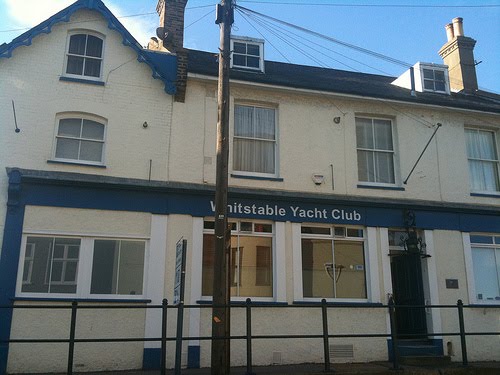
Whtistable Yacht Clup extended a warm welcome to the sailors


Clodia onWhitsable beach


Looking forward

all photos courtesy Giacomo DiStefano


Our Man On (about) the River, Giacomo DiStefano, is poised to begin what could prove to be the most challenging leg of his voyage as he sets out to cross the English Channel. He and his mate Jacopo Epis are currently in Whitstable, waiting on weather and a touch of bronchitis to clear. Remember this is in a 19' lug rigged open boat. The channel can get ornery, but the boat has a north sea viking heritage and Iain Oughtred's boats have a great reputation for seaworthiness, like their progenitors. It will be interesting to see how Giacomo and his Ness Yawl fare across the channel. Stay tuned here. Read all my previous posts on Giacomo's project here.

Sunday, January 31, 2010

Jumbo


Despite their constrasting size both these boats shown here were classed as 'Jumbos' and are typical of the St.Ives shape which enabled the vessel to remain upright when taking the ground. Legs would have been torn off in a crowded harbour, as shown below. The one on the right (above) and those against the quay (below) are so similar to 'Celeste' they are almost certainly from William Paynters' yard.

Photos reproduced by courtesy of The St.Ives Museum


Celeste


Jonny Nance
serving splices with Joe.

Photo; Pete Greenfield


'CelestFish Festival 31st Aug 09. photo: Colin Sanger
'Celeste' at Newlyn Fish Festival 31st Aug 09.

photo: Colin Sanger


Festival 31st Aug 09. photo: Colin Sanger

View looking forward

Photo by Peter Chesworth, courtesy of Water-Craft magazine.


Wrought iron foremast gate.

Photo by Peter Chesworth, courtesy of Water-Craft magazine.


Securing the mizzen boom

Photo by Peter Chesworth, courtesy of Water-Craft magazine.


Wrought-iron stemband and 'scud-hook'

Photo by Peter Chesworth, courtesy of Water-Craft magazine.


Photo by Peter Chesworth, courtesy of Water-Craft magazine.


Photo by Peter Chesworth, courtesy of Water-Craft magazine.


Celeste at low water

Photo: Ian Murren


Jonny Nance with Pete Goss, a finisher in the '96/'97 Vendee Globe. Pete's latest adventure was the recreation of Mystery, a Cornish Lugger which carried 7 Cornishmen to Australia in 1854/55. Upon completion of the boat, Pete and crew sailed the Mount's Bay Lugger in a recreation of the voyage. The new boat and venture was called Spirit of Mystery. I believe the occasion of this photo is Pete's purchase of a 'share' of/for the building of the new Jumbo.

photo Pete Goss


Jumbo II under construction:


all photos courtesy Jonny Nance unless otherwise noted


© THE ST.IVES JUMBO ASSOCIATION


Jonny Nance is an apostle for traditional boats and boatbuilding, and community involvement in these areas, in his native St. Ives, Cornwall,UK. He's created something called The St. Ives Jumbo Association to further these aims. And is doing a great job, as you can see at the Association's website. Celeste is his first replica and another is nearing completion. I was struck by the craftsmanship and attention to detail when first seeing the photos on the website, and paid closer attention to what was going on here, and my attention has been amply rewarded. This seems a model project.
Jumbo's were a late development in the local fisheries, a scaled down version of the larger mackerel luggers. The name arose in this way:
"To fishermen familiar with the much larger and more numerous mackerel boats the new Jumbos would have seemed particularly diminutive and so were ironically nick-named after London Zoos' famous African elephant - the biggest creature in captivity.

Jumbo had caused a storm of protest in 1882 following its controversial sale to the Barnum & Bailey Circus in the USA. "

It's Jonny's intention to race the two boats as a way of getting the community interested and involved in the skills needed to preserve and continue their local heritage. But for me he has a more interesting goal. Jonny see's the revival of these inshore fishing craft as a means of protecting local fisheries and promoting sustainable fishing, eco fishing, if you will, via a return to fishing under sail. In his words-

"When sailing the Jumbo you can readily appreciate why the lug rig remained popular for small fishing boats through to the last days of sail. To start with you've a wonderfully clear working area with the masts out of the way, and no boom to duck under. Even when close-hauled the sail and sheets are clear of the work area. This, combined with he manageable scale of the boat and rig makes the Jumbo an ideal model on which to develop skills and explore the potential of fishing for a living - under sail.

Our aim is to establish a racing class of these boats at St.Ives in order to regenerate a waterfront community in decline. How much more effective it would be if, in addition, these boats could be eventually used for the purpose for which they were designed whilst providing a seasonal income for a couple of individuals!

Clearly, there may come a time when, in addition to any green, carbon neutral credentials, a sail-operated fishery could become commercially viable or at least a natural way of conserving resources (as demonstrated by the Falmouth oyster fishery -much celebrated as the last in the world to be worked under sail). In the meantime the skills required need to be developed.

There's a growing recognition that this approach would at least address some serious issues; the sustainability of fish stocks, the rising cost of fuel, the dependence on imported goods and the lack of employment opportunities in rural areas to name a few.

And if successful, the model could be readily repeated elsewhere.

Only a few months ago such a proposal would have been dismissed as romantic fantasy. So far however, my inquiries have been met with a degree of excitement .

Stephen Perham, the Harbour Master of Clovelly, who has been working the herring season there for decades, explained he has been thinking of reviving the 'picarooner' (their Jumbo equivalent) for the purpose. It's no coincidence that a replica of this particular craft is currently under construction by students on the Traditional Boatbuilding Course at Falmouth Marine School.

Nathan De Rozarieux, the Project Director of Seafood Cornwall reckons there's sufficient public awareness to support a significant premium for 'zero-carbon' fish when sold direct to the customer. This would ensure a market for the smallest catches. This view is shared by Matthew Stevens MD of Matthew Stevens and Son, the regions leading supplier of fish and seafood based in St.Ives,who said,

"Clearly the time is right for an initiative like this. We look forward to receiving their first catch!"

Even the authorities are supportive. The Marine Fisheries Agency at Newlyn inform me that obstructive legislation has been amended to allow unlicenced (unpowered) vessels of under 10m. to land and sell fish.

Without realising it individuals from each of the contributing sectors: boatbuilders, part-time fishermen, fishing authorities, and marketting have been quietly thinking along parallel lines but as yet have not joined forces.

We are on the threshold of a revival that could see several small, inshore and engineless fleets springing up around our shores over the next decade.

The logical place to start is where we left off - and engines took over.

Sceptical? Of course - but just think where the organic industry was only 30 years ago!"

Apparently the British House of Commons is taking notice of such ideas. Other institutions are taking notice of Jonny and the Association's initiatives as well. The esteemed Tate Gallery held a fundraiser last spring to help make possible the completion of the second Jumbo.

Even an American group of descendants of the Cornwall Nance's is taking notice and appealing for help. If you can do so, please!

Addendum: In response to my questions regarding the origin of the Jumbo plans and their availability, since which a reader has also inquired about in the comments to this post, Jonny has this to say:

"The National Maritime Museum at Greenwich, London hold a body plan for a jumbo by Philip Oke redrawn around 50 years ago from a sketch by William Paynter. From this, by way of a half-model and lofting, I produced the moulds, reducing the scale to replicate the smallest recorded jumbo (keel 19' 6") suit our requirements. Jumbos varied in length and construction the largest being carvel and upper 20's in length where upon they are almost identical to small pilchard boats (the next class up).
My father took the lines off the St.Ives Punt (13') which was the first I replicated. No original jumbos or constructional drawings exist today.
Not much has been published on William Paynter despite his ledgendary status. I know it was something my father thought should be pursued.
As regards working drawings - there's currently only one which I'm using. All construction detail is my own supposition based on photographic evidence, a thorough knowledge of local practice and commonsense.
A dilemma hovers over its' publication: As you know, this entire project has been conceived to stimulate activity to benefit St.Ives. Our scheme is to establish a centre where jumbos and other craft may be built and maintained within the town, training and employing locals. If there's any interest to join the one-design jumbo class and commission a 3rd jumbo it will be something we have generated through our efforts entirely from scratch. At the risk of sounding 'protectionist', we are naturally keen that our overall project should be the first to benefit from such a demand at least at this early stage.
That said, our project is all about creating and inspiring opportunity and empowering the community and so if our model proves successful we will be encouraging others to do the same wherever he potential exists. Obviously the jumbo was designed to meet conditions at St.Ives. I hope a successful outcome of our planned experiments for commercial fishing under sail will encourage others to research their jumbo-equivalent. If ever there was a case for replicating our heritage this is it!

Monday, May 4, 2009

Stewart Brand Liveaboard in Sausalito

Tugboat Mirene, 1912


Stewart Brand


Stewart Brand, mastermind behind the Whole Earth Catalog,  an author concerned with subjects as varied as cybernetics and the evolution of buildings who describes himself as a finder(of ideas) and a founder (of foundations and such), a perfectly 'Brandian' turn of phrase,  showed up in an email from my brother John today. Originally an article in the NY Times by Edward Lewine, it came to me as a post  on South Williard . Stewarts current project is called the Long Now Foundation and is dedicated to fostering long term vision and thinking as opposed to the faster/cheaper paradigm which  seems to (still) be the vision of most business and political thought. Stewart and his thought and projects, WEC in particular have been a huge influence in my life. Enjoy this: 

Brand lives on Mirene, a tugboat moored in Sausalito, on the San Francisco Bay.

By EDWARD LEWINE
NY Times Published: April 15, 2009

Deceased 1960s pal he’d like to see again: Abbie Hoffman. He was brilliant and a card and dangerous to know and delightful in every way.

His best line: In 1966 I had buttons made with the paranoid-sounding slogan, “Why haven’t we seen a photograph of the whole Earth yet?” Well, we got the photos from NASA in 1969.

Moving house: The Mirene is a working, 64-foot-long tugboat built in 1912. We take the boat out cruising from time to time. We turned the wheelhouse and skipper’s cabin into our bedroom, with two rooms and a bath below.

Why a boat: The main thing is our houseboat community here, which is exceptionally congenial. The boat is inexpensive to live on, and you have no problem with earthquakes, wildfires or rising sea levels due to global warming.

Green living: I didn’t choose the boat because it’s green, but it is. It doesn’t take much to heat 450 square feet. Cooling is no issue on the water. We have solar panels and a demand water heater and use biodiesel fuel when we cruise.

Morning routine: Get up at 6:30 or 7:00 a.m. The trip from the bedroom involves going down a ladder outside. I breakfast in the galley and then go off to work.

Job description: I design stuff; I start stuff; I found stuff. On the passport I put “writer.”

Bad trip: That was my first trip. I had 400 micrograms of LSD under quite clinical circumstances at a psychological research institute in Menlo Park, Calif. It was in a white room with therapists sitting around.

Good trip: In 1963 or ’64 I showed up at the door of Ken Kesey, the novelist and LSD evangelist. I was involved in Kesey’s Acid Tests, which were happenings where LSD made its way around and everyone was there to entertain each other.

Acid Test memento: I have my Acid Test graduation diploma. The conceit was, “Can you pass the acid test?” Mine was signed by Neal Cassady, who inspired Kesey and was the model for Dean Moriarty in Jack Kerouac’s “On the Road.”

On the wagon: Since 1969 I haven’t used psychedelics. I realized I’d seen all I needed to see.

Drug of choice: I’m stoned right now on two cups of coffee. I’m 70, and the easiest way to young-up your mind is to drink caffeine.

Worst thing about the 1960s: Let’s see. I made the mistake of being married during the sexual revolution. Nice marriage; inopportune timing.

Pets: We had cats, but we had to put them down. That was horrifying, and we replaced them with a life-size stuffed tiger.

Home office: I work in a landlocked fishing boat named the Mary Heartline, which sits about 100 yards from the tugboat in a parking lot. It looks like a Victorian cottage.

Item you need on a tugboat: You’ll always be glad that someone has stolen a shopping cart, so you can get stuff from your car to your boat.

Controversial stand: That technology can be green. The book I just finished, “Whole Earth Discipline,” has chapters on why nuclear is green, cities are green, genetic engineering is green. The romantic nature-is-perfect approach is just horse exhaust.

Back to the WELL: I founded the WELL, a pioneering online community, in 1985, with Larry Brilliant and some others. The name is short for Whole Earth ’Lectronic Link. I have the American Heritage Dictionary I used to find the name.

Exercise routine: I hike Mount Tamalpais.

Evening routine: My wife, Ryan Phelan, and I tend to go to restaurants or throw together a dinner around 9 p.m. I’ll read a novel or a comic. We’ll take a bath together and be in bed by 11:30.

Favorite gadget: I have this memo-keeping device that must be 75 years old. It’s from the house I grew up in in Illinois. It uses rolls of adding-machine paper — which you can still get — and you write on it and tear the paper off.

Obsession: Getting rid of alien, invasive plants. I bear down on this form of pampas grass that comes from South America and has no business in California.

Art collection: We don’t have room for much. We do have a 1.5-inch-long enamel drawing of the Mirene under fireworks in the bay.

What he drives: A Land Rover LR2. As soon as there’s a good hybrid S.U.V., we’ll get one. We need a mountain vehicle.

Favorite item in boat: I have the table at which Otis Redding reportedly wrote “Dock of the Bay.” An antiques dealer in Sausalito obtained it. Everyone likes to believe the legend.

Native American memorabilia: I used to be a member of the Native American Church. I have my old peyote-ritual gear: the feather box, eagle-bone whistle and tortoise-shell rattle. That’s for use with peyote, a spineless cactus that gives you an eight-hour trip.

Favorite vacation: We got a weekend place on the Petaluma River. It is a dead dairy farm, and that is where we are every weekend.

Always in fridge: Root beer and Häagen-Dazs vanilla ice cream. I love root-beer floats.

Next big purchase: Hearing aids. That is going to be $2,000 or more.

At age 5, he wanted to be: A veterinarian. As an early teenager I wanted to fight forest fires.

Current project: With the Long Now Foundation, I am helping to build a 10,000-year clock inside a mountain in Nevada. We are trying to get people to think long-term, because civilization’s shortening attention span is mismatched with the pace of environmental problems.

MAY 2ND, 2009

Friday, February 27, 2009

Green Machine


Mike at Timmynocky has posted a link about an exciting new development based in Norway which has the potential to supply green electricity by exploiting the chemical differences between salt and freshwater to produce a kind of battery based on the reverse osmosis principles now in use at desalination plants. The technology,  if practicable, would be appropriate for most large estuary's worldwide. Lab tests have been run and the project managers are ramping up for full scale tests. Click the title bar or better yet, visit Timmynocky to delve a little deeper. Seems promising, but I am not a scientist or engineer. All opinions will be given space here. Let me hear from you.

Saturday, October 11, 2008

Oceanus

Creed O'Hanlon sent me a two year old essay saying he thought it might interest me. It does. So much that I'd like to share it with you. Note the title. I also recommend you take a look at his four part series Northing. Here's the earlier piece, originally published in the Griffith Review:


Seven-Tenths:

Random Notes From The Deep

An essay by Creed O’Hanlon

“One way to open your eyes is to ask yourself, 'What if I had never seen this before? What if I knew I would never see it again?’ “

- Rachel Carson, author and ecologist

-

1.

The first time I ever crossed an ocean under sail, I had to fly across it first.

It was 1979. I was one of a small crew of three bound for Fort Lauderdale, on the south-east coast of Florida, from where we were to deliver a forty-five-foot timber ketch to Malaga in Spain. The owner, an Englishman who had made his money dealing in second-hand aircraft, had secured our services just six weeks before the beginning of the Caribbean hurricane season. He had booked us on the cheapest flights he could find: an Air India service to New York from London’s Gatwick Airport, connecting with some bankrupt, no-name shuttle service to Miami. The initial flight followed a great circle route looping over the Arctic rim of the North Atlantic. The early Spring skies were clear. I had six hours to contemplate what a voyage across all that empty water would be like.

From 10,000 metres, only faint specks of white, the crests of the largest, wind-blown waves, glinted on the pale grey-blue expanse. When a large ship was sighted, every few hundred miles, it was like a tiny, russet insect. Nothing smaller – neither an iceberg nor a yacht similar in size to the one we would be sailing – was visible. It was hard to imagine what living just a few feet above the ocean’s surface, far from land, for nearly a month would be like, let alone the precarious imbalance of weather, seamanship, navigation, endurance, and a watertight hull on which survival depended. All I could think about was the deep, the miles of cold dark water that clawed at a vessel’s keel from the ocean’s bottom: to me, the thought of this was more disturbing than the intractable vastness of its surface, whatever the state of its swell, the speed of its shifting tidal streams and currents, and the unfettered strength of the wind.

A few days later, I sailed beyond the edge of the North American continental shelf, where the line of soundings plunged from less than a couple of hundred metres to a couple of thousand. As the last smudge of low-lying land slid beneath the horizon, I stifled a sudden, atavistic fear of the sea by reducing its daunting reality to statistics. The few tons of salt water my vessel displaced – right there, on a western eddy of the Gulf Stream, where a tentative ‘x’ in soft pencil ‘fixed’ the position of my departure east-bound across the Atlantic – were a minute fraction of the 1.37 billion cubic kilometres that covered roughly 71 per cent of the planet, an area of around 361 million square kilometres. On average, the world’s oceans were around 3,720 metres deep, although the Marianas Trench in the North-West Pacific was more than three times deeper, at 11,033 metres. The numbers were as abstract and as barely imaginable as the British Admiralty metric charts on which land was always a flat, bilious yellow, inshore waters an insipid blue, and seas beyond the 200 metres line of soundings white.


2.

Except maybe in those moments when we are immersed in it, or floating on it, the sea’s expanse is almost incomprehensible. We are so awed by its power that we ascribe aspects of human mood and even sentience to the limitless mutability of its surface state, especially during those episodes when it rises to inflict its force – note here the ready use of an emotive verb inferring mindfulness, even cruel intention – on us well above the high water mark that is the nominal DMZ between a marine environment and ‘dry’ land. No matter how much we love the sea, very few of us feel for its alien and uncompliant ecology the same intense intimacy, that visceral sense of connectedness, of elemental dependence, that we do for the landscapes of our natural environment. It has something to do with uncertainty, a fear not so much of the unknown as the unknowable. So much of the sea is invisible to us. Its most spectacular topography is unreachable, lying at depths well beyond the capacity of humans to reach without expensive and cumbersome mechanical support. Still, the several tens of millions of acres of dense submarine flora close to well-populated shores on every continent are as unknown and undocumented as the tens of thousands of miles of vertiginous oceanic trenches and mountain ranges that surpass the Himalayas in scale. We often glimpse the mammals, reptiles, fish, crustaceans, corals, and anenomes that populate inshore waters – we even like to claim a near-mystical empathy with those chimeric species of large, pelagic mammals such as whale and dolphin – but overall, our relationship with them is defined less by curiosity or concern than by a ruthless, industrialised harvesting that has turned humans into its most voracious predators.

Again, whatever uneasiness we harbour about this is assuaged by the oceans’ unrestrainable spill. From the air, where most landlubbers get their first view of open ocean unbounded by land, it appears too big and indomitable to be despoiled by mere human activity. Looking seaward from a heavily urbanised stretch of coast like Long Beach, California, or Yokohama, Japan, or closer to home, Sydney, the sea’s shimmering surface appears clean and unpolluted even beneath orange-tinted skies laden with dust, smoke, and chemical emissions. And yet from the traces of mercury that taint the flesh of nearly every species of edible fish found in the world’s major ocean fisheries to the dioxyn that has poisoned the marine food chain of Sydney Harbour (the insidious residue of a careless American-owned chemical plant that once operated on its shores), the health of the marine environment is failing. The effects of atmospheric warming might simply finish it off, starting with its most fragile creatures and habitats.

In the tropics, a mean rise of just a couple of degrees in water temperature causes coral to stress and to expel nourishing algae. It becomes bleached and, over time, will wither and die. Less than six years ago, at the International Coral Reef Symposium held in Bali, Indonesia, local researchers noted that about 27 per cent of the world's coral reefs – environments that support 10 per cent of the world’s fisheries – had been destroyed not just by rising ocean temperatures but by careless fishing, harbour dredging, coral mining, coastal deforestation and development, agricultural runoff, and so-called eco-tourism. Across the Indian Ocean, from the west coast of Africa to southern India, as much as 70 per cent of the coral population had bleached and died. If ocean warming increases, coral will be extinct in most parts of the world within 20 years.

Meanwhile, increased ocean temperatures are killing plankton, the marine food chain’s most elemental organisms, in such numbers that areas of decaying plankton are suffocating the ocean surface, leaching it of oxygen and killing other, much larger forms of marine life. Plankton that are not dying are retreating to cooler waters: according to a report two years ago in Z, a magazine published in Woods Hole, Massachusetts, “scientists at the Sir Alistair Hardy Foundation for Ocean Science in Plymouth, England, which has been monitoring plankton growth in the North Sea for more than 70 years, have said that an unprecedented warming of the North Sea has driven plankton hundreds of miles to the north. They have been replaced by smaller, warm-water species that are less nutritious.

Around the frozen continent of Antarctica, a warmer Southern Ocean has caused large areas of ‘permanent’ sea ice to recede. As it melts, algae that grow on its underside are becoming scarce. They are a food source for krill, which are in turn, the main food source for contracting populations of Blue whales, the largest mammals on earth, and smaller Minke whales and Adelie penguins. Exacerbating the crisis, another food source for krill, phytoplankton, is being consumed at a critical rate by tiny jellyfish-like animals, known as salp, which have begun to thrive in the now ice-free waters. According to a study conducted by the British Antarctic Survey, published in 2004, krill numbers have declined 80 per cent in less than 30 years.


3.

A quarter of a century before reports and statistics arguing the likelihood of a catastrophic deterioration of the marine environment within a generation began to pile up like past due bills on the desks of politicians, journalists, and academics, there was already plenty of anecdotal evidence that the oceans were not as pristine as they once were. During the half a dozen years during late Seventies and early Eighties that I worked as a professional seaman on vessels on both sides of the North Atlantic Ocean, on the Baltic, North, Mediterranean and Caribbean Seas, and along the Pacific coasts of the United States and Mexico, dockside mutterings about the lack of sightings of pelagic predators such as tiger sharks or of large pods of migrating whales or dolphins, or the curious disappearance of flying fish were common. Some noted that the North Atlantic’s nocturnal bioluminescence, the phosporescent shimmer of microscopic organisms such as plankton floating just below the surface, appeared to be fading, even under clear, moonlit skies. Yachtsmen and the crews of small coasters and fishing vessels worried about being sunk by half-submerged steel containers; thousands were lost overboard every year by merchant ships during bad weather.

Occasionally, one of us would bear witness to a small catastrophe. In 1977, I was on watch aboard a sea-going tug as it approached the Bay of Naples at the end of a two-day passage from Malaga in Spain when a dense pod of beak-nosed common dolphin surfaced about half a kilometre off the starboard bow. In a frenetic sequence of arcing leaps and splash-downs that churned the glassy swell into white water, they began to lead us between the islands of Ischia and Capri towards the Italian mainland. A few miles from Naples itself, the blue water turned brown. A pair of the dolphins leapt high out of the water and with a high-pitched squeal, fell backwards into it again. They didn’t swim but instead, bobbed lifelessly in the low swell. Several more dolphins thrashed on the surface around them, then rolled onto their backs and lay still. The rest of the pod swerved away to swim quickly seaward, no longer leaping. A few minutes later, the tug sailed past their dead, wallowing around a greasy slick of foul-smelling chemical less than a couple of hundred metres in diameter.

There are very few common dolphins left in the Mediterranean now. Once the most significant population of marine mammals in that part of the world, they have been all but wiped out through the toxic contamination of their habitat by industrial chemicals, or the reduction of their food sources through over-fishing. Hundreds have also been destroyed as by-catch in mass tuna kills (known as mattanze) around the coasts of Sicily or in commercial gill-nets.


4.

The sea’s natural inhabitants are not the only ones under threat. With the increasing instability of seasonal weather systems caused by the phenomena known as El Niño and La Niña, and localised fluctuations in ocean temperatures and atmospheric pressure, the intensity of which might change as a result of global warming, those who make their living on the sea and the increasing numbers of amateurs who set out on trans-oceanic passages in small yachts (aided by satellite global positioning systems that obviate the need for old-fashioned tools such as a sextant and a chronometer) are at greater risk than ever before from violent, unpredictable weather. During the West Atlantic hurricane season in 2005, 27 tropical storms were named by the United States’ National Oceanic and Atmospheric Administration, among them 15 hurricanes. Three of the hurricanes were devastating Category Five storms, and at least three of the tropical storms misbehaved in ways that were unsettling to sailors used to the general predictability of weather systems in the North Atlantic’s sub-tropical latitudes. Tropical storms Epsilon and Zeta sprung up outside the traditional hurricane season, the latter on December 30th, exactly a month after the season’s official end. Another late season tropical storm, Delta, wandered eastward across the Atlantic to batter the Canary Islands, off the coast of Morocco – a two-thousand-mile detour from the usual track of such depressions north along the eastern seaboard of the United States or across the Florida panhandle.

Even in northern latitudes, anecdotal evidence suggests that winds are blowing harder. The nature of the sea itself might also be changing. There are concerns, amplified by senior European scientists, that the fast-moving Gulf Stream that carries warm water in an arc across the North Atlantic – causing winter temperatures in Reykjavik, Iceland, to be a little higher than in New York, and tempering the worst effects of the high latitude depressions that track across Ireland and the British Isles throughout the year – is beginning to slow. The mooted long-term effect of this – Northern Europe beset by a ‘big freeze’ that could persist for several centuries – is the opposite of what is predicted if the Arctic’s sea ice continues to recede and the slow melt of Greenland’s giant glaciers persists or worse (but likely), accelerates.

Fifty-five years ago, the late Rachel Carson, one of America’s first environmental activists, assembled a series of her writings on the nature of the sea in a best-selling book, The Sea Around Us. Its tone is somewhat over-ripe by today’s standard, and its scientific facts have become, inevitably, amusing anachronisms, but the author’s confidence that the sheer size and volume of the sea could protect it from the worst that future humans would inflict on it was, for an American post-war generation steeped in the political and social idealism of Truman’s Fair Deal, and a desire for renewal, compelling. “For the sea as a whole, the alternation of day and night, the passage of the seasons, the procession of the years, are lost in its vastness, obliterated in its own changeless eternity,” she wrote. The trouble is, Ms. Carson’s confidence was inspired by a more innocent time. Today, we are numb to the stark symptoms of stress and deterioration that are apparent in nearly every ecosystem. We pay lip service to doing what it takes to alleviate them, let alone fix them, even as they threaten to upend the comfortable, affluent tedium of our surburban everyday (in Australia, just as elsewhere in the developed world, we have become less and less concerned with the effects they are already having in poorer, less well equipped parts of the world).

Then again, there is, in the closing lines of Ms. Carson’s book, unintended clues to another, grimmer scenario: “... [the sea] encompasses all the dim origins of life and receives in the end, after, it may be, many transmutations, the dead husks of that same life. For all at last return to the sea – to Oceanus, the ocean river, the ever-flowing stream of time, the beginning and the end.”

Sydney, 2006


Top and bottom photos courtesy Creed O'Hanlon,
Dolphins from Oceanus Magazine
Melting iceberg from Canadian photographer David Burdeny
Ocean trash from Treehugger