Showing posts with label Philosophy. Show all posts

Wednesday, July 28, 2010

Two Arrivals


Alessandro was towed into harbor, his engine disabled for the record attempt.


Ebullience!


Alessandro looks happy to be home!


Plastiki in Sydney Harbor with the iconic Opera Hall in the background


David de Rothschild


Plastiki crew, seemingly also ebullient.


the escort


my apologies to the photographers whose images are represented here for my failure to credit


Two arrivals, two goals accomplished. I'd like to congratulate each of these dreamer/doers.

First, Alessandro di Benedetto completed his circumnavigation, smallest boat around nonstop and unassisted, recognized by the powers that be of such things. An impressive, possibly amazing achievement, aboard his Mini 6.50. Dismasted during his initial attempt at Cape Horn, and expected by all watchers to retire, Alessandro persevered, jury rigged, and got on round.
Time taken by Alessandro Di Benedetto to make his trip around the world in the Mini 6.50 sailboat: 268 days 19 hours 36 minutes and 12 seconds. Applaud. He returned to Les Sable d' Olonne to fanfare, with his mom Anne Marie Di Benedetto there on the docks for his arrival. Anne Marie handled much of the logistics for the attempt, and was the email liaison which allowed me, and others, to communicate with Alessandro in the midst of his journey. See my initial post here.
Alessandro made it back to Les Sables on 7/22/2010. My personal congrats to Alessandro and Anne Marie

Brad Hampton of Yacht Pals wrote about the journey, here's an excerpt from after the dismasting:

On April 2, after receiving word from his team, YachtPals reported that Alessandro would have to make for land in Chile. And then a few hours later, we had to retract that statement. Alessandro had notified shore support that he was going to try to jury rig his boat, AND SAIL AROUND CAPE HORN! We double- and triple-checked. Was he serious? Was he crazy? Cape Horn is the nastiest patch of water on the planet, and most sailors wouldn't round it on a perfectly sound boat. Yes, he was serious, and maybe crazy too! But ever-so-slowly, Di Benedetto approached and then rounded Cape Horn, after which he pointed his bow for home.


The final trip across the Atlantic was slow, and held many challenges, but Alessandro crept along, persistently making headway while many YachtPals members watched his progress via his route tracker, fingers crossed for his success. We are now happy to report that Alessandro Di Benedetto has arrived back at his starting point after nearly nine months at sea. Pending WSSRC ratification, he will hold the official world record for a non-stop circumnavigation aboard the smallest boat in history. Bravo Alessandro! When sailors tuck their children into bed at night, they will tell your story, using words like bravery, persistence, and hero.

by Brad Hampton for YachtPals.com

David de Rothschild had a very different dream, and project. He set out to raise awareness of our degredation of the oceans, to see and document the almost mythical swirl of detritus forming an 'island' in the Pacific, and to do this with a boat built almost entirely of recycled material. To sail across the Pacific from the US to Australia. He managed the crossing, despite some harsh weather, and judging from the media attention to his landfall in Sydney, he'll certainly achieve his goal of consciousness raising. Whether it will have any real impact on how we treat our oceans is impossible to judge today, one can only hope. His catamaran, Plastiki, incorporated tens of thousands of plastic bottles built into the hull as structural and flotation elements. The boat has many other environmentally friendly adaptations, to wit, in the words of her creator:

"The Plastiki was nothing if not ambitious. We wanted bicycles that would generate electricity, a hydroponic garden, water stills, vacuum de-salinators, a composting toilet, solar panels, wind turbines, regenerative electric propulsion, satellite communications and pretty much anything else that constituted an innovative sustainable “system”. She was to be a floating showroom of non-emitting futurist ideas that were simple, elegant and wholly attainable."

Plastiki arrived in Sydney harbor on the 26th of July to great fanfare and media attention. Hopefully David will be able to leverage his success into increased awareness and eventual action. It's really nice to see someone who knows how to use wealth, bravo David, we expect to hear more from you.

Now where's that plastic bag?

Saturday, May 1, 2010

MOTR: Advenure truly underway

Out into the Thames estuary


Jacopo returns to Clodia after a time, unplanned, in the water


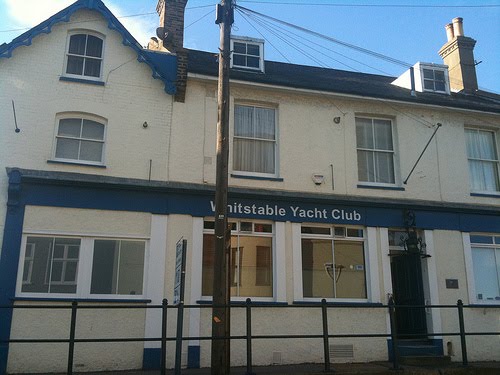
Whtistable Yacht Clup extended a warm welcome to the sailors


Clodia onWhitsable beach


Looking forward

all photos courtesy Giacomo DiStefano


Our Man On (about) the River, Giacomo DiStefano, is poised to begin what could prove to be the most challenging leg of his voyage as he sets out to cross the English Channel. He and his mate Jacopo Epis are currently in Whitstable, waiting on weather and a touch of bronchitis to clear. Remember this is in a 19' lug rigged open boat. The channel can get ornery, but the boat has a north sea viking heritage and Iain Oughtred's boats have a great reputation for seaworthiness, like their progenitors. It will be interesting to see how Giacomo and his Ness Yawl fare across the channel. Stay tuned here. Read all my previous posts on Giacomo's project here.

Sunday, April 11, 2010

News of Windvinder


Windvinder at sea


and here


Wipke rode the back of Windvinder for about 300 miles on the open sea.


She returned to land aboard this large outrigger canoe, a tuna fishing vessel.


Wipke and a local islander making a new tail fin for the Windvinder


Others have been inspired to build their own Windvinder's and set them free on the open sea. These 'offspring' have been dubbed 'Yellowfin', after the first new vessel, seen here, with yellow 'sails' or wings.

Wipke writes:

Marianas

"The strange thing about the Guam reports is that they do not contradict each other. And they come from very different phone numbers. Even from different countries! After all, it’s not so impossible that some kind of Windvinder is underway there. Two old canoes are easy to find, make them watertight, put two beams in between and a single-shaft windmill drive, and that’s it. The single shaft Windvinder doesn’t even need a keel or a center board. As long as it is very small, it can be really easy. Well, nobody has said that a Windvinder has to be big! Maybe the smallest ones have the biggest chance to survive…

The problem is the shaft. Wings could even be made from plywood, for a small six-blade windmill, but the shaft…? Bamboo doesn’t work, I have tried it. Not even for a one meter model. You need something really straight. But the islanders are masters in improvisation…

The more interesting question is, if the Mariana Windvinder really exists, how did he jump there? Most probably he is born north of the typhoon tracks. Or he is incredibly lucky; or both. But some connection with the original Windvinder must exist, because he seems to have our phone number on board. This contact number is not published on this website or anywhere else, it's only written on the Windvinder - and his descendants.
"


"Possible construction of the Mariana Windvinder, as described in the various reports of the past months: Two old canoes connected with bamboo spars. Windmill and propeller sit on the same shaft, no gearbox is necessary.


The windmill with six sails is not the most effective and certainly not the most storm proof solution, but no other windmill can be repaired or replaced so easily, without any special tools or knowledge. Bamboo and some rice sacks can be found anywhere.

The use of simple sails can be a good way to try out how much sail area is actually needed to propel the vessel against the wind. The sails can be reefed easily by furling them partly or completely around the bamboo.

It's also possible to use only three of the six sails. This could explain why some reports mention "three wings" and others "many"."


This drawing is a conjecture by Wipke based on reports of a 'sail wheel' as the means of propulsion for the Yellowfin.


Yellowfin sighting.

all photos and other materials courtesy Wipke Iwersen


This amazing story just gets better. I thought of Wipke Iwersen and her Windvinder project recently and wondered how things were progressing. So I wrote to Wipke and now she as replied. (Some of my long time reader may recall my earlier article on Windvinder, found here). Apparently, the Windvinder is doing well and Wipke and her team have recieved many reports of sightings, some with photos. He has needed some repair here and there, and recently wipke travelled to the South Seas to complete ome extensive repair work that was beyond what the locals could reasonably be expected to complete. She reports:

"I'm just back: 3 months in Oceania - repairing Windvinder and leaving him on the open sea again. This was not planned - but that's life! Windvinder was on a little island; fishermen had brought him there. Normally I don't hear of these repair-stops at the islands, or only when he is already gone again. (Mail on paper...) But this time they phoned me; the gearbox was broken, and that was something they could not repair on the island. So I took the opportunity to see and help him one more time - very probably the last time! But who knows...

Except for the corrupt officials, the islanders were very nice people. We had a great time, doing all the repairs together. A fantastic launching fiesta, some hundreds of miles of sea trials and a really moving Bon Voyage ceremony when we finally left Windvinder alone again, in the middle of the ocean. I went back to the land with a local tuna fishing vessel, a big outrigger canoe - after some 300 miles on the back of the Windvinder. Unbelievable trip...

There are even new Windfinders - that is REALLY great. Some bigger, some smaller - simple bamboo constructions, but very fast and very seaworthy. Powered and steered by nothing but wind. They have sails instead of epoxy wings. I had heard of them already last year; there were several sightings around the Marianas. But no photos, at that time. (How many fishermen bring a camera for a fishing trip in their outrigger canoe...?) I could only imagine what they could be... (I put some sketches on the Windvinder-website.)
Now I have finally seen them! They are wonderful. The people call them Yellowfin, after the first one who was seen in Southeast Asia, with yellow sails. Definitely the future of the species Windvinder...
A small one was even built at sea by one of the fishermen on our canoe, after we had left the big Windvinder. (There was no material on board to build a bigger one...)
He blessed his boat with the blood of a Yellowfin tuna and left it alone on the ocean."

You can follow up on this fascinating work of art,
with many more photos and reports, at the Windvinder website. Wipke plans to begin an Expedition to the Origins of the Wind late this summer aboard Thor, a classis wooden yawl about 50', I'd guess. She's looking for crew for the journey, "The voyage goes from the North Sea to the North Sea, with a detour around the world.
Starting summer 2010.

CREW WANTED
Requirements:
We need creative, enthusiastic, seaworthy people with practical and improvisation skills
People must have good English skills, any additional languages are an advantage
Boatbuilders, aerodynamicists, navigators, oceanographers and anthropologists – graduates or not – are especially welcome
but above all: only experienced sailors!
(in other words, people who know and respect the sea.)"

If you are interested, there is an email address on her website.

Saturday, February 20, 2010

Bernard Smith 1910-2010


Cover of "The 40 Knot Sailboat"


Bernard Smith
Courtesy Mr. Smith's Amazing Sailboats


Full size trials
Courtesy Mr. Smith's Amazing Sailboats


Courtesy ArtFormFunction


Bernard Smith passed away recently at the sprightly young age of 99. He was a tireless innovator, inventor and experimenter. Dubbed 'sailing's rocket scientist' his designs were instrumental in pushing the sailing envelope. I've written about him before, and his discoveries inspired many, including the builders of the visionary Vestas Sailrocket. His inquiring, restless mind led him to investigate many lines of inquiry, as his wife said, ' he was interested in everything'.

Thanks, Bernard.

There's an extensive bio/eulogy written by Frank Delano for fredericksburg.com here.

Sunday, February 7, 2010

Man on the River, by fair means


Giacomo and the Ness Yawl somewhere along the Po.


Roland Poltock in the Art Waiting Room at Lago


Roland at his work table


Shaping planks


The molds set up in the Art Waiting Room


Silvio wields a Japanese saw


all photos courtesy Giacomo Stefano


Giacomo De Stefano was introduced to me by Michael Bogoger of DoryMan. Michael asked if I'd be interested in writing about Giacomo (as he has) and helping him along in his mission. My answer was an enthusiastic yes, but then other things...so, finally, here it is. My apologies to Giacomo for the delay.
Giacomo is planning a voyage from London to Istanbul via an Oughtred Ness yawl, sailing and rowing. His goal is to raise awareness on several fronts, but most notably clean water, low impact transportation and the destructive effects of global tourism. He made a similiar voyage last year, also in a Ness yawl, down the river Po. I've had a little correspondence w/Giacomo and I do believe he possesses the passion, intensity and poetry of a true visionary. In his own words:

"According to WTO data published in the report, Changes in Leisure Time: The Impact of Tourism*, since 1998 tourism has become the largest industry on the planet. Nothing produces more, consumes more, ejects more and wastes more. Mass tourism, the real monster, develops at a very fast rate. Is there a way ot traveling, experiencing, and eating without eroding environments and cultures? Is there a way to bring a sustainable, local economy to the river sides society? My name is Giacomo De Stefano, and I am a traveler, a man who is looking for
new ways of dealing with our complex reality. I live on a boat in Venice. I row and sail, with little or no money. With less I try do more. I want to row and sail, on a little boat from London to Istanbul. I am not alone. My colleagues and I are a multi-ethnic, multi-lingual group, and I believe we and you can be of service to each other. You can learn more about us on our web site
unaltropo.com. I am, with the help of some good friends, organizing this journey called By Fair
Means, North sea to Black Sea, to help us save two great rivers and demonstrate a way of intelligent tourism."

The photos above represent the current progress toward Giacomo's goal. Shipwright Roland Poltock and his friend Silvio have set up shop in the lobby of Lago, a Venetian design firm. The lobby is synonymous with an art gallery aptly named The Art Waiting Room where the firm brings in artists to show pieces related to waiting. "Art Waiting Room is a container of stimuli to change the experience of waiting in Lago.Inside the waiting room, young artists reinterpret in ever different content to wait. This a project in collaboration with the Foundation March." Or as Nicolo Zago explains on DoryMan's blog: "Of course as you know, our reception area has now become the famous "Art Waiting Room" where we host live installations and performances, but until now we have never seen anything like this." Thus the building of the new Ness yawl becomes a sort of performance piece. In point of fact I would label the whole of Giacomo's oeuvre as performance art, a very broad work of art encompassing not only the aesthetic but also the social, the political, the environmental and the spiritual realms. Indeed, I believe it is a gesamtkunstwerk. (Please, if you don't know what this means, link to the definition!)

Giacomo seems very open, gracious and generous, he's invited Michael and I , and I'm sure many others, to participate in his voyage, and contribute by whatever means available, be it physical, logistical, media related or financial. Find out more at his website Un altro Po.

I asked Giacomo why an Iain Oughtred boat as opposed to a more local craft from his home area. His response is enlightening:

"I decided to use a Ness Yawl because is a very versatile boat. I was so lucky that Roland Poltock lent me the boat last year and I felt in love so much with it. Maybe I am a little bit close to my Norwegian origin, dating 1079, in Sicily or maybe I love too much Iain Oughtred..I miss the Venetian boats but they would not be good to sail along the Black Sea coast, and they are too heavy. Only the MAscareta could be good , and light but not seaworthy enough.
The other Italian boat are too heavy, like all the gozzi, to be rowed upstream decently, or hauled by myself in case of danger.

After all the planet is small and I am a citizen of this small planet. We decided to use names. So Norway is here too, in my crazy mind, and Scotland too.

This is part of a circle. About rivers and seas.

DON’T LEAVE THIS PLANET TO THE STUPID. PLEASE"

I dare not add anything more.

Except this: Man on the River's website is now active,

And you can watch the daily progress of the build here.

Sunday, June 14, 2009

Northing, Final, by Creed O'Hanlon

Skellig Michael , courtesy Creed O'Hanlon


Superachillles in the Shetlands, courtesy Creed O'Hanlon


An inaccurate map of Shetland from the Carta Marina of 1529, courtesy Wikipedia


Align Center
Shetland Islands, coutesy Eyefetch


Shetland Islands, coutesy Eyefetch


Shetland Islands, coutesy Eyefetch


Skelligs: 51° 4’ The 'N, 10° 3’'W We plotted a course north from the Skellig Islands, seven nautical miles off the coast of County Kerry, to Achill Head, the westernmost island extremity of County Mayo. It spanned more than 140 nautical miles of open ocean across the wide gulf of the Irish west coast. Off Achill Head, we would alter course again and with luck, carry the prevailing south-westerly wind all the way to Eilean Barraigh, in the Western Isles of Scotland, the so-called Outer Hebrides.
Skellig Michael, or Great Skellig (from the Gaelic “sceilig” or “sea rock”), the largest of the two Skellig Islands, is a forbidding spire of slate-grey rock that thrusts 215 metres straight out of the Atlantic. It looked like the peak of an underwater alp, materialising out of a grey sea mist to loom less than a mile ahead of us as we headed a south-going tidal stream in a light breeze. As we closed it cautiously, we could just make out some of the 670 steps carved into its face to form what the writer Geoffrey Moorhouse once described as “a stairway to heaven”. The steps actually lead to the remains of an abbey established in AD560 by St Fionan, a follower of St Brendan, with whom, legend has it, Fionan sailed from the Aran Islands, further north, all the way across the North Atlantic to Nova Scotia in an open, leather-hulled curragh. It was from the peak of Skellig Michael – where, a reference from the third century recalls, Daire Domhain, the legendary “King of the World”, rested before an epic battle of a year and a day against the giant, Finn McCool (Fionn mac Cumhal), and the Fianna, a band of noble, bardic warriors – that St Patrick, aided by an apparition of the archangel St Michael, banished the last venomous snakes from Ireland for all time.
Skellig Michael’s desolate grey slopes are pocked with crude, igloo-like hovels – the rough-hewn stone walls are nearly a metre thick – and small cells carved into almost sheer rock faces. There, for 600 years, hermitic monks managed to eke out a hard-scrabble existence comprising prayer, scholarship and the routine chores of survival.
We ghosted between the ragged peaks of Great and Small Skellig, stood out to sea. Another few hours brought the coast of County Galway abeam, a green-black smear low on the eastern horizon. Here, with a simple running fix plotted on a chart in pencil, I closed the circle of a voyage that had began in the 1850s, when both my paternal great-great-grandparents and their families sailed from these shores to Portland in Victoria. None was a seafarer, and the long voyages they made aboard three-masted sailing ships, south through the Atlantic and east about the Cape of Good Hope to run hard before the relentless gales and high seas of the Roaring Forties, were likely the first time any of them had ever ventured on the ocean. Up to their eyes in debt as tenants on small, rural lease holdings, near inland villages where their descendants still live today, they must have clung to the hope that their new lives as free settlers – as goldminers, farmers, graziers and policemen – in what was, not long before, just a far-flung English penal colony, would be better than the ones they had left behind.
My reasons for returning – and for sailing even further northwards, to islands long abandoned by whole communities that, after several generations, were finally defeated by the isolation and hardship of these unsheltered, gale-lashed shores – were less clear. My voyage was a voyage of hope and discovery, not to new lands, but to lands so old that it was as if there was never a time in which they had been unknown, unexplored. And somewhere between one distant landfall and the next, there was a vague chance the past might help me to decipher an incomprehensible present.


Monday, May 4, 2009

Stewart Brand Liveaboard in Sausalito

Tugboat Mirene, 1912


Stewart Brand


Stewart Brand, mastermind behind the Whole Earth Catalog,  an author concerned with subjects as varied as cybernetics and the evolution of buildings who describes himself as a finder(of ideas) and a founder (of foundations and such), a perfectly 'Brandian' turn of phrase,  showed up in an email from my brother John today. Originally an article in the NY Times by Edward Lewine, it came to me as a post  on South Williard . Stewarts current project is called the Long Now Foundation and is dedicated to fostering long term vision and thinking as opposed to the faster/cheaper paradigm which  seems to (still) be the vision of most business and political thought. Stewart and his thought and projects, WEC in particular have been a huge influence in my life. Enjoy this: 

Brand lives on Mirene, a tugboat moored in Sausalito, on the San Francisco Bay.

By EDWARD LEWINE
NY Times Published: April 15, 2009

Deceased 1960s pal he’d like to see again: Abbie Hoffman. He was brilliant and a card and dangerous to know and delightful in every way.

His best line: In 1966 I had buttons made with the paranoid-sounding slogan, “Why haven’t we seen a photograph of the whole Earth yet?” Well, we got the photos from NASA in 1969.

Moving house: The Mirene is a working, 64-foot-long tugboat built in 1912. We take the boat out cruising from time to time. We turned the wheelhouse and skipper’s cabin into our bedroom, with two rooms and a bath below.

Why a boat: The main thing is our houseboat community here, which is exceptionally congenial. The boat is inexpensive to live on, and you have no problem with earthquakes, wildfires or rising sea levels due to global warming.

Green living: I didn’t choose the boat because it’s green, but it is. It doesn’t take much to heat 450 square feet. Cooling is no issue on the water. We have solar panels and a demand water heater and use biodiesel fuel when we cruise.

Morning routine: Get up at 6:30 or 7:00 a.m. The trip from the bedroom involves going down a ladder outside. I breakfast in the galley and then go off to work.

Job description: I design stuff; I start stuff; I found stuff. On the passport I put “writer.”

Bad trip: That was my first trip. I had 400 micrograms of LSD under quite clinical circumstances at a psychological research institute in Menlo Park, Calif. It was in a white room with therapists sitting around.

Good trip: In 1963 or ’64 I showed up at the door of Ken Kesey, the novelist and LSD evangelist. I was involved in Kesey’s Acid Tests, which were happenings where LSD made its way around and everyone was there to entertain each other.

Acid Test memento: I have my Acid Test graduation diploma. The conceit was, “Can you pass the acid test?” Mine was signed by Neal Cassady, who inspired Kesey and was the model for Dean Moriarty in Jack Kerouac’s “On the Road.”

On the wagon: Since 1969 I haven’t used psychedelics. I realized I’d seen all I needed to see.

Drug of choice: I’m stoned right now on two cups of coffee. I’m 70, and the easiest way to young-up your mind is to drink caffeine.

Worst thing about the 1960s: Let’s see. I made the mistake of being married during the sexual revolution. Nice marriage; inopportune timing.

Pets: We had cats, but we had to put them down. That was horrifying, and we replaced them with a life-size stuffed tiger.

Home office: I work in a landlocked fishing boat named the Mary Heartline, which sits about 100 yards from the tugboat in a parking lot. It looks like a Victorian cottage.

Item you need on a tugboat: You’ll always be glad that someone has stolen a shopping cart, so you can get stuff from your car to your boat.

Controversial stand: That technology can be green. The book I just finished, “Whole Earth Discipline,” has chapters on why nuclear is green, cities are green, genetic engineering is green. The romantic nature-is-perfect approach is just horse exhaust.

Back to the WELL: I founded the WELL, a pioneering online community, in 1985, with Larry Brilliant and some others. The name is short for Whole Earth ’Lectronic Link. I have the American Heritage Dictionary I used to find the name.

Exercise routine: I hike Mount Tamalpais.

Evening routine: My wife, Ryan Phelan, and I tend to go to restaurants or throw together a dinner around 9 p.m. I’ll read a novel or a comic. We’ll take a bath together and be in bed by 11:30.

Favorite gadget: I have this memo-keeping device that must be 75 years old. It’s from the house I grew up in in Illinois. It uses rolls of adding-machine paper — which you can still get — and you write on it and tear the paper off.

Obsession: Getting rid of alien, invasive plants. I bear down on this form of pampas grass that comes from South America and has no business in California.

Art collection: We don’t have room for much. We do have a 1.5-inch-long enamel drawing of the Mirene under fireworks in the bay.

What he drives: A Land Rover LR2. As soon as there’s a good hybrid S.U.V., we’ll get one. We need a mountain vehicle.

Favorite item in boat: I have the table at which Otis Redding reportedly wrote “Dock of the Bay.” An antiques dealer in Sausalito obtained it. Everyone likes to believe the legend.

Native American memorabilia: I used to be a member of the Native American Church. I have my old peyote-ritual gear: the feather box, eagle-bone whistle and tortoise-shell rattle. That’s for use with peyote, a spineless cactus that gives you an eight-hour trip.

Favorite vacation: We got a weekend place on the Petaluma River. It is a dead dairy farm, and that is where we are every weekend.

Always in fridge: Root beer and Häagen-Dazs vanilla ice cream. I love root-beer floats.

Next big purchase: Hearing aids. That is going to be $2,000 or more.

At age 5, he wanted to be: A veterinarian. As an early teenager I wanted to fight forest fires.

Current project: With the Long Now Foundation, I am helping to build a 10,000-year clock inside a mountain in Nevada. We are trying to get people to think long-term, because civilization’s shortening attention span is mismatched with the pace of environmental problems.

MAY 2ND, 2009

Friday, March 6, 2009

Windvinder, Expedition to the Origin of the Wind


Windvinder 2005


Construction


Turbine blades


Windvinder launched


Windvinder sailing


The Bridge, an earlier project

all photographs courtesy Wipke  Iwersen


This is an amazing project which crosses the boundaries of contemporary art, science, anti science, anthropology, philosophy and fiction. In a sense it is a real fiction, a concrete dream, a three dimensional wish. Artist Wipke Iwersen has generated a Borges like expedition that almost defies explanation. The Windvinder is immensely beautiful and seems well designed to achieve it's goal, while that goal itself is nebulous and slippery. Wipke designed and built the craft, a sort of trimaran, which seems to be based on proa(Wipke calls the boat he, in typical proa fashion) and traditional kayak skin on frame building technology. It's method of propulsion is a wind turbine. At first glance I thought this was a sort of joke, but really, I know better, so I dug in and found what seems to be a profound/trivial paradox, and a lot of fun. I won't say anymore, because this kind of art is different for everyone who encounters it, and I've already colored your perceptions too much.  But I will leave you with some of the artists words:

"Windvinder is a seafaring challenge. A challenge to everything that has always remained the same – the suggestion of a new possibility. And this is exactly what this journey is about: this pull from beyond the horizon.
 
What makes us move? What drives us to push back our boundaries, further and further, beyond what is necessary or even seems possible? Why do people risk their lives to reach the North Pole, or the moon? Nobody would want to live there.
But what then do they want?

Windvinder does not travel from A to B; he is on a voyage to explore what drives him, towards the source of that invisible power that keeps his wings moving."
 

On reflection, I feel this is an important work and urge anyone capable of doing so to support this artist.
I will add one interesting note, one of the sponsors of the project is Dyson, Baidarka & Co.  

ps: added Saturday, 3/7/09; Bjorn Thommasson has also written about this project here.

I should also add that I learned of this project from Carl Cramer in the Woodenboat e-newsletter for March 2009. Thanks Carl.

Saturday, October 11, 2008

Oceanus

Creed O'Hanlon sent me a two year old essay saying he thought it might interest me. It does. So much that I'd like to share it with you. Note the title. I also recommend you take a look at his four part series Northing. Here's the earlier piece, originally published in the Griffith Review:


Seven-Tenths:

Random Notes From The Deep

An essay by Creed O’Hanlon

“One way to open your eyes is to ask yourself, 'What if I had never seen this before? What if I knew I would never see it again?’ “

- Rachel Carson, author and ecologist

-

1.

The first time I ever crossed an ocean under sail, I had to fly across it first.

It was 1979. I was one of a small crew of three bound for Fort Lauderdale, on the south-east coast of Florida, from where we were to deliver a forty-five-foot timber ketch to Malaga in Spain. The owner, an Englishman who had made his money dealing in second-hand aircraft, had secured our services just six weeks before the beginning of the Caribbean hurricane season. He had booked us on the cheapest flights he could find: an Air India service to New York from London’s Gatwick Airport, connecting with some bankrupt, no-name shuttle service to Miami. The initial flight followed a great circle route looping over the Arctic rim of the North Atlantic. The early Spring skies were clear. I had six hours to contemplate what a voyage across all that empty water would be like.

From 10,000 metres, only faint specks of white, the crests of the largest, wind-blown waves, glinted on the pale grey-blue expanse. When a large ship was sighted, every few hundred miles, it was like a tiny, russet insect. Nothing smaller – neither an iceberg nor a yacht similar in size to the one we would be sailing – was visible. It was hard to imagine what living just a few feet above the ocean’s surface, far from land, for nearly a month would be like, let alone the precarious imbalance of weather, seamanship, navigation, endurance, and a watertight hull on which survival depended. All I could think about was the deep, the miles of cold dark water that clawed at a vessel’s keel from the ocean’s bottom: to me, the thought of this was more disturbing than the intractable vastness of its surface, whatever the state of its swell, the speed of its shifting tidal streams and currents, and the unfettered strength of the wind.

A few days later, I sailed beyond the edge of the North American continental shelf, where the line of soundings plunged from less than a couple of hundred metres to a couple of thousand. As the last smudge of low-lying land slid beneath the horizon, I stifled a sudden, atavistic fear of the sea by reducing its daunting reality to statistics. The few tons of salt water my vessel displaced – right there, on a western eddy of the Gulf Stream, where a tentative ‘x’ in soft pencil ‘fixed’ the position of my departure east-bound across the Atlantic – were a minute fraction of the 1.37 billion cubic kilometres that covered roughly 71 per cent of the planet, an area of around 361 million square kilometres. On average, the world’s oceans were around 3,720 metres deep, although the Marianas Trench in the North-West Pacific was more than three times deeper, at 11,033 metres. The numbers were as abstract and as barely imaginable as the British Admiralty metric charts on which land was always a flat, bilious yellow, inshore waters an insipid blue, and seas beyond the 200 metres line of soundings white.


2.

Except maybe in those moments when we are immersed in it, or floating on it, the sea’s expanse is almost incomprehensible. We are so awed by its power that we ascribe aspects of human mood and even sentience to the limitless mutability of its surface state, especially during those episodes when it rises to inflict its force – note here the ready use of an emotive verb inferring mindfulness, even cruel intention – on us well above the high water mark that is the nominal DMZ between a marine environment and ‘dry’ land. No matter how much we love the sea, very few of us feel for its alien and uncompliant ecology the same intense intimacy, that visceral sense of connectedness, of elemental dependence, that we do for the landscapes of our natural environment. It has something to do with uncertainty, a fear not so much of the unknown as the unknowable. So much of the sea is invisible to us. Its most spectacular topography is unreachable, lying at depths well beyond the capacity of humans to reach without expensive and cumbersome mechanical support. Still, the several tens of millions of acres of dense submarine flora close to well-populated shores on every continent are as unknown and undocumented as the tens of thousands of miles of vertiginous oceanic trenches and mountain ranges that surpass the Himalayas in scale. We often glimpse the mammals, reptiles, fish, crustaceans, corals, and anenomes that populate inshore waters – we even like to claim a near-mystical empathy with those chimeric species of large, pelagic mammals such as whale and dolphin – but overall, our relationship with them is defined less by curiosity or concern than by a ruthless, industrialised harvesting that has turned humans into its most voracious predators.

Again, whatever uneasiness we harbour about this is assuaged by the oceans’ unrestrainable spill. From the air, where most landlubbers get their first view of open ocean unbounded by land, it appears too big and indomitable to be despoiled by mere human activity. Looking seaward from a heavily urbanised stretch of coast like Long Beach, California, or Yokohama, Japan, or closer to home, Sydney, the sea’s shimmering surface appears clean and unpolluted even beneath orange-tinted skies laden with dust, smoke, and chemical emissions. And yet from the traces of mercury that taint the flesh of nearly every species of edible fish found in the world’s major ocean fisheries to the dioxyn that has poisoned the marine food chain of Sydney Harbour (the insidious residue of a careless American-owned chemical plant that once operated on its shores), the health of the marine environment is failing. The effects of atmospheric warming might simply finish it off, starting with its most fragile creatures and habitats.

In the tropics, a mean rise of just a couple of degrees in water temperature causes coral to stress and to expel nourishing algae. It becomes bleached and, over time, will wither and die. Less than six years ago, at the International Coral Reef Symposium held in Bali, Indonesia, local researchers noted that about 27 per cent of the world's coral reefs – environments that support 10 per cent of the world’s fisheries – had been destroyed not just by rising ocean temperatures but by careless fishing, harbour dredging, coral mining, coastal deforestation and development, agricultural runoff, and so-called eco-tourism. Across the Indian Ocean, from the west coast of Africa to southern India, as much as 70 per cent of the coral population had bleached and died. If ocean warming increases, coral will be extinct in most parts of the world within 20 years.

Meanwhile, increased ocean temperatures are killing plankton, the marine food chain’s most elemental organisms, in such numbers that areas of decaying plankton are suffocating the ocean surface, leaching it of oxygen and killing other, much larger forms of marine life. Plankton that are not dying are retreating to cooler waters: according to a report two years ago in Z, a magazine published in Woods Hole, Massachusetts, “scientists at the Sir Alistair Hardy Foundation for Ocean Science in Plymouth, England, which has been monitoring plankton growth in the North Sea for more than 70 years, have said that an unprecedented warming of the North Sea has driven plankton hundreds of miles to the north. They have been replaced by smaller, warm-water species that are less nutritious.

Around the frozen continent of Antarctica, a warmer Southern Ocean has caused large areas of ‘permanent’ sea ice to recede. As it melts, algae that grow on its underside are becoming scarce. They are a food source for krill, which are in turn, the main food source for contracting populations of Blue whales, the largest mammals on earth, and smaller Minke whales and Adelie penguins. Exacerbating the crisis, another food source for krill, phytoplankton, is being consumed at a critical rate by tiny jellyfish-like animals, known as salp, which have begun to thrive in the now ice-free waters. According to a study conducted by the British Antarctic Survey, published in 2004, krill numbers have declined 80 per cent in less than 30 years.


3.

A quarter of a century before reports and statistics arguing the likelihood of a catastrophic deterioration of the marine environment within a generation began to pile up like past due bills on the desks of politicians, journalists, and academics, there was already plenty of anecdotal evidence that the oceans were not as pristine as they once were. During the half a dozen years during late Seventies and early Eighties that I worked as a professional seaman on vessels on both sides of the North Atlantic Ocean, on the Baltic, North, Mediterranean and Caribbean Seas, and along the Pacific coasts of the United States and Mexico, dockside mutterings about the lack of sightings of pelagic predators such as tiger sharks or of large pods of migrating whales or dolphins, or the curious disappearance of flying fish were common. Some noted that the North Atlantic’s nocturnal bioluminescence, the phosporescent shimmer of microscopic organisms such as plankton floating just below the surface, appeared to be fading, even under clear, moonlit skies. Yachtsmen and the crews of small coasters and fishing vessels worried about being sunk by half-submerged steel containers; thousands were lost overboard every year by merchant ships during bad weather.

Occasionally, one of us would bear witness to a small catastrophe. In 1977, I was on watch aboard a sea-going tug as it approached the Bay of Naples at the end of a two-day passage from Malaga in Spain when a dense pod of beak-nosed common dolphin surfaced about half a kilometre off the starboard bow. In a frenetic sequence of arcing leaps and splash-downs that churned the glassy swell into white water, they began to lead us between the islands of Ischia and Capri towards the Italian mainland. A few miles from Naples itself, the blue water turned brown. A pair of the dolphins leapt high out of the water and with a high-pitched squeal, fell backwards into it again. They didn’t swim but instead, bobbed lifelessly in the low swell. Several more dolphins thrashed on the surface around them, then rolled onto their backs and lay still. The rest of the pod swerved away to swim quickly seaward, no longer leaping. A few minutes later, the tug sailed past their dead, wallowing around a greasy slick of foul-smelling chemical less than a couple of hundred metres in diameter.

There are very few common dolphins left in the Mediterranean now. Once the most significant population of marine mammals in that part of the world, they have been all but wiped out through the toxic contamination of their habitat by industrial chemicals, or the reduction of their food sources through over-fishing. Hundreds have also been destroyed as by-catch in mass tuna kills (known as mattanze) around the coasts of Sicily or in commercial gill-nets.


4.

The sea’s natural inhabitants are not the only ones under threat. With the increasing instability of seasonal weather systems caused by the phenomena known as El Niño and La Niña, and localised fluctuations in ocean temperatures and atmospheric pressure, the intensity of which might change as a result of global warming, those who make their living on the sea and the increasing numbers of amateurs who set out on trans-oceanic passages in small yachts (aided by satellite global positioning systems that obviate the need for old-fashioned tools such as a sextant and a chronometer) are at greater risk than ever before from violent, unpredictable weather. During the West Atlantic hurricane season in 2005, 27 tropical storms were named by the United States’ National Oceanic and Atmospheric Administration, among them 15 hurricanes. Three of the hurricanes were devastating Category Five storms, and at least three of the tropical storms misbehaved in ways that were unsettling to sailors used to the general predictability of weather systems in the North Atlantic’s sub-tropical latitudes. Tropical storms Epsilon and Zeta sprung up outside the traditional hurricane season, the latter on December 30th, exactly a month after the season’s official end. Another late season tropical storm, Delta, wandered eastward across the Atlantic to batter the Canary Islands, off the coast of Morocco – a two-thousand-mile detour from the usual track of such depressions north along the eastern seaboard of the United States or across the Florida panhandle.

Even in northern latitudes, anecdotal evidence suggests that winds are blowing harder. The nature of the sea itself might also be changing. There are concerns, amplified by senior European scientists, that the fast-moving Gulf Stream that carries warm water in an arc across the North Atlantic – causing winter temperatures in Reykjavik, Iceland, to be a little higher than in New York, and tempering the worst effects of the high latitude depressions that track across Ireland and the British Isles throughout the year – is beginning to slow. The mooted long-term effect of this – Northern Europe beset by a ‘big freeze’ that could persist for several centuries – is the opposite of what is predicted if the Arctic’s sea ice continues to recede and the slow melt of Greenland’s giant glaciers persists or worse (but likely), accelerates.

Fifty-five years ago, the late Rachel Carson, one of America’s first environmental activists, assembled a series of her writings on the nature of the sea in a best-selling book, The Sea Around Us. Its tone is somewhat over-ripe by today’s standard, and its scientific facts have become, inevitably, amusing anachronisms, but the author’s confidence that the sheer size and volume of the sea could protect it from the worst that future humans would inflict on it was, for an American post-war generation steeped in the political and social idealism of Truman’s Fair Deal, and a desire for renewal, compelling. “For the sea as a whole, the alternation of day and night, the passage of the seasons, the procession of the years, are lost in its vastness, obliterated in its own changeless eternity,” she wrote. The trouble is, Ms. Carson’s confidence was inspired by a more innocent time. Today, we are numb to the stark symptoms of stress and deterioration that are apparent in nearly every ecosystem. We pay lip service to doing what it takes to alleviate them, let alone fix them, even as they threaten to upend the comfortable, affluent tedium of our surburban everyday (in Australia, just as elsewhere in the developed world, we have become less and less concerned with the effects they are already having in poorer, less well equipped parts of the world).

Then again, there is, in the closing lines of Ms. Carson’s book, unintended clues to another, grimmer scenario: “... [the sea] encompasses all the dim origins of life and receives in the end, after, it may be, many transmutations, the dead husks of that same life. For all at last return to the sea – to Oceanus, the ocean river, the ever-flowing stream of time, the beginning and the end.”

Sydney, 2006


Top and bottom photos courtesy Creed O'Hanlon,
Dolphins from Oceanus Magazine
Melting iceberg from Canadian photographer David Burdeny
Ocean trash from Treehugger