 I find this old Chesapeake Deadrise one of the most elegant creations I have ever seen, even in her current state and am drawn to the CBMM 'small' boat shed on every visit.
 I am also drawn to the apprentice boatshop, there's always something of interest there.
This years interest was a Finger Lakes trout fishing boat, from Lake Keuka, brought in by Dan Sutherland, head boatbuilder at the museum, for a bit of repair/restoration.
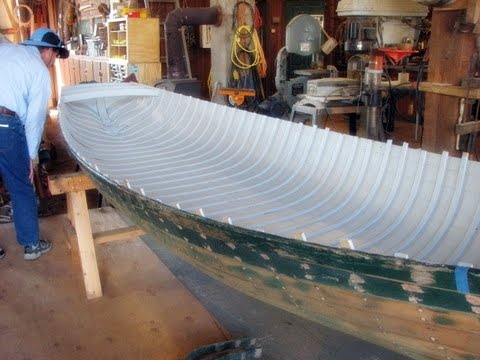
The trout boat is having her frames replaced in white oak, with new bronze fastenings replacing the sick old iron ones, the original northern white cedar planks are being retained. Thanks to John Hutchinson, the apprentice on duty, for a nice chat about her.
 One of the nicest boats of the day was this Herreschoff Coquina, Calico Jack,
brought down from the Springfield MA area by Scott LaVertue. My friend, new to boats, declared this her favorite boat of the day. I'd say she has a good eye.

Pulling into the dock looking just great, Coqina's seem to be meticulously cared for by their owners, who all seem to share her maker's opinion off her, that being Nathaniel Herreschoff himelf. Nat declared Coquina to be his favorite boat.

She's quite lovely

Here's Scott's dad Bob LaVertue cleaning his glasses after a slight mishap (capsize) with Pretty Jane during the all craft free for all 'race'. Bob is the genius behind the Springfield Fan & Centerboard Co. Long time sailing canoe fan, Bob commissioned Everett Smith to build Twilight years ago, in the 1970's.

Here's Bob's friend Dan Sutherland, another sailing canoe aficionado out of the Clayton, NY school. Dan is resident at the CBMM as head boatbuilder.

Dan's sailing canoe is looking a little more canoeish than most decked sailing canoes.
Formerly owner of of Sutherland Boat & Coach in Hammondsport, NY, I have an inkling that Dan is one of the foremost builders of decked sailing canoes today. For instance, see this.

Buna Mon I Ya is a Crotch Island Pinkey and a perennial participant here.
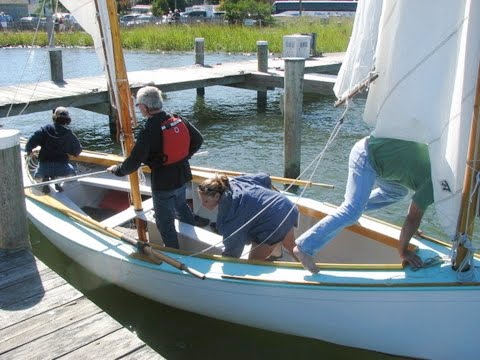
Built in 1974 by her designer Peter Van Dine, he's owned by George and Marla Surgent

Pete Lesher with a bit of heritage. Pete's the family custodian for this boat originally built by his great uncle, if I got it right.Built to a design by George Washington Sears, aka 'Old Nessmuk' , guru of the Adirondacks and the return to the woods movement around the turn of the 19th C. Sears, if I'm not mistaken, based his work on the lines of Rushton's Sairy Gamp.
This canoe was built by none other than Mr. C. Lowndes Johnson, the creator of the Comet Class boat.

Pete is the Curator at the CBMM, nd here he's about to launch his canoe with the help of co-worker Dan Sutherland

A delicate, almost ephemeral design, yet sound enough
 for Pete to venture out with his very young daughter
There's a museum installation which recreates the style of camping pursued by the canoe enthusiasts of that time, and background on an extended cruise undertaken by Lowndes Johnson & co. Pete has said he will forward me some of the logs from that journey, watch for the story here.

C. Lowndes Johnson's class boat beauty, the Comet, intended to be a smaller version of the Star class.

Tim Shaw, author of Chine Blog, looking happy to have his skin on frame outrigger canoe AL DEMANY CHIMAN in the water.

Mike Wick showed up this year with his lovely Pepita, always a favorite.


Barry Long's Melonseed Caesura, one of a pair he's building for himself and his better half. I'm guessing the first one finished is his, at least until the second improves on the lessons learned on the first. Both boats are almost finished, and the workmanship more than impressive. Barry has been writing a blog about his build of the two boats which is hands down the best build blog I've ever seen, informative and entertaining, and that's not an oxymoron.

Another Melonseed, Kandid, built by Barry's friend Tim Thatcher for his parents. Tim flew in from CO. for the fest.

On the road leading into the museum , adjacent to the camping area, I found this lovely creature which I'm guessing is a small Chesapeake Log Canoe, and if not a local sharpie type...can anyone help?

Certainly she's fitted out in a most serious manner, notice the holes drilled in the floors.
 Another mystery boat, again appears to be a traditional Chesapeake type. Look at that sloped mast! Taken from the dock at the Crab Claw while enjoying steamed shrimp, local microbrew, and the company of my companion for the day. What a good day it was.
All photos Thomas Armstrong
The 28th Mid Atlantic Small Craft festival was only my third. It's a thoroughly enjoyable event. Relaxed and friendly, Saturday is the public day but this is really a four day messabout staring Thursday and running through Sunday for most participants. I had hoped to get down there on Friday and camp, but sadly it was not to be, hopefully next year. Many of the participants come every year and the event has the flavor of a large family reunion, with camaraderie winning out over competition, though the race is seriously contested. It's a beautiful sight, with 80+ small/ish boats of varied description out in the river at once. Not there at the race's start, I was able to get photos of several of the boats as they returned from the melee.
I've connected with several friends at this event, its a great way to meet folks with a shared interest, in a lovely setting on the Miles River. The host is the Chesapeake Bay Maritime Museum and the museums collections are open to visitors. Both the museum and the charming historic town of St. Michaels are worth the trip, any time of the year.
Mike Wick, member of the Delaware River TSCA and a friend, (see his Pepita above) sent me the race results:
Race Results for sailing race at MASCF 2010 Thanks to David & Kathy Cockey
Finish Order Owner Type Class
I've connected with several friends at this event, its a great way to meet folks with a shared interest, in a lovely setting on the Miles River. The host is the Chesapeake Bay Maritime Museum and the museums collections are open to visitors. Both the museum and the charming historic town of St. Michaels are worth the trip, any time of the year.
Mike Wick, member of the Delaware River TSCA and a friend, (see his Pepita above) sent me the race results:
Race Results for sailing race at MASCF 2010 Thanks to David & Kathy Cockey
Finish Order Owner Type Class
NN Al Fittipaldi Thistle !st HP Blue
Marianne Pete Lesher Log Canoe 2nd HP Red
Moth Adam Blackwell Moth 3rd HP White
Black Swan Bill Covert Sail Canoe 1st SC Blue
NN Larry Haff Sail Canoe 2nd SC Red
Mud Hen Ron Gibbs Celebrity 4th HP
Spat Bill McGraw Sharpie (Kirby) 5 HP
Malu Michael Jones Stretch Windmill 1st 2-sail Blue
Pepita Mike Wick 16 ft Melonseed (Brady) 1st 1-sail Blue
NN Andy Slavinskas Blue Jay (S &S) 1st BJ Blue
NN Harold Bernard Glen-L 15 2nd 2-sail Red
Obadiah Pete Peters Marsh Cat (Barto) 2 nd 1-sail Red
Skye David McCullouch
Skinny Swampscott 3rd 2-sail White
Junie Jump Up Turner Matthews Penobscot 17 1st schooner/ 3-sail Blue
NN Dan Sutherland Sailing Canoe 3rd SC White
Buna-Mon-I-Ya Aaron Surgent Crotch Island Pinkey 2nd 3-sail Red
NN George Loos Blue Jay (S & S) 2nd BJ Red
Slip Jig Kevin Brennan Navigator (Welsford) 3rd 3-sail
Baguette Carl Weissinger Baby Sandbagger 4th 2-sail
NN Kevin MacDonald Marsh Cat 3rd 1-sail
NN John Deppa Sailing Canoe 4th SC
Dandy Cat Paul Skalka Handy Cat 4th 1-sail
Catnip Ned Asplundh Marsh Cat (White) 5th 1-sail
Calico Jack Scott Lavertue Coquina (Herreshoff) 5th 2-sail
Whisper Dennis Keener Lug-rig skiff 6th 1-sail
Allegretto Larry Huffman Sea Pearl 6th 2-sail
NN John Guidera Melonseed (Jones) 1st MS Blue
Kandid Tony Thatcher Melonseed (Barto) 2nd MS Red
Crab Skiff Mike Moore Cambridge Skiff 7th 2-sail
2nd Wind Ron Hearon Blue Jay (S & S) 3rd BJ White
Wild Rover Frank Stauss Core Sound 17 8th 2-sail
Stiff Woodie John Allen Sailing Canoe 5th SC
Comfort Doug Oeller Marsh Cat 7th 1-sail
Mystic Charlie Steigerwald Sailing Dinghy 1st small Blue
Dolphin Jon Bornman Marisol skiff 2nd small Red
Sallie Adams Bob Pitt (FMM) Spritsail Sharpie 9th 2-sail
Bonita Marie Cobb DC 10 Sailboat 3rd small White
Utility skiff Jack Mizrahi Dobler 16 8th 1-sail
Whisp Phil Maynard Sharpie (Redmond) 9th 1-sail
Sierra Howell Crim Dinghy 10th 1-sail
NN Bob Lavertue Sailing Canoe 6th SC
NN Pamela Claggett Chesapeake 18 Tri Special
Apple Pie David Kavner Sailing Canoe (Rushton) 7th SC
Hanna Banana John England Skiff (England) 4th small
Sailing Canoe 8th SC
Woodwind John Sandusky Dory 9th 2-sail
Catnip Ron Gryn Catboat ( Gill Smith) 11th 1-sail
Bill Rutherford Peapod 12th 1-sail
Wee Punkin Lacy England Punkin (Thayer) 1st Sq Bow Blue
Kermit Ed Cobb SF Pelican (short) 2nd Sq Bow Red
NN Jim Thayer Punkin 3rd SQ Bow White
Wm Henry Harrison Paul Helbert Sailing Canoe (Storer) 9th SC
Marianne Pete Lesher Log Canoe 2nd HP Red
Moth Adam Blackwell Moth 3rd HP White
Black Swan Bill Covert Sail Canoe 1st SC Blue
NN Larry Haff Sail Canoe 2nd SC Red
Mud Hen Ron Gibbs Celebrity 4th HP
Spat Bill McGraw Sharpie (Kirby) 5 HP
Malu Michael Jones Stretch Windmill 1st 2-sail Blue
Pepita Mike Wick 16 ft Melonseed (Brady) 1st 1-sail Blue
NN Andy Slavinskas Blue Jay (S &S) 1st BJ Blue
NN Harold Bernard Glen-L 15 2nd 2-sail Red
Obadiah Pete Peters Marsh Cat (Barto) 2 nd 1-sail Red
Skye David McCullouch
Skinny Swampscott 3rd 2-sail White
Junie Jump Up Turner Matthews Penobscot 17 1st schooner/ 3-sail Blue
NN Dan Sutherland Sailing Canoe 3rd SC White
Buna-Mon-I-Ya Aaron Surgent Crotch Island Pinkey 2nd 3-sail Red
NN George Loos Blue Jay (S & S) 2nd BJ Red
Slip Jig Kevin Brennan Navigator (Welsford) 3rd 3-sail
Baguette Carl Weissinger Baby Sandbagger 4th 2-sail
NN Kevin MacDonald Marsh Cat 3rd 1-sail
NN John Deppa Sailing Canoe 4th SC
Dandy Cat Paul Skalka Handy Cat 4th 1-sail
Catnip Ned Asplundh Marsh Cat (White) 5th 1-sail
Calico Jack Scott Lavertue Coquina (Herreshoff) 5th 2-sail
Whisper Dennis Keener Lug-rig skiff 6th 1-sail
Allegretto Larry Huffman Sea Pearl 6th 2-sail
NN John Guidera Melonseed (Jones) 1st MS Blue
Kandid Tony Thatcher Melonseed (Barto) 2nd MS Red
Crab Skiff Mike Moore Cambridge Skiff 7th 2-sail
2nd Wind Ron Hearon Blue Jay (S & S) 3rd BJ White
Wild Rover Frank Stauss Core Sound 17 8th 2-sail
Stiff Woodie John Allen Sailing Canoe 5th SC
Comfort Doug Oeller Marsh Cat 7th 1-sail
Mystic Charlie Steigerwald Sailing Dinghy 1st small Blue
Dolphin Jon Bornman Marisol skiff 2nd small Red
Sallie Adams Bob Pitt (FMM) Spritsail Sharpie 9th 2-sail
Bonita Marie Cobb DC 10 Sailboat 3rd small White
Utility skiff Jack Mizrahi Dobler 16 8th 1-sail
Whisp Phil Maynard Sharpie (Redmond) 9th 1-sail
Sierra Howell Crim Dinghy 10th 1-sail
NN Bob Lavertue Sailing Canoe 6th SC
NN Pamela Claggett Chesapeake 18 Tri Special
Apple Pie David Kavner Sailing Canoe (Rushton) 7th SC
Hanna Banana John England Skiff (England) 4th small
Sailing Canoe 8th SC
Woodwind John Sandusky Dory 9th 2-sail
Catnip Ron Gryn Catboat ( Gill Smith) 11th 1-sail
Bill Rutherford Peapod 12th 1-sail
Wee Punkin Lacy England Punkin (Thayer) 1st Sq Bow Blue
Kermit Ed Cobb SF Pelican (short) 2nd Sq Bow Red
NN Jim Thayer Punkin 3rd SQ Bow White
Wm Henry Harrison Paul Helbert Sailing Canoe (Storer) 9th SC




2.JPG)


 Posts
Posts


