Showing posts with label environmental. Show all posts

Friday, February 24, 2012

AK Ilen Restoration part four: Education and the Future


LIMERICK: The Ilen mainmast at the AK Ilen Wooden Boatbuilding School


LIMERICK: An ILEN School Instructor beside an old Kenmare Punt - thelines of this beautiful boat are being recorded so that new punt can be built at some point in the future


SKIBBEREEN: Work continues on the ILEN - here an ILEN Boatyard Shipwright is creating a template in marine play so that the precise shape can be transferred to a block of hardwood


LIMERICK: An ILEN School Instructor moves rapidly ahead with the construction of a traditional Clare Curach - when all the laths are in place, he will turn the boat over and fit the frame to the gunwhale


SKIBBEREEN: ILEN Shipwrights take a welcome winter break and,in seasonal mood, share a meal in the weeks before Christmas 2011


LIMERICK 2: A trainee ILEN School Instructor plans his next project - great planks of Douglas Fir lie ready behind him for work on the spars and masts of the ILEN


SKIBBEREEN: A Shipwright works inside the timbers of the ILEN's hull - his technical skill and expertise are balanced by the beauty of the form around him


SKIBBEREEN: A Shipwright works on the foot of the ILEN's stem - the early morning light, streaming through the open window, illuminates perfectly what man can do with natural wood


LIMERICK: A young participant in the LIMERICK School absorbed in shaping the end of a lath to fit to the Curach behind him


SKIBBEREEN 6: Shipwrights preparing to fit stanchions on the ILEN's starboard side forward


SKIBBEREEN: A senior ILEN Shipwright giving instructions on how to make a template for a lodging knee


LIMERICK: Seen through a scuttle (a porthole), an ILEN School Instructor checks the internal dimensions of the ILEN's main deckhouse


All photos courtesy the AK Ilen Company


The story of the restoration of the Ilen is not just a story about saving one boat. The Ilen is at the center of the genesis of the AK Ilen Company, but the 'Maritime Adventure' is a living, growing entity, primarily involved in education but also looking broadly ahead to the future with involvement in the marine component of the EU integrated strategy for the Atlantic area. This last will explore the viability of wooden sail powered vessels as a piece of the European coastal economy... more on this later.

The AK Ilen Co. is currently engaged in three major forays.

The Big Boat BuildWorkshops in Baltimore, Cork, see my previous post for an explanation and testimonial.

The AK Ilen Wooden Boat Building School in Limerick. Dr. Martin Kay, a principle of the Co. explained to me how the school works:
"We don't offer programmes, we offer space in which to start the learning adventure. What people do in (the school) is up to them. We help them take stock: we accredit past experience and design pathways forward from vocational to academic achievement. It means that someone who has not succeeded with conventional education can come to us and say "Well I did manage to do that and I found this really interesting." Sometimes people come to us under police guard. Wherever they find themselves is where we start. And we find that their re-engagement in learning is transformational."

And there's a new project on the Aran Island of Inisheer aimed at developing the islanders understanding of their traditional curach and how to build them efficiently. This program will begin in about two months and eventually morph into a local boat building center.

Additionally, last summer the Co. formed a boatbuilding partnership with the Northwest Schoolof Wooden Boat Building. This is essentially an exhange program for instructors. Tim Lee,an instructor at the School was over last summer and will be coming again this year.

Quite recently the Company decided to go into the mobile-classroom-and-workshop business which will work across Munster (initially across Cork, Kerry and Limerick but we shall extend it in time to Waterford, Clare and Tipperary).

I asked Gary MacMahon, Director of the Co. about the formation and function of the Company and he replied on a couple of levels:

"The 'Company' was incorporated so that we could (be) associated at a corporate organizational level within Ireland. At it's most irreducible we follow an educational mission for the purpose of - enquiry and creativity. By way of clearer elaboration: (from a talk given by Gary on the occasion of the opening of the Boat Building School's new facility in Limerick last June).

On this educational floor where we build wooden boats we witness the transformative effect of working with timber. This tangible, creative and awakening education of the heart, gives vitality to all who partake, and enables them to address other aspects of life with energy and confidence.

And we awaken in two ways – the way of knowledge which is cognitive and of the head and the way of intuition which is perennial and of the heart.

We have seen young people come in here, people who have never before had the privilege of engaging with their surroundings in a structured cultural manner, suddenly awaken, with courage and joy as they work with mallet and chisel.

What is happening here works and we hope to maintain and expand it. Next week, master boat builder Timothy Lee comes from the United States, the current home of wooden boat building, to work with us for the summer, as visitor, teacher, external examiner and peer, to keep us in touch with the best there is.

Happiness is endemic to existence. We look forward to working with you to achieve that tumble home, or default position, of prosperity and harmony for life."

Stated goals of the school are to foster the building of character, the taking of personal responsibility, the development of leadership skills and contributing to the community.

Looking abroad and ahead are some exciting developments. Dr. Kay in particular is investing a great deal of energy in developing the AK Ilen Company's international presence and influence on European policy. In expressing to me his vision of how wooden boats can figure in the marine economy as a key component of the EU integrated strategy for the Atlantic area, Dr. Kay wrote:

"Wooden boats driven principally by sail (i.e. with an auxiliary engine) can take part in the exciting new maritime economy and the projects being commissioned. They are ideally suited to servicing off-shore installations and aquaculture platforms. And having a low magnetic signature, they are ideal for carrying scientific projects, surveillance and so on. Wooden sailing boats are sustainable, in the sense that they are constructed from replenishable resources, they have a low carbon footprint and are powered by the wind. Wooden sailing boats are known to add value to the visitor experience - in other words, people like looking at them and will spend time and money coming to see where they are made. Local employment follows both the employment of wooden boats and increased tourism, and is accompanied by investment in coastal infrastructure and more business opportunities in turn. Wooden boats can even add options to coastal economies by providing alternatives for local sea routes where non-time sensitive cargoes are concerned. The arguments are strong but there is, I sense, some resistance to them even though naval specialists will concede that they are now having to consider using sails to power patrolling ships because the costs of diesel are so high.
Voicing those arguments is why I started the Atlantic Wooden Boat Builders & Operators Group. My co-chairmen are the EU Commission (DG MARE) and the former chairman of the EU DORNA Project (preserving the nautical heritage) which concluded last autumn in Spain. His name is Lino Lema and he works for the Galician Maritime Council. DG MARE will now stand back and allow Lino and I to grow the involvement of Boat Builders and Operators from Portugal to Scotland. We shall be presenting the case for including sail power and wooden boats in rotuine coastal operations. We shall present projects promote local boatyard capacity. And I personally will help sail the Auxiliary Ketch ILEN into the ports of Cork, Falmouth, Douarnenez and so on, to bring products and people on their own adventures around our coasts."

Seen as a whole, the various activities of the AK Ilen Company represent a coherent business-oriented team which is delivering a highly innovative programme of education, working at the community, the vocational, the academic and policy levels. Truly, An Irish Maritime Adventure!
Please join me in supporting their ongoing work.

The Team

Br. Anthony Keane
Liam McElligott
Gary Mac Mahon
Eugene Pratt
Paul Murphy
Dr. Martin Kay
Dr. Andrew Hodgers

As I mentioned in the previous post I have been investigating the feasibility of organizing a group from North America to venture over to Baltimore and get in on the action, while there's time left to do it. Gary MacMahon has indicated that the AK Ilen Company would be very receptive to such a group. Any readers who think they might be interested in such an adventure should contact me via e-mail, zekeur at netzero dot net. Could be a great experience. I have no details yet, but would like to test the waters, let me know.


Originally published by Thomas Armstrong in 70.8%


Tuesday, May 10, 2011

MotR: Clodia, Giacomo & Co. Cross the Channel


Clodia in Ramsgate prior to the crossing


Giacomo sailing out


crew Bruno rowing out of Ramsgate


Giacomo amidst the Channel


video and all photos courtesy Man on the River/Giacomo De Stefano


Our Man is back on the River, rather, this time on the sea. After a hiatus from his ambitious project, Giacomo De Stefano has triumphantly resumed his adventure after a bout with a rare and potentially deadly virus. High congratulations are in order. Giacomo and his crew Bruno Porto successfuly navigated the English channel in about 9 hours, sailing from Ramsgate Uk to Gravelines France aboard their 19' Ian Oughtred designed Ness Yawl, Clodia.

Here is Giacomo's report of the crossing:

"We did it!

Crossing the English Channel is something special:
To make it real we had to rely on many friends and on our best commitment and effort. Not to mention lots of luck.
I thought to all those people who lost their lives in these cold and troubled waters, even in the best weather conditions as we were so fortunate fo find yesterday.
Streams, sea beds,shallows, big ferries and commercial ships: A lot to worry about for a nutshell like Clodia.

We could never have done it without the help of Chalky, a sailor friend, who escorted us all the way from Ramsgate to Gravelines.

A support boat is required by maritime regulations to cross the Channel for a small boat, engine free, like our Ness Yawl.

This is the report of our day: We leave from Ramsgate at 6 o’clock after a rainy night that didn’t seem like a good omen. Chalky already offered us a good coffee.

We get out of the harbour by rowing, under a bright sun: In the meantime Paolo is filming us from the top of the pier.

To cross the shipping lanes at 90°, Chalky asks to tow us, because the wind is contrary and he wants to get to Gravelines before 4.30 p.m. for the high tide. We can’t turn his offer down, even if it doesn’t stick to our values: We could have easily made it without any help, but not following the regulamentary 90°.

We need to get out quickly from the routes of the big ships, that need many miles to stop, so we accept to get towed for what is strictly needed.

When the shipping lanes are at our back, the wind calms down. The green power of Bruno comes very handy and we row for a couple of nautical miles: Then, when we have to cope with an opposite stream of nearly 2.5 knot (faster than us!), the wind comes to our help at about 12-16 knot, keeping constant for the following hours.

We can now swiftly sail for hours: The day is beautiful and Clodia doesn’t seem to care much about the sea, running fast toward the French coast.
The last 12 miles are fantastic: We literally fly over the waves caused by streams and shallows, and by a stronger wind, reaching 6.3 knot speed.

We enter the canal of Grand Fort Philippe al 4 p.m. local time, after 9 hours and 35 nautical miles of navigation from Ramsgate. A little thrill: The gaff jumps over the peak of the mast, hit by a naughty wave. I quickly turn down the mainsail and leave the rope, avoiding any further trouble. Everything goes well, but it could have been very dangerous.

The access to the channel leading to Gravelines is a bit difficult, but we enter quite well, then we sail for the last 3 miles and dock in the wonderful Marine. Fantastic!

Gravelines welcomes us with all its peace and beauty. The fortress of Vauban is very nice.
We also discovered a 57 metres vessel, replica of the 18th century original, under construction: Impressive! Here you can find more info.

Thanks to all of you for support and help, we felt your presence every time. We dedicate a special thought to Roland, Silvio and Jacopo that should have been aboard with us.
Shortly, we’ll set sails to Saint Omer. A big hug.

Giacomo and Bruno"

You'll find map of the crossing, more on the project, and full documentation with a link to the project Flickr site at Man on the River.

See previous posts on the adventure here.

Giacomo, it's lovely to see your triumphant return, welcome back and my deepest congratulations on the successful crossing!

thomas


Tuesday, November 23, 2010

Old Weather: Swords into Plowshares


Rosario
submarine depot ship, ex-sloop, Condor-class, was 980t, 1898(l), 6-4in, 13kts, 130 crew. Sold 1921
Nov 1913-Sep 1918, China, Hong Kong


Similar but unidentified depot ship, with old submarines alongside (Maritime Quest)


Log of Rosario


Torch
old sloop, Alert-class, 960t, 1895(c), 6-4in, 13kts, 106 crew. Sold 1920
Mar 1914-Nov 1914, May 1918-Aug 1922, Pacific


Log of Torch


rum-running schooner waiting to load up at Demerara, British Guiana during US prohibition 1924
(Yeoman of Signals George Smith)


Logs courtesy Old Weather

Images courtesy NAVAL-HISTORY.NET 1998-2010
working with National Maritime Museum & Citizen Science Alliance/University of Oxford


Here is a very engaging project which is truly interactive internet at it's best. A project which will appeal to all generations, from the youngest, greenest (climate change) activist to the older veterans of the wars and all in between, a unifying force for collaboration. And a chance to easily make a contribution to and participate in scientific research which can help us understand where we stand in terms of climate change and inform our future. And it's fun. Here's what you can do, anyone can do. Go to the Old Weather website, read the intro, review a couple of the tutorials and get to work. You'll pick a vessel of your choice and join a crew of other folks working on the same boat. Your task will be to log some entries into the database by viewing the actual log entry of your chosen ship. The entries will pertain to the location of the vessel, the weather entries of the day, and the log of events aboard ship for any given day, which can range from tedious to exhilarating. Tis a cool magnifying glass thingie which will help you read the entries. And it all goes to helping science understand where we are in terms of the geologically recent past, in order to grasp weather changes over the last century. to wit:

Introduction:
Help scientists recover worldwide weather observations made by Royal Navy ships around the time of World War I. These transcriptions will contribute to climate model projections and improve a database of weather extremes. Historians will use your work to track past ship movements and the stories of the people on board.

There are links to photos and a synopsis of each vessel's history. This is a well conceived and executed project, a joint effort of several UK institutions. An example of interdisciplinary sharing, and an engaging of the public to share in the grunt work of scientific research that should and hopefully will be taken note of. This works, and in my opinion, it rocks.

Take the data from these ships and the history from these ships, engaged in warfare, and, turning swords into plowshares, help the understanding of climate change and help tell their stories. This is redemption in action. Turning weapons into data into understanding into prediction ( I guess) and into action (I hope).


Wednesday, July 28, 2010

Two Arrivals


Alessandro was towed into harbor, his engine disabled for the record attempt.


Ebullience!


Alessandro looks happy to be home!


Plastiki in Sydney Harbor with the iconic Opera Hall in the background


David de Rothschild


Plastiki crew, seemingly also ebullient.


the escort


my apologies to the photographers whose images are represented here for my failure to credit


Two arrivals, two goals accomplished. I'd like to congratulate each of these dreamer/doers.

First, Alessandro di Benedetto completed his circumnavigation, smallest boat around nonstop and unassisted, recognized by the powers that be of such things. An impressive, possibly amazing achievement, aboard his Mini 6.50. Dismasted during his initial attempt at Cape Horn, and expected by all watchers to retire, Alessandro persevered, jury rigged, and got on round.
Time taken by Alessandro Di Benedetto to make his trip around the world in the Mini 6.50 sailboat: 268 days 19 hours 36 minutes and 12 seconds. Applaud. He returned to Les Sable d' Olonne to fanfare, with his mom Anne Marie Di Benedetto there on the docks for his arrival. Anne Marie handled much of the logistics for the attempt, and was the email liaison which allowed me, and others, to communicate with Alessandro in the midst of his journey. See my initial post here.
Alessandro made it back to Les Sables on 7/22/2010. My personal congrats to Alessandro and Anne Marie

Brad Hampton of Yacht Pals wrote about the journey, here's an excerpt from after the dismasting:

On April 2, after receiving word from his team, YachtPals reported that Alessandro would have to make for land in Chile. And then a few hours later, we had to retract that statement. Alessandro had notified shore support that he was going to try to jury rig his boat, AND SAIL AROUND CAPE HORN! We double- and triple-checked. Was he serious? Was he crazy? Cape Horn is the nastiest patch of water on the planet, and most sailors wouldn't round it on a perfectly sound boat. Yes, he was serious, and maybe crazy too! But ever-so-slowly, Di Benedetto approached and then rounded Cape Horn, after which he pointed his bow for home.


The final trip across the Atlantic was slow, and held many challenges, but Alessandro crept along, persistently making headway while many YachtPals members watched his progress via his route tracker, fingers crossed for his success. We are now happy to report that Alessandro Di Benedetto has arrived back at his starting point after nearly nine months at sea. Pending WSSRC ratification, he will hold the official world record for a non-stop circumnavigation aboard the smallest boat in history. Bravo Alessandro! When sailors tuck their children into bed at night, they will tell your story, using words like bravery, persistence, and hero.

by Brad Hampton for YachtPals.com

David de Rothschild had a very different dream, and project. He set out to raise awareness of our degredation of the oceans, to see and document the almost mythical swirl of detritus forming an 'island' in the Pacific, and to do this with a boat built almost entirely of recycled material. To sail across the Pacific from the US to Australia. He managed the crossing, despite some harsh weather, and judging from the media attention to his landfall in Sydney, he'll certainly achieve his goal of consciousness raising. Whether it will have any real impact on how we treat our oceans is impossible to judge today, one can only hope. His catamaran, Plastiki, incorporated tens of thousands of plastic bottles built into the hull as structural and flotation elements. The boat has many other environmentally friendly adaptations, to wit, in the words of her creator:

"The Plastiki was nothing if not ambitious. We wanted bicycles that would generate electricity, a hydroponic garden, water stills, vacuum de-salinators, a composting toilet, solar panels, wind turbines, regenerative electric propulsion, satellite communications and pretty much anything else that constituted an innovative sustainable “system”. She was to be a floating showroom of non-emitting futurist ideas that were simple, elegant and wholly attainable."

Plastiki arrived in Sydney harbor on the 26th of July to great fanfare and media attention. Hopefully David will be able to leverage his success into increased awareness and eventual action. It's really nice to see someone who knows how to use wealth, bravo David, we expect to hear more from you.

Now where's that plastic bag?

Sunday, June 6, 2010

Oops, we may have a problem here


Seawater covered with thick black oil splashes up in brown-stained whitecaps off the side of the supply vessel Joe Griffin at the site of the Deepwater Horizon oil spill containment efforts in the Gulf of Mexico off the coast of Louisiana Sunday, May 9, 2010. (AP Photo/Gerald Herbert)


A tugboat moves through the oil slick on May 6, 2010 in the Gulf of Mexico. (Michael B. Watkins/U.S. Navy via Getty Images) #


Oil burns during a controlled fire May 6, 2010 in the Gulf of Mexico. The U.S. Coast Guard is overseeing oil burns after the sinking, and subsequent massive oil leak, from the sinking of the Deepwater Horizon oil platform off the coast of Louisiana. (Justin E. Stumberg/U.S. Navy via Getty Images)


Dark clouds of smoke and fire emerge as oil burns during a controlled fire in the Gulf of Mexico, May 6, 2010. The U.S. Coast Guard working in partnership with BP PLC, local residents, and other federal agencies conducted the "in situ burn" to aid in preventing the spread of oil. (REUTERS/Mass Communication Specialist 2nd Class Justin Stumberg-US Navy)


A pod of Bottlenose dolphins swim under the oily water Chandeleur Sound, Louisiana, Thursday, May 6, 2010 in the Gulf of Mexico. (AP Photo/Alex Brandon)


Winds cause ripples to form on the water of grassy marsh wetlands in St. Bernard Parish, Louisiana, as work continues to try to protect it from the massive oil spill on May 9, 2010 in Gulf of Mexico. (Joe Raedle/Getty Images)


An oil-stained cattle egret rests on the deck of the supply vessel Joe Griffin at the site of the Deepwater Horizon oil spill containment efforts in the Gulf of Mexico off the coast of Louisiana, Sunday, May 9, 2010. (AP Photo/Gerald Herbert)


Oily water is seen off the side of the Joe Griffin supply vessel at the site of the Deepwater Horizon oil spill containment efforts in the Gulf of Mexico on Saturday, May 8, 2010. (AP Photo/Gerald Herbert)


A helicopter takes off from the helipad of the Development Driller III, which is drilling the relief well at the site of the Deepwater Horizon oil spill, in the Gulf of Mexico on May 11, 2010. (REUTERS/Gerald Herbert)


15 One of the New harbor Islands is protected by two oil booms against the oil slick that has passed inside of the protective barrier formed by the Chandeleur Islands, as cleanup operations continue for the BP Deepwater Horizon platform disaster off Louisiana, on May 10, 2010. (MARK RALSTON/AFP/Getty Images)


Blobs of oil from the massive spill float on the surface of the water on May 5, 2010 in Breton and Chandeleur sounds off the coast of Louisiana. (Joe Raedle/Getty Images)


Captain Johnny Bourgeois and deckhand Chris Crappel (left) of Venice, Louisiana retie netting for shrimp trawling as they wait for the shrimp season to reopen in Venice, Louisiana May 9, 2010. Louisiana Department of Wildlife and Fisheries (LDWF) Secretary Robert Barham announced that the shrimp season in the territorial seas of the central coast of Louisiana from Four Bayou Pass to Freshwater Bayou were closed effective sunset Saturday. (REUTERS/Sean Gardner)


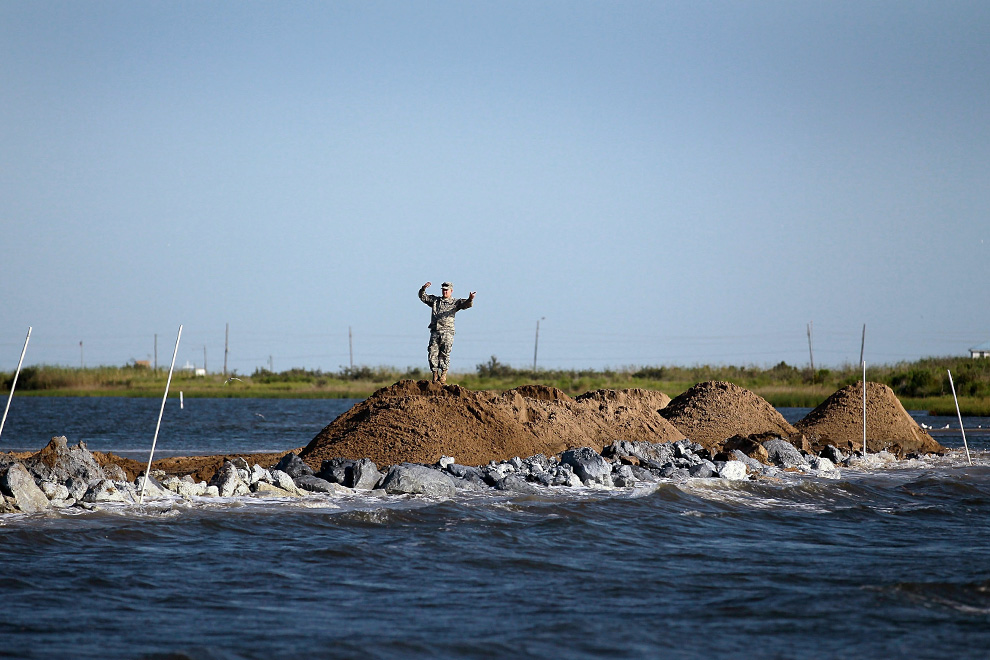
Louisiana National Guard Private Dallas Bacon guides a dump truck as they use dirt to create an earthen barrier as they try to protect an estuary from the massive oil spill on May 10, 2010 in Lafourche Parish, Louisiana. (Joe Raedle/Getty Images)


Louisiana National Guardsmen use Blackhawk helicopters to build a dam to protect the fragile wetlands known locally as "Bayou" near the town of Grand Isle, as work continues to protect the coastline from oil after the BP Deepwater Horizon platform disaster off Louisiana, on May 11, 2010. (MARK RALSTON/AFP/Getty)


Oil from the Deepwater Horizon oil spill makes its way to shore on Chandeleur Islands in Louisiana on May 7, 2010. (AP Photo/The Dallas Morning News, Vernon Bryant)


An aerial view of the northern Chandeleur barrier islands shows sheens of oil reaching land, Thursday, May 6, 2010 in the Gulf of Mexico. The islands rest 20 miles from the main Louisiana coastline. (AP Photo/David Quinn)


This image provided by NASA shows the Mississippi Delta (top right) and the growing oil slick in the Gulf of Mexico on May 5, 2010. Photo was taken by International Space Station Expedition 23 flight engineer Soichi Noguchi. (AP Photo/NASA - Soichi Noguchi)


Shrimp boats are used to collect oil with booms in the waters of Chandeleur Sound, Louisiana, Wednesday, May 5, 2010. (AP Photo/Eric Gay)


An oil soaked bird struggles against the oil slicked side of the HOS Iron Horse supply vessel at the site of the Deepwater Horizon oil spill in the Gulf of Mexico off the coast of Louisiana Sunday, May 9, 2010. (AP Photo/Gerald Herbert)


all photos:
© 2010 NY Times Co.


I haven't yet written about the Gulf disaster because it has seemed overwhelming and incomprehensible and beyond the scope of my reporting, though certainly not beyond the scope of 70.8%'s stated intention. I found these photos and felt they were a testament to the realities that will stand alone. While they do not encompass the totality of suffering by humans, critters, plant and stone, they do give us a window. Even the very wind is affected.
Amidst the flurry of finger-pointing, with harsh vitriol being doled out to BP, to Obama, to NOAA, I'd like us to remember that anyone reading this is complicit in this crime against our Mother and home.

Thanks to the Boston Globe and the NY Times group for making this witness available.

PS: I don't quite know how to say this but... beautiful photographs of tragedy are in themselves a paradox and irony. Perhaps amateur photos would in an sense convey the tragedy more explicitly.

Certainly the gulf disaster is a wake up call to us all, and especially points a finger towards a return to fishing under sail.