Showing posts with label Canoe Yawl. Show all posts

Friday, November 12, 2010

Constance .3: First Sail


Constance ready at East Mersea

courtesy Dick Wynne


Sailing photos off East Mersea by Martin Treadway


courtesy Martin Treadway via Dick Wynne


courtesy Martin Treadway via Dick Wynne


courtesy Martin Treadway via Dick Wynne


courtesy Martin Treadway via Dick Wynne


Nice rear end

courtesy Martin Treadway via Dick Wynne


Mr. Wynne looks pleased with Constance

courtesy Martin Treadway via Dick Wynne


courtesy Martin Treadway via Dick Wynne


Constance at Wivenhoe 18 July, presumably returning from Mersea

photo unattributed


Fabian Bush (who built her) just sent me (Richard) this snap he received of Constance, with first reef, on the return leg of this year’s white-knuckle-ride of a race. Me helming, son Mike sheltering. More about the race at the East Coast Classics website.
(And here, on the ASA site)

photo unattributed
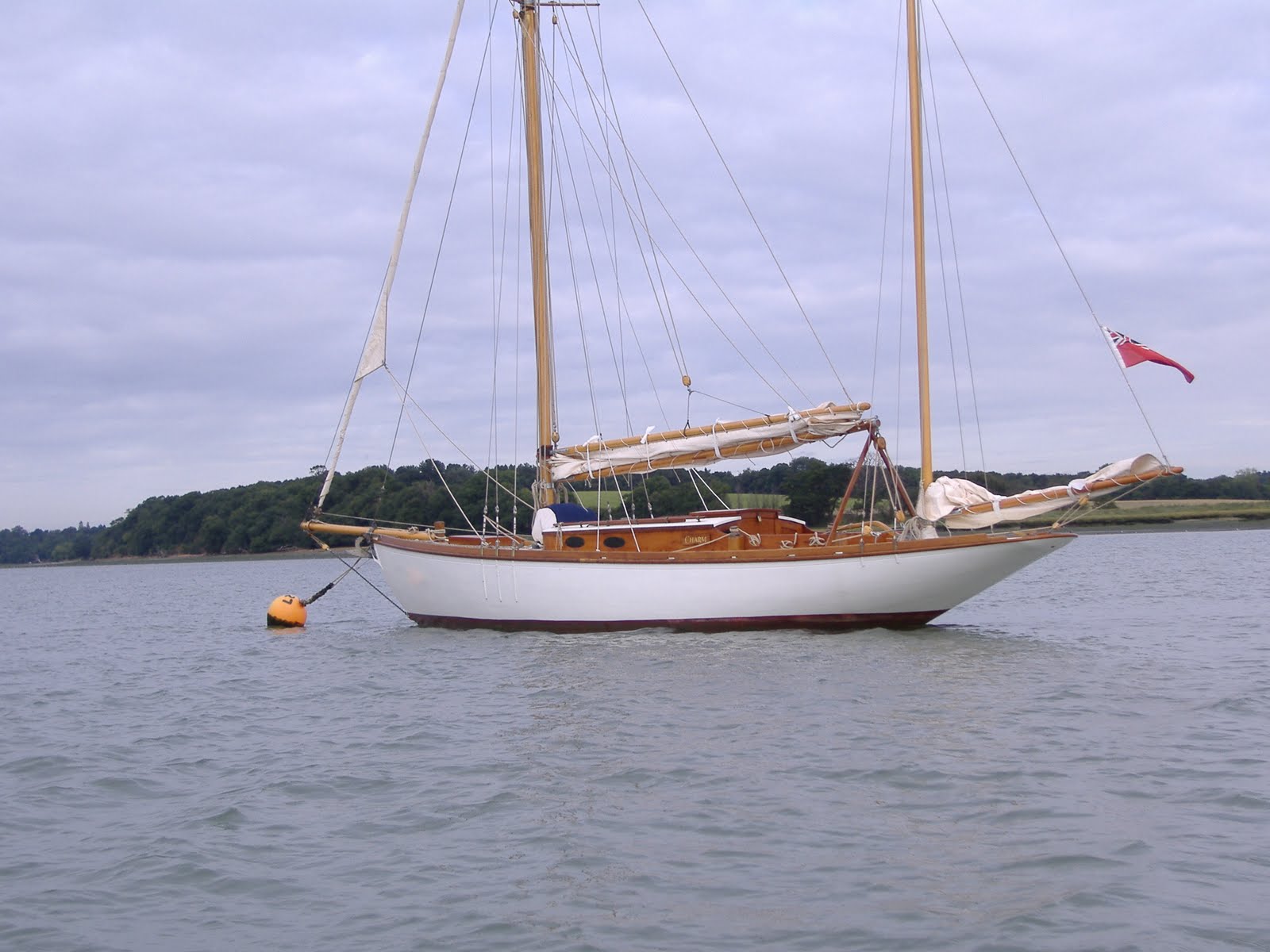


Dick Wynne's new venture, Charm


canoeyawl.org


Constance was launched July 8 2006, and a week later Dick picks up the narrative of her first sail:
A week later my son Mike and I took her for her first proper sail, downriver to Mersea Island and out on the Thames Estuary, in a moderate breeze on a gloriously hot day. On a reach under that ample sail area, she was just exhilarating; I’ll need a lot more experience of her to report in full on her sailing characteristics. On beaching her for lunch at East Mersea we were pleasantly besieged by admirers.

We were lucky enough to encounter ASA Hon Treasurer Peter Maynard on his Folkboat ELIZA, with professional photographer Martin Treadway on board, so were able to secure that Holy Grail, photos of our own boat under sail, on her very first day out. Readers will be familiar by now with the details of her design, so I leave you with these photos of her finally in commission, and a promise of more detail photos to come.


That was four years ago. While I was in correspondence with Dick about this series, he informed me that he is in the process of selling Constance, with mixed feelings, of course, and acquiring a new(old) Albert Strange masterpiece, Charm, a sister ship of Thad Danielson's Sea Harmony.

I have also included a link to the new (as of July) website put up by Dick Wynne and two other members of the Albert Strange Association, canoeyawl.org , home of the Canoe Yawl Association, whose raison d'etre is as follows:

'The CYA was started by three active members of The Albert Strange Association as a means to focus exclusively on a small boat type which offers so much to today's cruising sailor. We encourage you to visit the ASA where we think you will find much of interest.'

Take a look in. If you like canoe yawls (who doesn't), you'll find much beauty there. The site is still in it's incubation phase, so you can have a hand in growing it

Tuesday, November 9, 2010

'Constance' .2: Launch


Down the ramp in Rowhedge on the River Colne


Easily seen here, some stern details, click the photo for a larger image to study further.


Into the Colne, with a local audience


Isn't she lovely


Quayside, stepping the mast, and rigging


All rigged


Constance in her mudberth


Preparing for the first sail


all photos courtesy Dick Wynne


In my previous post on Constance I shared several photos of the building of Dick Wynne's Albert Strange Wenda. Here we see the result and her launching. Here's Dick on Constance's launch:

On Saturday 8 July CONSTANCE, a traditional clinker rendition of Albert Strange’s much admired but seldom built Design No 45 WENDA of 1899, slipped into the waters of the River Colne at Rowhedge in Essex, across the road from builder Fabian Bush’s yard. With the aid of a sweep Fabian and I got her alongside the little quay to step her mast and rig her with the help of family and friends, and by next day were able to sail her past the crowd assembled for the annual Rowhedge Village Regatta to applause well-deserved by her builder.

And here some comments from Phil Bolger via the ASA weblog:

Bolger on CONSTANCE

August 10th, 2006 by Dick Wynne, London

Readers may be aware that the working plans for Albert Strange’s Design #45 WENDA were developed for WoodenBoat magazine by Phil Bolger about 20 years ago, in response to strong interest from the magazine’s readership. Both Fabian Bush and I have corresponded with Phil during the building, and on receipt of some photos of her on the water which I sent him, Phil wrote back:

“Thank you very much for the photos of your lovely Wenda (CONSTANCE). They all delight me, especially the one showing her nestled into a mud berth, and those showing the beauty of a canoe stern.

My compliments to Mr Bush, and to Mr Hall as the cut of the sails looks extremely nice. Watch out for that added halyard outside the jib roller. I had a traumatic experience with such an arrangement when the sail was allowed to thrash, rolled the second line into itself, and would not go in, out, up, or down, in the mid-watch and a rising wind in the middle of the Med.”

I plan to move the lower end of the spare halyard to the foot of the mast, where it will be out of the way yet available if needed. I doubt that loss of the wire forestay through the jib roller would result in danger to the fairly short, keel-stepped mast before the spare could be deployed.

[Postscript — Phil Bolger also did us proud with a double-page spread in the October 1 (2006 ed.) issue of Messing About in Boats — Ed]

You can access many more photos as well as informative articles on Albert Strange boats, designs, painting and stories, and boats by his contemporaries, on the ASA weblog .

Next up, first sail et al.

In the meantime, visit the ASA blog for more Strange boats, and there's also a new kid on the block, started by Dick and others from the ASA, canoeyawl. org ...go! ( more on this later)


Sunday, May 9, 2010

Campion Sail: Tom Dunderdale's 'Apple', et al.


A four plank aside half-decked Apple, gaff cutter rigged with tumblehome transom, sailing in the Alps
photos courtesy E. Reinhard.


Apple yawl dayboat, main and mizzen rigged with balanced lug sails and conventional transom
photo courtesy Tom Dunderdale, Campion Sail and Design


Apple yawl dayboat
photo courtesy Tom Dunderdale


Apple yawl dayboat
photo courtesy Tom Dunderdale


Peter Lord's 5 plank Apple 'Vips' with modified interior and his own carbon fibre spars and sail plan,
courtesy of Wojtek Baginski taken during the Raid Finland 2007 when he crewed for Peter Lord


Stitched and ready for glassing - Peter Lord's most impressive 5 plank Apple lugger with his own customized internal layout and rig. This hull is one of a number of variations based on the original 4 planker, including one with greater flare to the topsides and 3 inches more beam

courtesy Peter Lord


Vips in good company at Raid Finland, the lineup from left to right, Welsford, Oughtred, Herreshoff, Campion, Michaleck
courtesy Wojtek Baginski


Apple's Lug Yawl Sailplan- see her designer's comments below


'Pearl 16, a day sailer or beach cruiser, half-decked, with multichine stitch and tape or glued clinker-over-stringers construction. The hull is of 6mm ply, the deck and cockpit of 5 or 6mm, with centre-board and dagger-board options. The cockpit has various permutations, from deep and open, to reduced volume, through to self-draining, but all with built-in buoyancy. Pearl, with either a lug main and mizzen, gunter yawl or gaff cutter rig, is beamier, flatter floored, fuller transomed than Apple, with lead and water or water ballast.'


Here's Pearl's midsection redesigned for sleeping floors per my request


'George Holmes’ design the ‘Ethel’ of 1888 was digitised then stretched by Selway Fisher - who then drew up their own stitch-and-glue strake pattern for the hull, which I used when constructing the first one.

I further modified the appearance of the design during construction to produce the boat in the photo by altering both deck camber and sheer, and building a different deck and cockpit layout - with in particular the narrow, sweeping side-decks and coamings - as well as a new high aspect-ratio semi- pivoting daggerboard, a high aspect ratio lifting rudder and a wider, more practicable tiller (all necessary as I intended racing the boat), and altered the rig twice - both during construction and a few months after. Most construction details are different, too. Further detailed changes were listed in ‘The Boatman’ review in the October/November issue of 1992.

The final appearance of the boat - though not the hull - is different to both Fisher’s digitised design and the original ‘Ethel’. Fisher’s modified version - which he named the ‘Lillie’ - follows Holmes’ original layout of deck and cockpit, low aspect centreboard and non-lifting rudder, but with his own rig; and it is this which he offers in his on-line catalogue - though illustrated with a photograph of the changed deck and cockpit of my boat.'


"Though the gloss is no longer -some eight years later - as deep as here, you can still see your own face in the
original finish."


'Electra: with a lower, flatter and fuller floor, the lines of this canoe yawl could be likened to a compromise between George Holmes' Ethels 1 and 111, but she is longer - with more freeboard - slightly beamier and certainly more burdensome with a sharper, deeper bow for better windward work as well as a drier, more comfortable performance in a steep chop. For 7 plank multi-chine or glued clinker. Stable yet fast, attractive and able, light yet strong, the seven plank aside hull goes together reasonably quickly to give a satisfying traditional appearance with modern materials. Sealed tanks run under the side decks for a good part of the hull to provide buoyancy and strength. Provision has been made for 55 kg of water ballast if required. These hulls give a true planing performance if sailed hard, whilst retaining the noted sea-kindliness of the double-ender if sailed more gently.'


all material courtesy Tom Dunderdale/Campion sail and Design, unless otherwise noted


Tom Dunderdale's elegant distillation of the British workboat, especially those from Cornwall, Kent and Sussex, really caught my eye. His flagship boat is the Apple and her plumb bow, lug yawl rig and raking transom hit home for me, but there are many iterations/variations. Conceived with an eye to tradition, the designer states:

Apple is a sweet-sheered, originally yawl-rigged, balanced lug day-sailer that has a surprising turn of speed. From her plumb bow to her raking transom, she has very much the air of a traditional boat, but her lines reflect modern thinking more than might at first be apparent. With the original small yawl lug rig layout she is exceptionally easily controlled with finger-tip-light steering at any degree of heel, showing the inherent balance of the hull form and will heel to some 40 degrees without driving the gunwale under when hard on the wind, remaining well mannered and docile. The flair of the forward sections tends to throw spray clear and she is surprisingly dry when sailed hard. Off the wind in a breeze, she lifts smoothly onto a plane without effort or fuss. In lighter airs, she slips along in a most satisfying manner, and will even sail herself for short periods if the sails are balanced carefully. For those who regularly sail in light wind areas, the large light weather mizzen makes for a truly stunning performance. And when the wind dies in the evening, she will row surprisingly well as the quarters are well lifted, the beam moderate and the weight surprisingly light thanks to the glass/ply/glass construction. Should a more sedate approach to sailing be required, the Apple will easily accommodate sand or shingle ballast bags as she has considerable carrying capacity without spoiling her sailing lines, and such disposable ballast ensures that easy manhandling ashore is not lost. Integral water ballast tanks can be built in to the decked version, too.

Apple was designed as a rewarding, handsome, open day-sailer for large lakes, rivers and sheltered estuary waters, one that could be built in a modest single car garage on a very modest budget yet would engender a real pride of ownership, with an ability and performance to entrance and enthuse her crew, most especially when sailing in company with modern craft, and not demoralize them with indifferent or poor sailing qualities once the novelty of sailing something 'traditional' has worn off. In her original open form, she is not, however, designed for cruising exposed coastal waters in strong winds - which is in keeping with other open or even partially decked designs, traditional or modern, old or new, including some supposedly able 'cruising' dinghies and dayboats - as it would be asking too much of such a light and almost totally open boat - and such a simple, inexpensive one - and probably of her crew, too. [But note that with the substantial reduction in open cockpit space as well as increase in weight to give the necessary momentum to punch through head seas, the decked, ballasted version is more suitable for open waters. The inherent exceptional balance of the design makes for far sweeter, easier handling than the hard-mouthed antics of some portly dayboats when over-pressed, whilst the ballast provides surprising power and stability with the crew inboard. There's a general absence of slamming when driving hard through a short hollow chop with little thrown spray or when weaving through a confused head sea and partially luffing the crest and then bearing away down the back, whereas a full bowed 'U' sectioned boat in such conditions will stamp and slam if not stop, throwing spray, thin sheets or, if they're really unfortunate, solid lumps of water at her luckless crew. In such conditions, a dry, well-tempered boat truly shines, and Apple is just that.] Within the constraints of the design, there really is little on the water that approaches her - she is handsome, able and distinctive.

Digging a little deeper into the Campion website (a word of warning: at first navigating the website is a bit like learning to drive in a foriegn country, challenging, but worth the effort) I discovered a wide range of delightful small boats, most of them with a traditional feel, and all drawn with the amateur builder in mind, using modern materials and construction techniques. With some of these designs, Tom offers a dizzying array of options, allowing the builder to tailor the boat he builds precisely to his needs. In addition to the Apple, I especially like the Pearl and Electra designs (see design notes above). I am so taken with the Pearl in fact, that, notwithstanding great designs by Oughtred, Welsford, Vivier and a covey of American designers, I'm ordering plans of Pearl. Of course, it'll no doubt be a long time building, and I need to get my O'Day in this year. I've been corresponding with Mr. Dunderdale, both as a collaborator 0n this article and as a potential design client, and have found him forthcoming, generous and erudite.

Tuesday, April 27, 2010

Nord Vinden still available...


This beautiful boat is still available. You can read about her and see more detailed photos here. Built by William Clements in 1988, to George Holmes Ethel design, this boat is a marvel. I've been in touch with the owner and he is asking 10k, though she's probably worth twice that. If you have interest or questions, please contact me via my email address, visible in this blogs introduction, and I will connect you with the owner. Located in southern VA.

Sunday, April 18, 2010

Help us find this boat: 'Twilite'


Everett building with Emmett, (maybe), poking out of the backpack

courtesy Hallie Bond & WoodenBoat


'Twilite', built to JH Rushton's Vesper design.

Courtesy © Benjamin Mendlowitz


Bob LaVertue paddling Twilite

Courtesy © Benjamin Mendlowitz


Twilite's sumptuous bronze rudder

Courtesy © Benjamin Mendlowitz


The completed hull in Everett's shop with the deck framing in.

courtesy Emmett Smith


Two more shots of the work in progress

courtesy Emmett Smith


Everett Smith's first boat, Merganser, loosely based on Rushton's Princess, resting on his shop floor

courtesy Everett Smith


Twilite surrounded by her admirers. Mason Smith (left), Everetts brother, wrote the WoodenBoat article,
Bob LaVertue (standing before the sail) commissioned Everett Smith ,(kneeling in the red check shirt) to build Twilite

courtesy Emmett Smith


John Brady recently forwarded me an email from Emmett Smith who is trying to locate a boat built by his father Everett. Emmett's email was originally sent to Tom Shephard, a fellow member of the Delaware River chapter of the TSCA. John thought I might be interested, and inevitably, I am. Here's the gist of the matter:

"Dear Mr. Sheppard,

My Name is Emmett Smith. John Brady gave me your name. I am looking for a very unique boat that I think may be in the Philadelphia area. It is a reproduction of a Rushton Vesper model decked sailing canoe that my father Everett Smith built for a customer in the 1970's. It was called 'Twilite,' and got a bit of press from WoodenBoat at the time. For me, it is a part of my family history, and I am anxious to find it.

The boat was sold by the Ross Bros. in Massachusetts in the late 1980's and entered the world of designers and antiques. It found its way to Wanamakers Department Store at 1300 Market St. in Philadelphia, whee it was on display from 1991-1996. When Strawbridges bought out Wanamakers, the boat went into a storage unit at 8th and Market. In 2006, when FDC-Macy's moved into 1300 Market St., the old storage building was cleared out and the boat was sold. This is information from the Visual Director of Macy's, a man named Mark Moody, who oversaw the selloff but does not remember who the boat went to.

So far this is where the trail ends. The boat was sold in downtown Philadelphia in 2006. So, I am contacting people in the area who would take note of a unique boat such as this. If you have seen it or have any leads for me please be in touch. I am looking also for anyone else who sells or deals in boats or maritime antiques; anyone who might have come across this boat.

The boat is Alaskan cedar over oak, with mahogany decks and coamings and spruce masts. The folding rudder and Radix style centerboard are handmade as well. The boat has copper flotation tanks under the decks. It did have a flag with its name, but I do not know if it is still with the boat. The Ross Bros. also stamped their name before they sold it, probably under the thwarts and seats. I have attached a couple of pictures as well.

Thank you so much for your time."


I was intrigued. I searched my spotty WoodenBoat archive and found the article in WoodenBoat # 65, august 1985. Jogged my memory. As a recent graduate of the Pennsylvania Academy of Fine Art ('83)I was thrilled to read this article which depicted the boatbuilder as artist. It introduced me to sailing canoes, canoe yawls, and J H Rushton. I think I bought the Manley book on Rushton shortly thereafter and visited the Adirondack Museum within the year. I wrote Emmett to get permission to write about his search and some intriguing info came to light. Emmett is now a boatbuilder living on the West coast and also doing consulting work for various institutions. Everett now has his shop in Canton, NY, the location of Rushton's old boatworks. He served for a time as the curator of the Antique Boat Museum at Clayton, NY. Bob LaVertue, who commissioned the boat, I met at the MASCF last year. He crafts bronze and copper hardware for sailing canoes of this kind, including the folding fan centerboards in Springfield MA, and while he created some of the hardware for Twilite, the radix centerboard was made by John Wells.

This boat has a rich heritage, and Emmett would like to return it to the family fold. ANYONE having any info regarding the whereabouts of this family heirloom should contact Emmett, or me or John Brady.

Special thanks to Benjamin Mendlowitz for permission to use his lovely photos of Twilite. You really owe it to yourself to visit his website. And thanks to Tom Jackson at WoodenBoat for putting me in touch with him.

Friday, April 9, 2010

Nord Vinden for sale on ebay


Nord Vinden


Full view


Stern on


A view forward


Cockpit seating


This is the centerboard arrangement with the lever for the folding bronze fan keel.


Parrel beads attach the standing lug mainsail to the mast


Boom yoke for the mainmast


And for the mizzen


Leathered oar


The rudder arrangement


Tiller attachment


One last look


all photos courtesy John Wurdeman


Built to a George Holmes design by William Clements in 1988, this compelling canoe yawl is for sale on ebay. William Clements is a long established builder of small craft and is known for his attention to detail. Take a kook at the photos here. John, the owner, was kind enough to send me photos of the boat as ebay has implemented new software which no longer allows direct downloading of photos from their site. John was also kind enough to send along some particulars on his exquisite little craft. John spoke to William Clements about what it would cost to build one of these today and the estimate was in the$20k range! The original Holme's boat was Ethel, and is a point in the evolutionary chain which eventually led to the larger Humber yawls as developed by Holmes and his contemporary Albert Strange. A recent publication by the fledgling Loderstar Books treats Holmes and his designs at length. I have yet to read it but it's on my list.

The owner lists her attributes:

Nord Vinden
Lug Rigged Canoe Yawl 13’, beam: 4’
Folding caned seat for use when rowing, Shaw and Tenney oars with
leathers, coppertips, black locust tiller, boomkin, yokes and cleats -
bronze oarlocks, pintal, gudgeons and fastenings - cherry stems,
cockpit coaming, king planks - ash and spruce deck framing - mahogany
rub rails - sapele maring plywood bulkheads - bruynzeel mahogany
marine plywood hull - teak deck - 340 lbs, designed by George Holmes
(1888), built by William J. Clements in 1988, includes trailer and
cover, garage kept, 100 square ft sail area, folding bronze keel,
draws 6 inches/2 feet, flip up rudder, excellent condition, would cost
$20,000 plus to build today according to builder.

The auction ends April 14, the 5k reserve has not been met, so here's your chance to own a modern/classic at 1/4 the price.