Showing posts with label Minimalist cruising John Welsford. Show all posts

Wednesday, July 17, 2013

22nd annual WoodenBoat Festival at Mystic Seaport .3

Around the Seaport


The 28' sandbagger 'Annie' was built by D. O. Richmond about a half mile downriver from the Seaport in 1880 and came to Mystic in 1931 as the first boat in a collection that now numbers over 500 craft. Much more of her story here.


'Aida' is a 33' keel/centerboard yawl built in 1926 by the Herreschoff Mfg. Co., designed by N. G. Herreschoff.


Recently restored by Doug Hylan in Brooklin, ME. More about 'Aida' here.


'Aida' is the most recent addition to the Seaport's fleet. There's a beautiful book about 'Aida' written by Maynard Bray available in the Seaport's bookstore.


The 'CW Morgan' in the water, on her cradle, "taking up" ie swelling her planks to a tight fit before her launch this Sunday, July 21, 2013.


A view to give a taste of the immensity of this ship.


Continuing the theme of immensity, here are some of the spars waiting in the wings for rigging the ship. She'll be rigged after the launch.


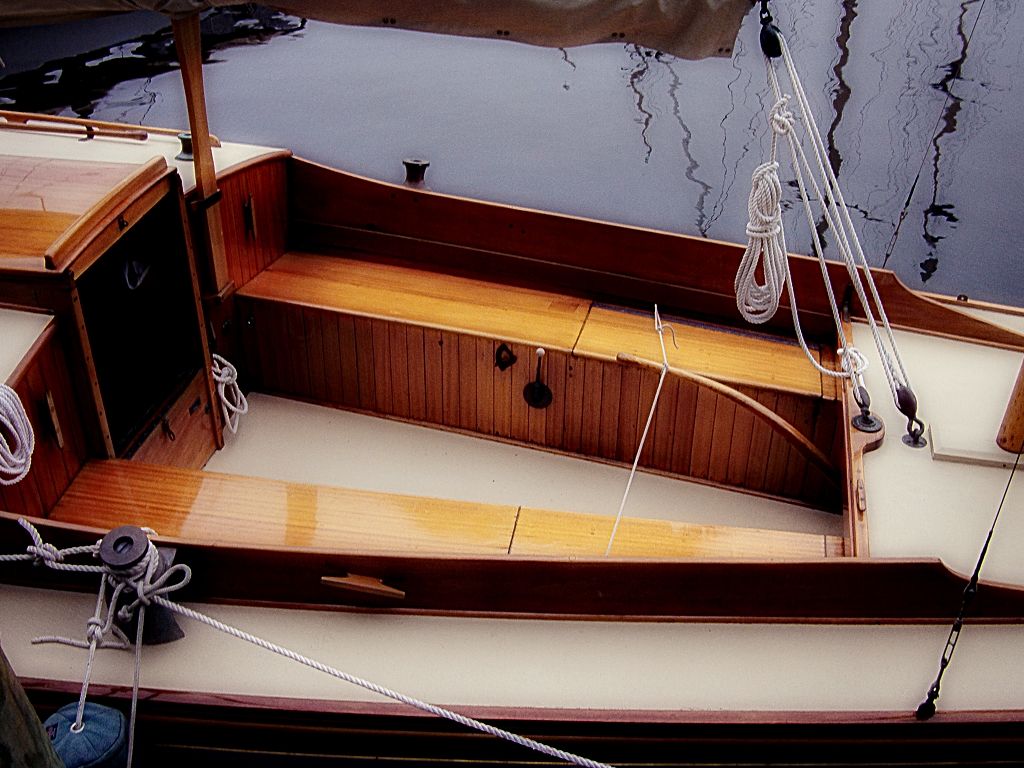
By way of supreme contrast, here's the microcruiser Scamp, a joint project of The Small Craft Advisor and noted NZ boat designer John Welsford.


? Found art


Higher ups aboard the 'Joseph Conrad'


Jon Wilson, the creator of WoodenBoat Magazine. We had a short chat and Jon informed me that while he's still at WoodenBoat almost daily, he is also deeply involved as director of a non-profit called JUST Alternatives which mediates victim/offender dialogue. There is an in depth article about this man with a foot in two worlds from Yankee Magazine, well worth your time.


Ben Fuller, "Living National Treasure" ( he'll no doubt hate that). Ben's an avid small boat advocate and member of the TSCA. Ben is the Curator at Penobscot Marine Museum (look into their extensive photo archives) and a former Curator at Mystic. He's also the owner of 'Ran Tan', more of which later. Here he's chatting with John Harris of CLC.


Coasting Schoooner 'Austraila' was built in 1862 on Long Island. She served as a blockade runner based in the Bahamas during the Cival War, and consequentially spent over 60 years in the Chesapeake hauling goods.


Later she was acquired by the DuPont family as their yacht, and was donated to Mystic in 1951. In 1961 she was hauled for refit but the damage at that time was too great, she was retired to a shed on campus as an educational exhibit. Read more..,


'Breck Marshall' is a reproduction Cape Cod catboat c.1900, built at  Mystic in 1987 and  in use today as an excursion boat for museum visitors. More...


The John Gardner Small Craft Workshop is held most years at Mystic as part of the WoodenBoat Festival. It is situated on Australia beach, adjacent to the 'Australia's shed and directly in front of the John Gardner Small Craft workshop, still in use, building small craft in the Gardner tradition. John was a visionary historian and teacher. He is credited with saving many American small craft from obscurity and as a key figure in the wooden boat revival. He served as Associate Curator of Small Craft at Mystic Seaport from 1969 to 1995. The workshop is held as a collaboration between Mystic Seaport, WoodenBoat Magazine and The Traditional Small Craft Association.


Good night, Mystic Seaport
 

A quick sail aboard 'Ran Tan'


'Ran Tan' is a modified wherry, drawn by Antonio Dias. imagined and owned by Ben Fuller.


Ben brought 'Ran Tan' down for the John Gardner Small Craft Workshop, which operates a livery under the auspices of the TSCA. Here you can try any of the offered boats, no charge.


Ran Tan is Irish slang for a sort of walkabout, according to Tony.


Tony is a friend and invited myself and brother John for a sail.


John's duty was to watch for other craft, especially where the sail blocked Tony's view. I, being considerably heftier, was assigned to be moving ballast. The boat is very light (200lbs.), and lively, so I was moving around quite a bit trying to keep her on the flat.


Antoino at the helm.


Sailing past the 'Morgan'


Tony and John back at the dock after a fun sail. I do not have lot's of experience in small craft and it was enlightening. Antonio Dias is a truly multifaceted man, artist, talented designer and writer, take a look at his website. Thanks, Tony. You can read an earlier post on this blog about Tony and his boat designs here.


Text and photos copyright Thomas Armstrong, first posted on 70.8%

Sunday, August 2, 2009

NZ Welsfords

Tusk, Owen's Navigator


Tusk again, photos John Hitchcock


Welsford Light Dory


Waiata


Houdini with cabin


Navigator


and another


Owen Sinclair sent me some great photos of John Welsford designed boats from his native New Zealand. There are several Navigators, a light dory, an Houdini, a tender and the 6 M. Whaler. He also sent some musings on the Navigator, one of which he owns. Here are Owen's thoughts:


After more than 12 years ownership I think the key word is versatility.
I can launch and sail it alone or with non-active passengers, up to 3 adults (in addition to myself), or with crew managing the jib, sitting out in fresh conditions and bailing as needed. I have had 5 children in it on a small lake; we would have taken a sixth but ran out of lifejackets (PFDs to Americans). At anchor I, at about 100 kilograms (over 200 pounds), can board it over the side with no risk of it capsizing on me.
Tusk has the yawl rig with a gunter main and conventional boom; this contributes to the versatility. When the wind gets up and a reefed main is still too much sail the main can be dropped entirely onto the boom and stowed there. This also a handy move when taking people out sailing for their first time: start under jib and mizzen, and then once everyone is comfortable with the motion, hoist the main. The mizzen is helpful in holding the boat head to wind while raising, lowering, or reefing the mainsail. I have sailed without the mizzen and found it decidedly more difficult to drop and stow the main in fresh conditions without it.
It will sail to windward under the jib and mizzen only; there is a wind and sea range, which I can’t quantify, where it is difficult to tack under this rig. Never mind; gybing is safe and easy and when the wind rises some more tacking becomes possible again. The jib and mizzen can still be too much sail. This is one area where John W’s original plan, for the headsail to be set flying, would be useful. A smaller headsail could then be set from inside the boat. And a smaller or reefed mizzen would then be useful. But I haven’t heard of anyone doing this. I do know of two Navigators which set gennakers in light air. This would be fun, but best done on a crewed boat I imagine.
There is a long learning curve with the mizzen, both tuning and using it. John Welsford says it should be set up as flat as possible always, but I have found that slackening off the snotter and allowing a bit of draft into the sail is very helpful to boat speed in light winds and flat water. The mizzen is helpful in tight spots: by pulling it sharply to windward it helps kick the stern around. But don’t hold it there too long or leave it sheeted in when tacking; it will nail the boat head to wind! And there are other tricks: I anchored one day in a strong, steady breeze blowing parallel to the shore with both crew and me in need of a toilet stop. By pulling the mizzen seawards the boat was forced to swing in to the shore where we stepped out into shallow water taking a rope to pull the boat back to us afterwards and leaving the mizzen free. With the sprit boom it doesn’t flog when left set. It is common for other sailors to think that the mizzen is too small, or the boat is too small for a mizzen to be effective. Some voice that; others leave the thought unvoiced until they try the helm, leave the mizzen sheeted in too hard and just about have the tiller pulled out of their hand. Then they voice their original thought together with the amendment: something like: “there is some drive in that mizzen.” The Navigator is normally very light on the helm, being well balanced. And yes, it is possible to set up the sails, at least on the wind, so the boat will sail itself. But the only reason for doing this is to move about the boat and when you do this the balance changes and it won’t self-steer any more. But it will heave-to or the main and jib can be dropped, the mizzen sheeted in and the boat will look after itself while you change, get food or whatever.
There is plenty of stowage under the foredeck making it easy to carry camping gear or keep lifejackets/PFDs and wet weather gear there. Through the summer I routinely carry extra lifejackets out of the way. The design arouses a lot of interest and it is nice to be able to offer people a sail without having to worry about finding another lifejacket on the spot.
A 2hp Honda pushes it easily, even in high winds. But David Perillo, whose opinions must be respected given his considerable experience with two different Navigators, found a 6hp engine useful.
John Welsford originally designed the Navigator as a sail training boat. Accordingly it has a planing hull. And it does plane even with the “cruising” yawl rig. This surprises some people, especially kids brought up in yacht clubs on the superiority of the Bermudan rig. For speed it is at it’s best in a good breeze with two people in, an experienced sailor handling the jib sheets and understanding the need to move smartly when tacking or to sit out in gusts. It may be even better with 3-up, but I have only once sailed in a good breeze with 2 experienced crew. It was great fun that day. It is exhilarating flat off the wind with the board up, the mizzen out one side, the main out the other and, with crew, the jib poled out the same side as the mizzen. In high winds it will surge onto the plane like this, with no sign of the dreaded death roll. It feels like a giant surfboard.
There are vocal opinions about the virtues of the sloop-rigged Navigator versus the yawl-rigged version. I can only say that for my purposes, mostly sailing alone in day-sailing/cruising mode, often well away from populated areas, sometimes with inexperienced passengers (as distinct from crew) and only occasionally with experienced crew, it has been ideal. Someone on the Welsford Yahoo forum once said they were building one with provision for both rigs. This would have to be the ultimate for versatility. I note that some people have converted their Navigator from the Bermudan to the yawl rig. I don’t know of anyone who has made the conversion in the opposite direction. I do have fantasies occasionally of building one light with a self-draining deck and the sloop rig, finding a couple of crew and joining the racing at the local dinghy club. That would be great fun!
The only criticism I have of the design has been fixed in later versions. Mine has the centrecase as originally designed and with crew, especially two of them, water pours through the opening when off the wind in fresh conditions. But one of the crew can bail……..
Fini.


Mr. Welsfords boats are not only beautiful, but are reputedly extremely seaworthy. Many of his designs bring to mind English workboats from another era, yet don't look dated. A skillful and competent designer of small boats. If you are not familiar with his work you may want to aquaint yourself with it.

You can find more Welsford boats as well as a wealth of other small, open boats at Openboat NZ.

There's a Furled Sails interview with John Welsford here. Recommended. I would like to hear from other Welsford owners, especially in the US., but really from anywhere. Send me a note and some photos of your boat.


I would also appreciate hearing from owners of Iain Oughtred boats with the same kind of post in view. Let me hear from you!