Showing posts sorted by relevance for query sgoth. Sort by date Show all posts

Friday, August 12, 2011

Sgoth Niseach


The Dutch three-masted schooner Oosterschelde on a visit to Stornoway for Sail Hebrides. She is being escorted out of the harbour by two traditional Hebridean fishing vessels, Jubilee in front and An Sulaire behind. These two boats were participating in a race as part of the Sail Hebrides Maritime Festival.

courtesy Donald Macleod


Jubilee arrives at the Old School site in Lionel, Ness where she remained until repairs were carried out in 2005

courtesy Falmadair


Jubilee makes a welcome return to Port of Ness, where she was originally launched in 1935

courtesy Falmadair


Align Center
Stressful sailing. Onboard Jubilee

courtesy Franzi Richter


An Sulaire

courtesy sulaire


An Sulaire and crew in the inner harbour.

courtesy Donald Macleod


Aboard An Sulaire

courtesy Franzi Richter
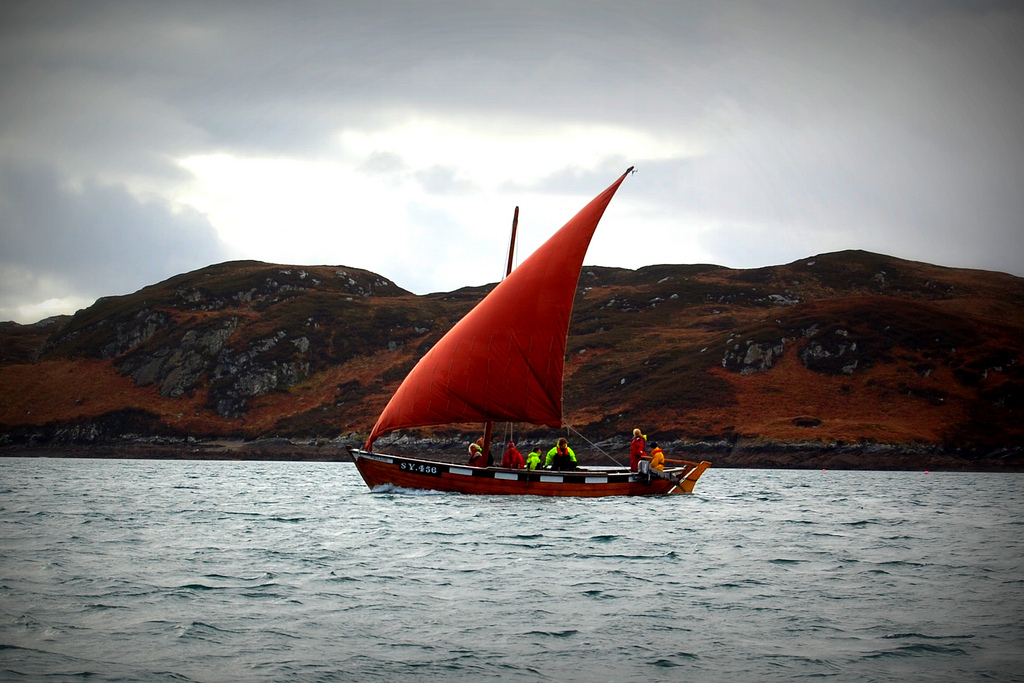


An Sulaire

courtesy Franzi Richter


The crew hauling Mayflower up the slipway at Skigersta pier in the early 1950s. Read more about Mayflower here.

courtesy Falmadair


The 20 foot keel length Pride of Lionel was owned by Norman Campbell (Tabaidh), 6 Lionel, and registered as SY 455 on 25 May 1918.

courtesy Falmadair


Mairi MacLeod's Runag...


courtesy Mairi MacLeod


build underway...


courtesy Mairi MacLeod


at the Lyme Regis Boat Building Academy in 2009.


courtesy Mairi MacLeod


Mairi chose to build a half-size Sgoth Niseach. Full size boats were just over 30', the boat that Mairi built is 16' 6". The translation of Sgoth Niseach is 'Ness-type skiff', Ness being the northernmost part of the Isle of Lewis in the Outer Hebrides where the boats were used for fishing. 'Runag', Gaelic for 'little sweetheart', was planked in Alaskan yellow cedar on oak, the planks and ribs fastened with traditional rose head copper nails.

courtesy Mairi MacLeod


Sgoth Niseach translates into English as Ness Skiff, at type of small fishing vessels which evolved in the region of Ness, northernmost part of the Isle of Lewis in the Outer Hebrides. They are double ended like their Norwegian ... but have a distinctive large dipping lug rig which some have likened to a lateen sail. I asked Iain Oughtred about his view of the evolution of this boat type and especially that big sail. Iain's reply:

I think the evolutionary process went from the faerings etc, with short horizontal yards, to some later Nordlandsboats, which exended the luff far forward, still with a short yard. Up to about 10-oared boats. Then the Shetland Sixareens and Yoals, which peaked up the yard – though still calling it a square sail, but by now very asymmetric. Very efficient sail, especially in the racing yoals. In Lewis, the yard got even longer, and the sail as large as could be contained within the length of the boat, which was different in being big, beamy, heavy. That yard was really a handful. They must have been giants.

These boats had nearly died out completely by mid 20th century, but some worthy restorations and new builds are keeping their heritage alive.

Jubilee was built in 1935 by John F. Macleod. By 1978 she was in need of restoration, was purchased by a group on behalf of the Ness community, funds were secured and work begun. She was re- launched in1980 at Ness Harbour. Further repairs were undertaken in 1995 to coincide with the building of a new Sgoth, An Sulaire. The 28' Jubilee is currently the ward of Falmadair, the North Lewis Maritime Society.

An Sulaire is a 'new' 30ft. sgoth, commissiond by the An Sulaire Trust, built by John Murdo Macleod, assisted by Angus Smith. Macleod is the son of John F. who built Jubilee. He is regarded as a master boatbuilder and the BBC produced a documentary of the build. She is currently in Ullapool on the Scottish mainland for some repair work.

In 2009 Mairi Macleod of Stonaway was completing her course at the Lyme Regis Boatbuilding Academy. She chose to build a half size sgoth as her final project and was helped by John Murdo Macleod. It's a beautiful boat as you can see in the above photos. After graduating other concerns intervened and the boat is still unfinished, but it back in Stornaway, awaiting Mairi's finishing touches, planned for next summer.

There's a Facebook page for these boats here.

Finally, here's a link to some closely related boats I've written about previously.

A big thanks to Iain Oughtred for his insight.

Original post Thomas Armstrong @ 70.8%


Sunday, February 28, 2010

BUILDING LILY; the Orkney Yole Association

Blaeu, Atlas of Scotland 1654, ORKADVM ET SHETLANDIE Orkney and Shetland

courtesy Wikipedia


North Isles Yole "Lizzie" racing in the Sanday regatta at Kettletoft during the 1950's. She is a smaller example of the Yole , she is rigged with a Dipping lug.


Lizzie II, a North Isles Yole. Built by Richard Wilson and his father Andrew. Launched May 2008.


Gremsa, A South Isles Orkney Yole built by Len Wilson


A simplified drawing of the hull lines of the 18' South Isles Yole Emma. Drawn by Dennis C Davidson.
Lily was built to these lines.


Lily begins


Planking begins


Nearly finished planking


Deck beams in place


a consultation between Association members


Lily's striking hull with hard bilges


Lily launched!


all photos courtesy Orkney Yole Association


Off John O' Groats, at the northeast tip of Scotland, lies a group of islands known collectively as Orkney. Inhabited for at least 8500 years, these islands abound in Mesolithic and Neolithic sites. Invaded by the Norse and annexed by Norway in 875, Orkney was pledged to Scotland in 1468 by the King of Denmark in lieu of a dowry, and finally annexed in 1472 after a failed redemption attempt. Rich in Nordic culture, and perhaps the most 'Viking' county of the UK, Orkney continues it's vibrant life and heritage.

The Orkney Yole Association has been responsible for a revival of interest in their local Yoles, setting up regatta's, preserving boats and knowledge and leading the way to new boats being built.
These boats are related to the Sgoth Niseach, or Ness Skiff, or Ness Yawl, by way of likely being the model followed by builders on Lewis and Harris. As Len Wilson of the Association states, "Be aware that we are not the same people as the Gaels in the west. This is Viking country. There is no Celtic heritage here, though there is a relationship in the boats. I am not an expert on the western boats but I know we exported Orkney yoles to them back in the 18th century and I see similarities in some of the photos".
The association's website is full of information and history and current activity.The boats were central to the islanders way of life until recently." Until the mid 1960s the yole was the Islanders' motor car and pick-up truck, transporting coal, peats, animals, animal feed, fish, cheese and eggs to the market, the weekly groceries and, of course, passengers". The Orkney Yole is built lapstrake, upright in the Scandinavian way. Originally sprit rigged , as with most Scandinavian workboats, there have been dipping lug versions and more recently the gunter main has predominated. There is a brief but enlightening discussion of yole types on the association website here.
The building of Lily, pictured above, was financed in part by the UK's Heritage Lottery Fund and built by Orkney's last commercial boatbuilder, Ian Richardson. Please visit his website.
The association has also produced a lovely calendar, which I've written about previously. Thanks to Len Wilson for his help and generosity.

Sunday, December 13, 2009

Sgoth Arcach, ' Gobhlan Gaoithe' aka Swallow, an Orkney Yole on the Isle of Skye


"The rebuilding of an Orkney Yole from the 1920's. Work done in Camuscross from 2002 onwards, mostly by Fergus Walker between 2004 and 2007, with timely help from family and friends."


Building


Good lines

Boat in 2003 after several planks put in by Gus MacLean


Lots to do


The boat would be ritually taken out every year to make way for hay into the hayloft. Sometimes she even blew over in gales.


Night light


This is the boat after I had spent a summer replacing the planks on the starboard side.


New plank


The work done here was as done at the end of the summer of 2006. New material was a while in coming - this is it having arrived in about May 2007!


Progress


Having been ill for two months, the arrival of Tjerand (fellow student from boatbuilding in Norway) and Paul - the both of them being students at the Chippendale furniture school near Edinburgh - was a godsend! Just about on the mend, the work they did was a real kick start


Celebrating a good day's work


Tjeand and Paul at the local


Hard at work


Tjerand removes most of the stem


One strake up


6th strake ( one full plank length of boat) all done


Not a patch on the old plank!?


Screwing patches onto joins (scarphs) of a strake made up of dodgy short bits stops it losing shape when you remove it


Frames


Sawn frames fitted on the port side.


Floorboards begin


Middle floorboard section resting on beams fixed to the sawn frames


Marking floorboards


Fergus uses skills learnt at Bunnpris, Coop and Rimi in Norway


Floorboards finished!


High speed tarring


Tar mixture is 1/3 pine tar, 2/3 linseed oil and a bit of turps on the inside.


The smell of tar


Susan and Malcolm


Getting tanned


Fergus and Jared


Arrgh the midges!


Jared scratches, Fergus sensibly has his shirt on


THE LAUNCH

"The launch, on the 11th August 2007, turned out to be brilliant day, with crowds of people from Camuscross and beyond, as far as Norway, Germany and the Netherlands, coming to see the spectacle and join in in their boats. A dance was held with Fergie MAcDonald afterwords at Duisdale hall."


The boat sets off


Heave ho


Beannachdadh


Sea blessing from Carmina Gaedelica by Ian Urquhart. The boat is named "Gobhlan Gaoithe" - Swallow


Og båten går å hoooiiiiii!


Only the intrepid Fosen people remain in the water


Sailing well


Having come through the dornie, heading for Eilean Iarmain Pier


TRIPS

"All trips are sunny on Gobhlan Gaoithe. The camera never lies."


An Cuiltheann

An Cuiltheann is a sawtooth range of mountains on Skye (ed.)


Machiel and Fergus


Easy sailing


On watch


Gavin, Fergus, Machiel


Beach


Malcolm


Turas gu Loch na Beiste


Fergus with makeshift boom


Through the Kylerea narrows


Jared


Gabhan


Malcolm a streap


all photos, titles, headers and captions courtesy Fergus Walker except where indicated


Here's a story that 'warmed the cockles of me heart'. An Orkney yole restoration on the Isle of Skye . A young Fergus Walker is the main protagonist in this story, with supporting roles from his father and other members of his local community. The boat was purchased in 1997 by Fergus and his father from a man who'd been working in Caithness, said he'd bought the boat there. Built, he said c. 1920, rigged with a single lug sail and jib, but later Fergus discovered a mast step forward and figures she was originally rigged in the traditional manner of these boats, two masted sprit rigs with a jib tacked to a bowsprit. Fergus suspects she's a Stroma Yole. They sailed her, Fergus and his dad, for a couple of seasons, then the leaks got so bad they abandoned her ashore for a decade or so, until Mom threatened to burn the boat if they didn't do something with it. Moved into a shed, they had a local boatbuilder replace a few of the worst planks. Fergus then went off to Norway, attending the renowned folk/craft school Fosen Folkhøgskole, where he built the local craft (the Åfjords Boat) and learned traditional Norwegian boatbuilding skills which would prove useful in his endeavor to recreate his boat. Upon his return he commenced his restoration. As you can see from the photo essay, Fergus had lots of help from family and friends. The boat was christened 'Swallow' or Gobhlan Gaoithe in Gaelic, for the birds that took up nest in the shed during the rebuilding. The literal translation of the Gaelic is 'fork in the sky'. Fergus reports that as they launched the boat, a flight of swallows careened above the boat. You'll find more about his journey through this process on Fergus' weblog about the renovation accompanied by his photo log on Flickr. I've asked if there are drawings, did they take off lines, but have yet to hear from Fergus about that. I'll let you know.

Fergus pointed me to the Orkney Yole Association, where I found a new boat, Lily, under construction, and, surprise, it's been built in the traditional Norwegian way, right side up, though they did use molds.

Fergus has finished his course in Product design at Dundee University. His 'Degree Piece' , a sort of thesis project, is the Human Powered Flour Mill, found here.