Monday, July 9, 2012

21st WoodenBoat Show @ Mystic Seaport_2: Gannon and Benjamin Tribute

Matt Murphy, Editor of WoodenBoat, opens the proceedings.

Matthew Stackpole

Emily Bramwell

Jon Wilson

Nat and Ross, and Carl Cramer,publisher of WoodenBoat

Charlotte
Charlotte

Charlotte

Charlotte

Charlotte
Eleda

Eleda

Eleda

Eleda

above photos copyright Thomas Armstrong


Rebecca launch

Rebecca

Rebecca's interior

Ross and Nat sailing Rebecca

all Rebecca photos courtesy Alison Shaw


Always a treat at the WoodenBoat Show is the tribute dinner, recognizing folks who have made a considerable contribution to the wooden boat community. This years recipients were Nat Benjamin and Ross Gannon, owners, creators and resident gurus of the internationally acclaimed Gannon and Benjamin Marine Railway on Martha's Vineyard.  The Railway was born in 1980 as a result of the pair's sailing into Vineyard Haven Harbor and finding no railway to haul them out and so effect repairs. What has grown from their initial impulse has become a unique establishment dedicated to producing the highest quality wooden boats, and something of a cultural fixture on the Vineyard.

As in other years, there was a lineup of several speakers which included Matthew Stackpole, former executive director of the Martha's Vineyard Museum is currently working on the CW Morgan restoration, Emily Bramwell, Vineyard resident and owner of the 24' gaff sloop Nell a Nat Benjamin design built by the yard, Scott Dibiaso, skipper of Juno, the teams largest to date, a 65' schooner, again Nat's design, built at the yard, Brian and Pam Malcolm, current owners of Rebecca which they have sailed 25k miles,designed by Nat and built at the yard, Steve Corkery, legendary boat broker and Jon Wilson, founder of WoodenBoat magazine and who knew these guys before there was a WoodenBoat. 

What emerged over the course of the evening was a portrait of a boatyard unlike any other.  Called a 'magic place' and a 'temple of work' by Matthew Stackpole, he attested to a mingling of the tangible and spirit at the yard. No one, he allowed, is simply a visitor or client at this 'temple', all have a tool thrust into their unsuspecting hands, with some instruction. Emily Bramwell described how the addition of the railway/boatyard had a place in the forging of the islands identity. She related how, after a devastating fire in 1983, the community fell in and helped to save what could be salvaged and participated in the boatyard's resurrection. Scott Dibiaso had worked at the yard prior to becoming the skipper of Juno, recalled that the doors were unlocked and the lights on 24/7 and owners encouraged to work on their boats. Brian and Pam Malcom of Rebecca described the 2nd floor sail loft as pristine and compared it to the chaotic workshop, ankle deep in sawdust. Steve Corkery related an anecdote, which, if I could recall it all, would be titled "you call this a LEAK?". The last speaker was Jon Wilson, and he opened his remarks by reminding us all the work of these two giants of contemporary wooden boat building would not have been remotely possible without the behind the scenes support of their families. He went on to say that the Gannon and Benjamin boats are amazing to sail, a result of the blend of wisdom and experience brought to their design and construction. 

What I took away from the evening was a picture of a place somewhat paradoxical, and therefore very real. A place where a sort of hippie openness, a reverence for tradition, and the highest of work ethics and skill combine to indeed create a 'temple of work'.   I feel I must investigate at first hand!

Now, a disclaimer and an acknowledgement. In the above text I may or may not be quoting directly, but certainly within the spirit of the respective comments. Also, my own photos of Rebecca, taken at the show, were sadly ruined by an undetected bit of stuff on my camera lens, but serendipity came to the rescue. I have recently been contacted by the writing/photo team of Tom Dunlop and Alison Shaw, per a separate matter I'll write about later. These two produced the exquisite book 'Schooner', published by Vineyard Stories. The book is about the building of Rebecca and Alison Shaw kindly sent me some photos from their (highly recommended) work. I can't thank you enough. 

All three boats pictured above are Gannon and Benjamin productions and were present at Mystic for the weekend. The schooner Charlotte is the subject of a documentary film. She is Nat's personal boat, and an archive of her build is found here. Eleda is Ross' boat, designed by his nephew Antonio Salguero

Originally posted on 70.8% by Thomas Armstrong 

Tuesday, July 3, 2012

21st WoodenBoat Show @ Mystic Seaport_1: Planking the CW Morgan

 A plank exits the steam box after about 3 hrs, cook time.

Picked up by the fork lift, the planks limberness is evident.


It's brought into the shed to be fitted.
 The new plank is lifted into place by many crew members. The popularity of this demo is apparent here, I could barely squeeze in enough to get a photo.

 These are all new planks save the very first visible
.
Drilling for the silicon bronze spikes...
and hammering it home.
The new plank in place.
The crew.
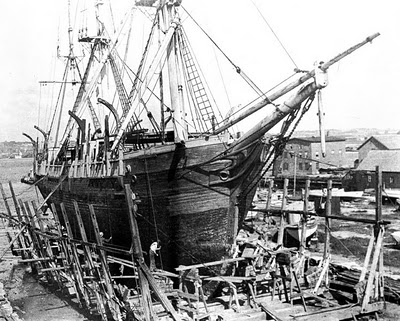
Leviathan
View of the large shed where much preliminary work is done.
Same again, you can see this is where the spars are being worked on or fabricated.

all the photos above copyright Thomas Armstrong
Morgan launch. A friend sent me a link to a page of early photos of the Morgan.

View aboard.

The two photos above courtesy PTLDME via John Brinton, thanks John.


This years WoodenBoat Show at Mystic Seaport was, as always, a great experience. One of the features of the show I enjoy most are the demonstrations, and this year they hit a home run. On both Friday and Saturday the CW Morgan crew demonstrated steam bending and planking for the big whaleship's restoration. A wow. The Morgan is being planked in a mix of white oak and longleaf yellow pine. These planks are 36' long, 14" wide and 3" thick and weigh in at an average of 500lbs. though there must be a bit of difference in the two species. I was unable to determine which I was photographing, but my money is on the pine. The plank is steamed for about 3 hrs. to make it pliable enough to conform to the shape of the hull.

The old adage is 'many hands make light work'. In the case of planking the Morgan, I would suggest that though there were indeed many hands involved, this is still not 'light' work. Once the new plank is in places it is clamped and wedged to allow the crew, a mix of volunteers and staff, to secure the plank with wooden trunnels and 7"silicon bronze spikes, robustly hammered into place as seen above.

This demonstration was highly instructive, revealing the immense effort being poured into the restoration of this massive icon. It was also wildly popular with the show attendees, as you can see in my photo taken from the stairway which goes up to her deck. I had to push in just to get a narrow shot of the plank going into place. Once things calmed a bit I was given a hardhat and allowed to get a little closer to the action. This work is ongoing, with the hull being re-planked from the garboard planks up. The lower, garboard planks are deemed worthy to stay in place but will receive copper plating. The projected relaunch date is about a year from now, with a voyage to New Bedford planned for 2014. 

Thanks to Mystic Seaport and WoodenBoat Magazine for continuing excellence, and a special thanks to John Brinton for his link.

Originally posted by Thomas Armstrong on 70.8%


Tuesday, June 12, 2012

Whitehalls blossom at the Workshop on the Water

Both boats seen here, the carvel in the foerground.


Interior of the carvel Whitehall.


Fine entry of the carval boat, flanked by the whaleboat on the left and the lapstrake on the right.

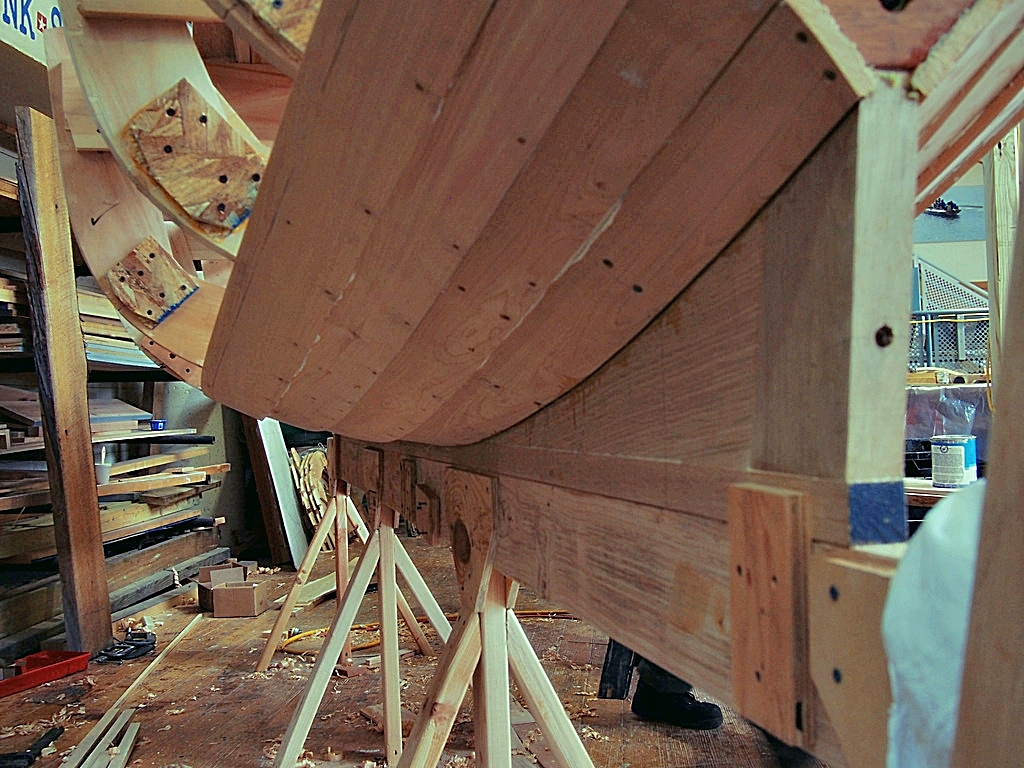
The lapstrake Whitehall growing up around her molds.


Detail of the carvel boat showing her floor timbers and frames.


Slack bilges and flaring sides create a beautiful form.

Here one can see the wineglass transom that characterizes the Whitehalls.


Planking up the lapstrake boat.


Workshop volunteer Nick Pagon clamps up a strake...

and begins cutting the gain.

Lovely


all photos copyright Thomas Armstrong


The Whitehall is generally considered to be the quintessential American rowboat. The iconic design was derived from European models, fast rowing gigs, wherries and cutters. The name originates from Whitehall Street in New York City where they were first built. They ranged in length from 14 to 22 feet and are recognizable by their fine entry and distinctive wineglass transom.  Considered to be one of the fastest, easiest rowing designs known they served as water taxi's, pleasure boats and are still a favorite with home and professional builders alike. They were first built in lapstrake and later carvel.

In a program that incorporates both CHAD students and workshop volunteers, two Whitehalls are currently underway at the Workshop on the Water in Philadelphia, one lapstrake and one carvel. They will join the workshop fleet when completed, hopefully by the end of June and will compete in rowing matches with the two extant Whitehalls in the small craft collection.

The project, overseen by lead boatbuilder at Workshop on the Water Bruce McKenzie, is building to  John Gardner plans, with slight modifications by Nick Pagon.

See Gina Picton's student driven blog on the project here.

A further intro and appreciation of Gardner and his work can be found at the TSCA. 

I apologize for the discrepancies in the spacing of the captions, the new 'blogger' and I are having some issues.

Originally published by Thomas Armstrong in 70.8%


Saturday, May 26, 2012

70.8%

 
All the Water on Planet Earth

Illustration Credit & Copyright:
Jack Cook, Woods Hole Oceanographic Institution, Howard Perlman, USGS
Explanation: How much of planet Earth is made of water? Very little, actually. Although oceans of water cover about 70 percent of Earth's surface, these oceans are shallow compared to the Earth's radius. The above illustration shows what would happen if all of the water on or near the surface of the Earth were bunched up into a ball. The radius of this ball would be only about 700 kilometers, less than half the radius of the Earth's Moon, but slightly larger than Saturn's moon Rhea which, like many moons in our outer Solar System, is mostly water ice. How even this much water came to be on the Earth and whether any significant amount is trapped far beneath Earth's surface remain topics of research.


courtesy APOD


The Inimitable Webb Chiles kindly sent me a link which I could not resist. Thanks, Webb.

Sunday, April 15, 2012

"straight is the line of duty; curved is the line of beauty": G.L. Watson - the Art and Science of Yacht Design

The handsome cover of this volume from the Peggy Bawn Press


George Lennox Watson by Sir James Guthrie RSA


Peggy Bawn sailing herself off Brooklin, Maine, 2007


Peggy Bawn on Belfast Lough c.1894


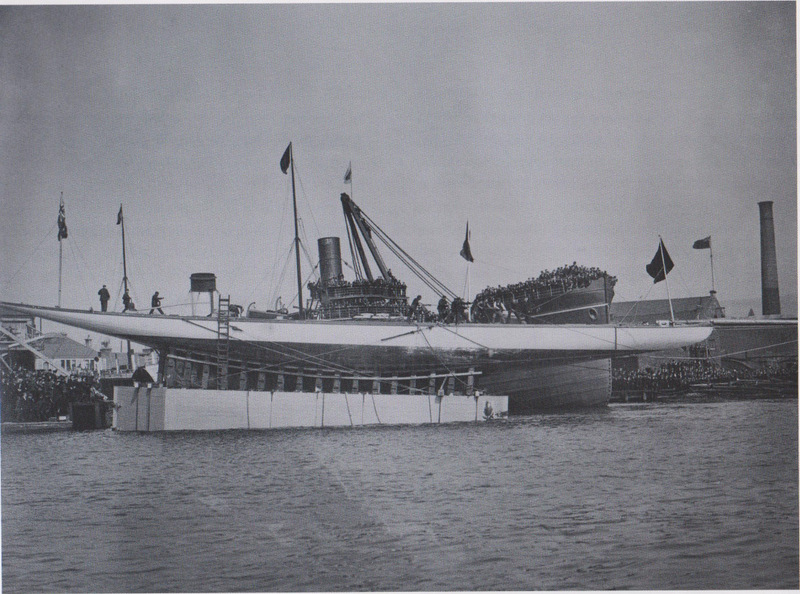
Shamrock II's launch, Clydeside


Hunter's Quay c.1882 Royal Clyde Regatta


In Famous Clyde Yachts, Henry Sheilds painted Watson's 1884 5 tonner Shona. Shona gained her fame in America as Charlie Barr's first command.


J. Stwart Clark's Ornsay on Rothsay Bay.


Watson designed this Lowestoft Beach Yawl Happy New Year IV, 1893


Spinnaker Letting Go by Barlow Moore depicts Watson's Valkyrie II losing the 1893 Americas Cup to Nat Herreshoff's Vigilant


Watson, c.1894


Sir Thomas Liptons Watson designed Shamrock II in the 1901 America's Cup


A rare onboard view of Shamrock II during the 1901 Cup. That's Watson with binoculars.


Queen of Scots (1903) designed for William Coats


I must confess that when I received this lavishly illustrated work, I had no knowledge of Watson or his renown. Gary MacMahon (see my AK Ilen posts) was a member of the production team for this sumptuous book through the work of his design firm Copper Reed Studio in Limerick, Ireland and was kind enough to send me a copy. The publisher, Peggy Bawn Press, is named after the small cruising/racing yacht, recently restored and pictured above. Below is a synopsis of this beautifully designed and exhaustively researched volume found on the publisher's website. I'm including this as it is far more succinct than I would be.

"Martin Black’s biography of the great Scottish designer, George Lennox Watson, is much more than a record of his life and work during the Golden Age of Yacht Design. Perhaps uniquely, it also describes the emergence of the role of the modern independent designer, of any profession or discipline. Watson’s career spanned a seminal period in industrial and social development, marking the transition from instinctive and evolutionary craft work to the application of disciplined technological innovation, using new material technology and tank testing.
So this book sheds light on social and industrial history with hundreds of contemporary illustrations, most of which are previously unpublished. Watson’s genius shines through in early racing cutters carrying clouds of sail, pro-bono pioneering work on lifeboats, America’s Cup challengers, and ultimately in sumptuous steam yachts, Watson’s adage: Straight is the line of duty; curved is the line of beauty... is consistently evident.
Carrying his prodigious research lightly, the author’s work floats easily above its load waterline, including delightful mini biographies of the colourful leading characters. Even the footnotes are entertaining.
Meanwhile this extensive and ambitious first volume has an easy “dip-in” structure to be savoured in slices. For example, the chapters on the America’s Cup challenge the conventional histories with newly discovered first hand insider sources.
In recent years, through many superb restorations, classic yachting has found a significant nostalgic niche in the yachting media, if only because of the innate beauty of the yachts and the spectacle they provide. This has revived the reputations of designers Herreshoff and Fife, but Watson’s genius needed to be rescued from a relative obscurity which was triggered by his early death. Was he “the greatest yacht designer of the 19th century”, as Olin Stephens acknowledged? Read Martin Black’s book and see if you agree. At the very least, you will find that George Lennox Watson deserves his place among the pantheon of the greats.
Then you may also answer the question I posed initially; along the way, you will enjoy many illuminating experiences, and also a rattling good yarn!"

Henry J Cooney

While this is not an inexpensive book, it is one that deserves a place on the bookshelf of anyone interested in yacht design and/or the America's Cup. Have a look!

Originally published by Thomas Armstrong in 70.8%